Saturday, April 22, 2023

French Polynesia 2023 - Rimu Vine (Seaweed Scent)


Technical Details:
Issue Date: 21 April 2023 Printing Technique: Offset
Face Value: 130
Photo: Hereana MOE
Author: FARE RATA 2023
Perforation: 26x36
Number of stamps per presentation 25
Number of stamps 25

Scented stamp : Seaweed “Rimu Vine”

The Rimu Vine (Caulerpa chemnitzia) nicknamed «green caviar», is a seaweed very popular in French Polynesia and has a strong potential in the South Pacific market (New Zealand, Fiji, Samoa, etc) but also internationally, especially in Japan.
The gathering activity of this species is traditional in many Pacific islands, especially in French Polynesia, in the Austral archipelago. The typical recipe is to mix fresh seaweed with coconut milk, to obtain a delicate dish combining the iodized taste of seaweed and the sweetness of coconut milk.

Algae have beneficial properties for health. They are rich in minerals, vitamins, fiber, and polyunsaturated fatty acids, and have recognized antioxidant and antimicrobial activities. These nutritional properties are very interesting to reduce cardiovascular risks.
It is noted that in ancient times, seaweed was reserved for women because they were not allowed to eat pork, turtle, coconut and banana. So they were picking algae to supplement their diet.

Today, French Polynesia wants to develop an island rural aquaculture aimed at the commercial development of remote islands but also to promote food self-sufficiency in Polynesia. One of the country’s objectives is therefore to develop algoculture. In addition to the nutritional purpose, algae can be exploited in other fields such as cosmetics or pharmacology. Thus, a research program agreement was established between the Ministry of Marine Resources and the University of French Polynesia (UPF) to identify the various aspects of the exploitation of the Rimu.

The Rimu vine exists only in the wild in the Southern Archipelago. This resource remains fragile and sensitive to poor environmental conditions. In addition, an unreported exploitation of the resource can lead to its extinction. This is why cultivation trials have been underway for several years to create sufficient biomass to feed the Polynesian market, but also to preserve this precious local resource.

Fare Rata, the Polynesia Post Office is pleased to be able to highlight through this scent stamp, the «rimu vine», hoping to make you want to taste it but also to contribute to this effort to preserve our underwater biodiversity, so fragile.

Thursday, April 20, 2023

Gibraltar 2016 - Christmas Biscuits


Technical Details:
Issue Date: 02 November 2016
Designer: Stephen Perera
Illustrator: © ingimage
Printer: Lowe-Martin Group
Colours: 4 colours + Varnish
Size: 32 x 32mm
Values: G (22p), 40p, 64p, 70p, 80p, £2

About Christmas

Modern Christmas biscuits can trace their history to recipes from Medieval Europe.By the Middle Ages, the Christmas holiday had overtaken solstice rituals throughout much of present-dayEurope. However, the old feast traditions remained and while the roast and drink recipes were probably quitesimilar to what earlier Europeans had enjoyed, the pastry world was experiencing some amazing changes.Spices like nutmeg, cinnamon and black pepper were just starting to be widely used and dried exotic fruits likecitron, apricots and dates added sweetness and texture to the dessert tray. These items, along with ingredientslike sugar, lard and butter, would have been prized as expensive delicacies by medieval cooks. Only on themost important holiday could families aff ord treats like these, which led to a baking bonanza to prepare forChristmas. Unlike pies or cakes, biscuits could be easily shared and given to friends and neighbours. Thus ourmodern Christmas biscuits date back to these medieval gifts.

Though biscuits have come a long way since medieval times, some things haven’t changed. Many Christmasbiscuits are still heavily spiced. We think of ‘traditional’ Christmas fl avours like cinnamon, nutmeg and ginger,and those are exactly the same spices medieval cooks would have used in their cookies ages ago. Gingerbreadis a classic Christmas biscuit, and yet it’s also a biscuit that would have tasted strikingly similar back in theMiddle Ages. Ginger, cinnamon, nutmeg and mace combine to make a snappy, spicy taste, just like they wouldhave back then. Gingerbread uses molasses as a sweetener, something that medieval cooks would appreciateas refi ned sugar was so expensive. These cooks would not have made gingerbread men, however. The fi rstperson to try that was none other than Queen Elizabeth I of England, who had the biscuit molded into theshapes of her favorite courtiers.

Sunday, April 9, 2023

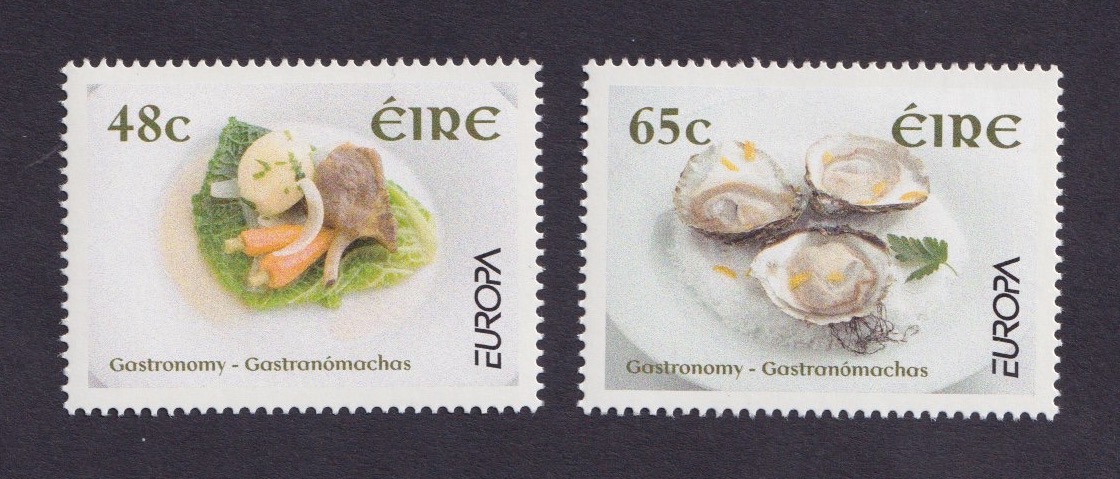
Ireland 2005 - EUROPA, Gastronomy


Date of Issued: 09 May 2005
Sheetsize: 10
Perforation: 14¼ x 14

48c - Irish Stew
65c - Oysters

Friday, April 7, 2023

Macau 2002 - Gastronomy and Sweet, Hawker's Food


Technical Details:
Date of Issued: 26 September 2002
Subject: Gastronomy & Sweets II - Hawker's food
Size: 30mm x 40mm
Perforation: 13.4 by 13
Set of 5
Format Sheet: 16 of 4 designs
Perforations: 13.4 x 13
Issuing Authority: Macao Post
Printer: Cartor Security Printing

Thursday, April 6, 2023

Taiwan 2012 - Traditional Festivals


Technical Details:
Date of Issued: 20 June 2012
Dimension of Stamp: 40mm × 32mm
Printer: China Color Printing Co., Ltd
Designer: Huang Li-jun
Sheet Composition: 20 (5×4)
Print Color: Colorful
Process: Offset
Paper: Phosphorescent Stamp Paper
Perforation 121/2

So as to introduce traditional Chinese festivals, Chunghwa Post is issuing a set of four stamps featuring the Chinese New Year, the Lantern Festival, the Dragon Boat Festival, and the Mid-Autumn Festival. The designs of the stamps follow:

1. The Chinese New Year (NT$5): Chinese New Year is characterized by auspicious celebrations that symbolize the idea of the old giving way to the new. The stamp features fireworks to convey a sense of joy and fruitfulness. It also shows traditional New Year’s calligraphic couplets, with chun (the character for spring) on one side of the door, and fu (the character for good fortune) on the other. These convey the idea that “with spring comes good fortune.”

2. The Lantern Festival (NT$5): The Lantern Festival is like a mini Chinese New Year. Every household celebrates and hangs decorative lanterns. The stamp features a traditionally styled lantern, glutinous rice balls, and wooden red flip-flops representing that everything comes in pairs. The design is meant to convey the idea of blessings coming as families gather to celebrate the holiday.

3. The Dragon Boat Festival (NT$10): Dragon boat races and eating zongzi are the two activities most representative of the Dragon Boat Festival. It is a folk tradition to hang sweet sedge and Asian mugwort over the door to one’s house so as to ward off insect infestations. It is also customary to wear sachets of fragrant herbs dangling from one’s waist and to drink realgar wine as a way of praying for peace and safety.

4. The Mid-Autumn Festival (NT$25): “The moon is full and the people united.” The Mid-Autumn Festival is a holiday that celebrates reunions. The stamp features a shiny, bright moon and the Jade Hare and Lady Chang’e accompanying each other in the Palace of the Moon. The moon cakes symbolize the beauty of the clan being whole and united.

Malta 2020 - Joint Issue Malta-Slovakia ‘Viticulture’


Technical Details:
Issue Date: 24 October 2020
Designer:Miguel Farrugia & Adrian Ferda
Photography: Ta' Betta Wine Estates & & Turecek Winery
Process: Offset
Size:€0.59
Values:44mm x 31mm

About Joint Issue Malta – Slovakia ‘Viticulture’

The philatelic issue, themed "Viticulture", consists of two stamps. The Malta stamp features a vineyard located in the limits of SiMalta while the Slovak stamp portrays a vineyard in the Skalica region renowned for production of the Skalicky rubin wine.

Malta
The history of wine-making stretches over several millennia dating back to over 7,000 years BC. Local wine production dates back over 2,000 years, during the time of the Phoenicians who were actively involved in transporting wine together with grapes and winemaking technology throughout the Mediterranean.
Malta's climate is favourable to wine production, and Malta has several strains of grape used in the production of wine. The ¿a (red) and Girgentina (white) are indigenous to Malta.
The Malta stamp features Ta' Betta Wine Estate, a boutique winery situated in Girgenti, limits of SiSyrah, Cabernet Franc, Cabernet Sauvignon, Merlot and Chardonnay are the main grape varieties that are specifically grown in this estate, producing a portfolio of three wines.

Slovakia
The Slovak stamp features a bottle of Skalicky rubin 2019 from the Slovak National Collection of Wines produced by Tureèek Winery in the foreground and a vineyard in Vintoperk Hill in the background.
The historical name Skalicky rubin, comes from the geographical area, the Skalica region and Rubin, which refers to the colour of the wine (ruby). In 2017 the wine became recognised and protected by EU law as product exclusive to this specific geographical area.
This wine is produced by the fermentation of grapes of the Blaufrankisch, St. Laurent and Blauer Portugieser varieties.The grapes to produce this wine are grown precisely in the defined area of the Skalica region. This wine is characterised by its colour and its full flavour which contains a high amount of tannin and antioxidants.

Sunday, March 19, 2023

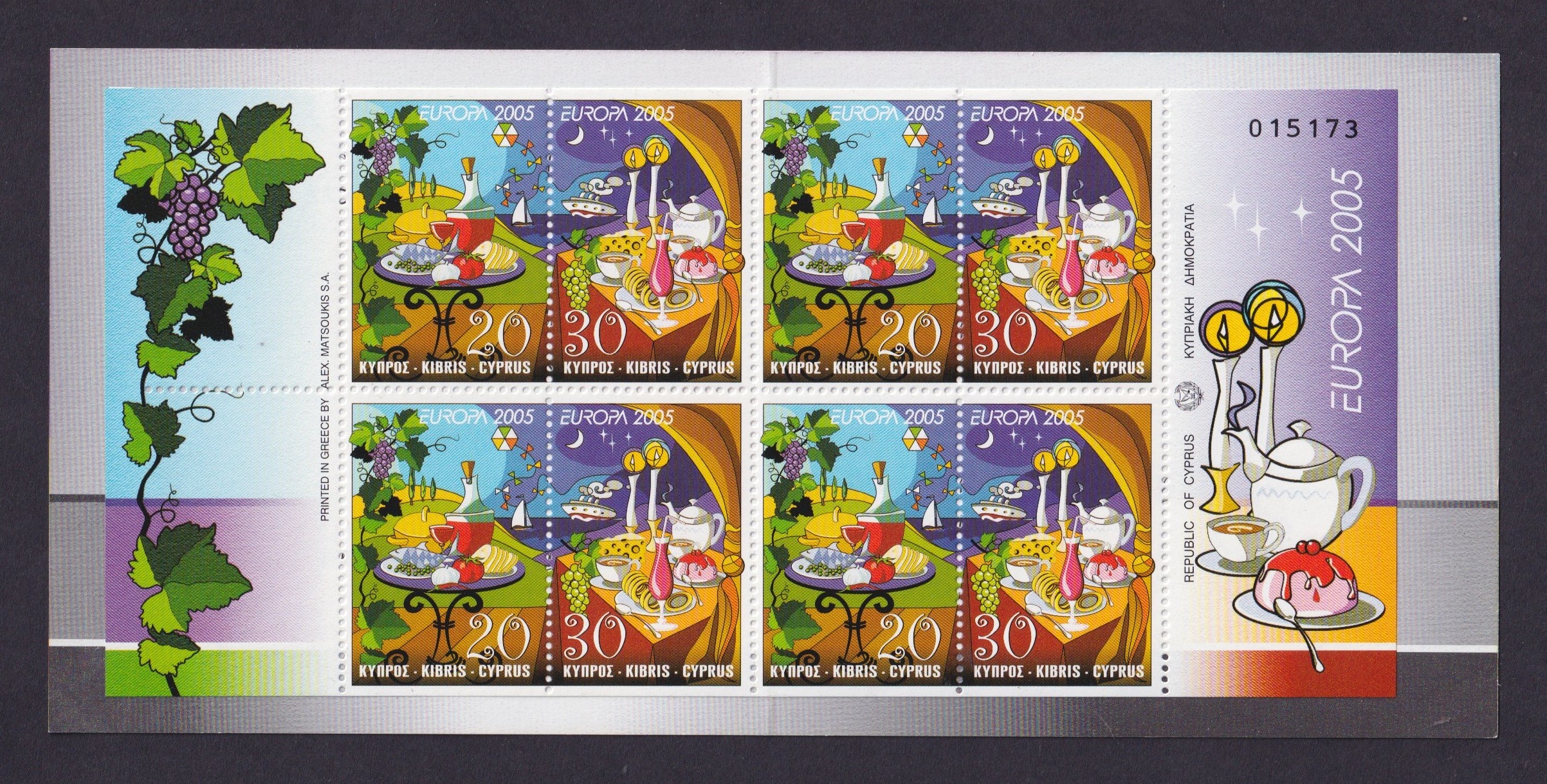
Cyprus 2005 - EUROPA, Gastronomy


Ireland 2005 - EUROPA, Gastronomy


Date of Issued: 09 May 2005
Perforation: 14¼ x 14

48c - Irish Stew
65c - Oysters

Tuesday, March 7, 2023

Macau 1999 - Dimsum


Date of Issued: 21 August 1999
Perforation: 12

Wednesday, March 1, 2023

Thailand 1990 - International Letter Writing Week, Thai Desserts


Technical Details:
Issue Name : International Letter Writing Week 1990
Issue Date : 07 October 1990
Perforation : 14
Denomination : 2.00 Baht, 3.00 Baht , 5.00 Baht , 6.00 Baht
Details : To commemorate the 1990 International Letter Writing Week by illustrating the drawings of Thai dessert conservation (except Khanom Cho Muang) which won first prize in the painting competition during 1989 International Letter Writing Week
Size : 27 x 45 mm
Printer : Leigh-Mardon PTY., Ltd., Australia

Friday, February 17, 2023

Seychelles 1989 - Traditional Food


Creole Cooking:
R1 - Tec-Tec Broth (Tectec Soup)
R2 - Pilaff Seychelloise (Pilaf Seychellois)
R3 - Mullet Grill in Banana Leaves
R5 - Daube

French Polynesia 1988 - Traditional Food


French Polynesia 1987 - Traditional Food


French Polynesia 1986 - Traditional Food


Saturday, February 11, 2023

Romania 2016 - Live healthy! Bible Food


Technical Details:
Issue Date: 24 November 2016
Designer: Mihail Vamasescu
Process: Offset
Colours: 4
Stamps Size: 48 x 33 mm
Minisheet Size: 110 x 120 mm
Values: 1.60 Lei; 4.50 Lei; 8 Lei; 15 Lei

About Live healthy! Bible Food

“And God said, Behold, I have given you every herb bearing seed, which is upon the face of all the earth, and every tree, in the which is the fruit of a tree yielding seed; to you it shall be for meat.” Genesis 1:29

The Bible gives us much information on food and many rules about healthy nutrition. These simple and modest foods can provide a complete food palette underlining healthy eating and the subject of the postage stamp issue “Live Healthy!”.

Since the tendency to return to nature and generally the natural products has accentuated over the past few years, one should adopt a diet that ensures complete nutrition to maintain the body’s energy, without leading to the weakness of body and soul.

When God addressed the chosen people He said: “For the Lord thy God bringeth thee into […] a land of wheat, and barley, and vines, and fig trees, and pomegranates; a land of oil olive […].” Deuteronomy 8:7-9

Using grain since ancient times is mentioned in the Bible. In ancient beliefs, bread had the attribute of a living being, sometimes being even considered the embodiment of God.

Wheat, flour, and bread dough are loaded with meanings and symbols as current and appropriate as they are old, a sign of joy and abundance. In biblical times the bread was made from wheat or barley. Both grains are rich in vitamins, fiber and cellulose, being symbols of life and rebirth and constituting essential and crucial food for both humans and animals.

The fig tree is mentioned several times in the New Testament and the Old Testament. Biblical references to the fig tree are symbolic and subject to many interpretations.

The Bible attests the figs nutritional value, but also their value as health remedies.. They can be eaten both fresh and dried and contain very high levels of potassium.

Since ancient times the pomegranate was used for medicinal purposes because of its amazing properties. The pomegranate was and is considered a symbol of health, fertility and eternal life.

Rich in antioxidants, these fruits, which were attributed curative qualities ever since antiquity, help improve blood circulation and strengthen the immune system. Pomegranates are used as an ingredient for drinks or food in many countries and rhodium flowers are used in traditional medicine for their astringent effect.

Popular worldwide, the vine is a symbol of life, health, and especially joy. In the Bible we find many references to vines and wine, all with deep meanings, and loaded symbols.

In Christian worship, wine from the grape, turned during Mass into the Blood of Christ, is the source of life.

The wine, along with bread, honey and oil are considered a staple food, symbol of wealth.

In addition to the very good taste, grapes are miracle foods for the body. Vitamins and minerals make grapes a very healthy choice and, therefore, it is appropriate to eat them more often.

The olive tree is considered the “eternally fruitful tree”, being a tree with an extraordinary length of life, having amazing regenerative power, remaining over time a symbol of peace, wisdom and purity.

Considered some of the most nutritious fruits, olives are also real medicine. Olives, green fruit, fleshy, becoming black-purple when ripe, contain fewer carbohydrates and are an excellent source of mono-unsaturated fatty acids. Therefore can be a light and delicious snack, but can also be used as ingredients for different dishes.

As the fruit of the olive tree produces a rich and viscous oil which can be burned in lamps for religious rituals, the olive tree was considered sacred. Used daily in the diet, olive oil reduces the risk of heart disease and is recommended in diets.

Romfilatelia thanks the Diocese of Alexandria and Teleorman and the photographer George Avanu for the support granted in the creation of this postage stamp issue.

Saint Pierre dan Miquelon 2002 - The Tiaude Cod, Traditional Dishes

 
Technical Details:
Date of Issue: 10 July 2002
Size: 52 mm x 31 mm
Perforation: 13
Printing: Offset Lithography
Face Value: EUR 0.50
Format Sheet of 10
Perforations: 13 x 13
Issuing Authority: Service des Postes de Saint Pierre et Miquelon
Printer: ITVF LA POSTE Périgueux

Monday, December 26, 2022

Austria 2020 - Schweizerhaus


Technical Details:
Issue Date:11 July.2020


About Schweizerhaus

The "garden of the Viennese"


A true Viennese institution features as the design on this year's special stamp from the “Catering with tradition ”series: the venerable Schweizerhaus in Vienna's Prater.

The Schweizerhaus has a long history. As long ago as 1716, the British travel writer Lady Mary Montagu reported on a “Swiss hut” which had been established to cater for Swiss hunters. After the Prater was opened to the public by Emperor Joseph II in 1766, the “Zur Tobakspfeife” inn opened there in 1780, later being renamed “Zum Russland Kaiser”. During the early 1840s, the young architect Eduard van der Nüll, who later went on to build the Vienna State Opera, built a new public house in the architectural style of a Swiss chalet at this location, but it was destroyed in April 1945.

The Kolarik era started in 1920, exactly 100 years ago, when the Viennese master butcher Karl Kolarik took over the business, and the business in the Wurstelprater is still run by the Kolarik family today. The Schweizerhaus is particularly well known for the original Budweiser Budvar and its crispy “Original Schweizerhaus pork knuckle”. Set under ancient walnut and chestnut trees and located close to the main alley through the Prater, the extensive, shady beer garden invites customers to savour traditional Viennese and South Bohemian specialties such as tripe soup, pork casserole with cabbage, or dumplings filled with plum jam , all top quality, home-made food produced in-house.

Saturday, November 12, 2022

Norge 2022 - Christmas, Gingerbread


Technical Details:
Issue Date:11 November 2022
Designer:Camilla Kvien Jensen
Printer:Joh. Enschedé Security Print
Process:Offset
Values:Domestic 20g x4

About Christmas

Gingerbread is most often made at Christmas. The world's largest "gingerbread town" is built every December in the Norwegian city of Bergen. And in 2016, Holmestrand proudly presented the world’s longest gingerbread train in connection with the official opening of its new railway station inside the mountain.

In December 2021, Norway Post and the TV 2 breakfast show “God Morgen Norge” jointly launched a contest on Facebook and Instagram asking people to send in photos of their own gingerbread creations. The four winning entries would be the motifs for the 2022 Christmas stamps. The entries included gingerbread houses, gingerbread men and other shapes, and decorations. Two winners were selected by an expert panel of judges consisting of Wenche Andersen from “God Morgen Norge”, stamp designer Camilla Kvien Jensen and Stamp Director Halvor Fasting. The other two winners were voted by “God Morgen Norge” viewers.

Spain 2020 - EUROMED, Traditional Gastronomy in the Mediterranean

Technical Details:
Issue Date:16 July 2020
Process:Offset
Size:40,9 x 57,6 mm
Values:€2

About Euromed - Traditional Mediterranean Gastronomy

One of the most popular culinary delights to be enjoyed on the Costa del Sol in Malaga is the ‘espeto’ or skewered sardines. A simple, easy-to-prepare dish based on sardines skewered on a bamboo spit that, after being cooked over a barbecue, are eaten in the natural environment offered by the beaches that surround the Mediterranean. Nonetheless, the simplicity hides a special technique that has been perfected over the years by traditional culture so that the fish, most often sardines, are skewered well and not lost while being cooked.

In short, a culinary art that forms part of the culture in Malaga and traditional Mediterranean gastronomy.

Its popularity dates back to the late 19th century with the arrival of the first tram and railway lines in Malaga, which enabled inhabitants to visit the coastline to enjoy a day at the beach, which used to be called baños de ola or sea bathing. One of the fishing villages that people used to visit was El Palo, where Miguel Martínez Soler set up his famous bar on the beach in 1882 called La Gran Parada, one of the first beach bars on the Costa del Sol. He was the first to skewer sardines on a stick and place them in the sand next to the fire. The place soon attracted attention not only from the people of Malaga but also from such celebrities at that time in Spanish history, such as King Alfonso XII himself.

Nowadays, numerous restaurants near the sea and beaches cook espetos in little boats that, besides making the work of espeto chefs easier, allow the sardines to be positioned according to the wind in order to prevent a smoky taste.

The stamp, which is issued as part of the annual Euromed Postal series, is presented in Premium Sheet format with six stamps that incorporate a die cutter that silhouettes the sardines skewered over the fire, which, when printed using the silver-effect cold-foil technique, simulates the tone of the fish scales.

Wednesday, October 12, 2022

Malta 2022 - SEPAC, Local Beverages


Technical Details:
Issue Date: 13 September 2022
Designer: Daniel Spiteri
Process: Offset
Size: 31mm x 44mm
Values: 37c, 57c ,€1.40 and €2.00

About SEPAC - Local Beverages

Possibly Malta's best-known beverage is the non-alcoholic, amber-coloured Kinnie. Long a household name in Malta, it was introduced in 1952 as an alternative to the soda drinks proliferating after WWII. Of course, its recipe is a closely guarded secret, but the acquired taste is distinctly one of bitter oranges with extracts of the herb Artemisia absinthium colloquially known as wormwood. Kinnie is exported to seven countries and also produced in Australia under licence. In the stamp design, the bobbing Luzzu boat, seascape and slice of orange complement Kinnie's retro label and bottle.

On a different level are Malta's locally produced wines. With an abundance of vines, the Islands have been producing wine for centuries. The second stamp depicts a bottle of the local Gellewza grape wine made from a dark-skinned variety of grape that is indigenous to the Islands. Only a small volume is made from this little-planted variety, but it is increasingly found in blends, softening the spiciness of the wine, and adding a bright cherry flavour. Emerging from a family-run vineyard, Delicata's Gellewza grapes are traditionally grown on old bush vines which are largely dry farmed. The wine is unoaked, has a garnet colour and this stamp depicts a backdrop of Valletta.

The stamp shows the unusual yet popular Bajtra liqueur. Made by Marsovin, these liqueurs are based on ancient recipes dating to the Knights' presence in Malta and seek to reflect the warmth and fragrance of the Mediterranean. Bajtra liqueur is made from the fruit of the Opuntia Ficus- Indica, commonly known as the prickly pear. One may see these all over the Islands and which are harvested between August and September annually. The pulp of the fruit is then extracted, sieved, and fermented, by the addition of a yeast species. The liqueur is translucent, pink in colour and stands out beautifully against the backdrop of the citadel of Mdina.

Several popular craft beers have recently appeared on the local market. One such beer is the hop-blend known as San Blas - its name paying homage to the secluded red sandy beach located below the village of Nadur in Gozo. The deep amber colour of this Indian pale ale is dominated by the explosive character of a carefully selected hop blend that showcases the citrusy and peachy notes of American hop varieties, and the more subtle, spicy notes of its British counterparts. Our design for this stamp shows hops at the fore with San Blas beach in the background.

This SEPAC set of four stamps has been designed by Daniel Spiteri.

Monday, June 27, 2022

Ireland 2022 - Irish Breakfasts


Technical Specification:
Date of Issue: 28 April 2022
Design and Illustration: Ailbhe Phelan
Values and Quantities: N Se-tenant (148k) Pair of National Stamps; W Se-tenant (120k) Pair of International Stamps
Size: 36mm x 36mm
Paper: TR102gsm PVA gum
Colour: Multicolour with phosphor tagging
Make-up: Sheetlets of 16
Perforations: 13.25 x 13.25
Printing Process: Lithography
Printer: Royal Joh. Enschedé

Issued on April 28, the stamps capture the distinctive culinary offerings of the tasty Irish breakfast.

There is something magical about the Irish way of starting off the day on the right note that makes a huge impression on visitors to Ireland as well as on our own population.

The four stamps (two in ‘N’ and two in ‘W’ denomination) reflect the varied options available. Hand-drawn and digital skills are used to illustrate The Traditional Irish Fry, Piping Hot Porridge, Wholesome Homemade Breads and Healthy Smoothie.

"The theme was a perfect one for me, Irish Breakfasts. It was such a good fit that as soon as I had the brief in my little hands I was easily inspired. There had to be The Irish Fry (no baked beans, puhleese), Porridge was a no brainer (even though I’m not a huge fan of the texture of cooked porridge), the range of Irish Breads - soda farls, brown soda loaf - are items that I make and grace my breakfast table regularly and yes, I do enjoy a fruity Smoothie particularly during the summer!"

Sunday, June 26, 2022

Kyrgyzstan 2022 - The Pistachio Tree


Date of Issue: 23 June 2022

About Flora of Kyrgyzstan - The Pistachio Tree

The pistachio is a member of the cashew family, it is a small tree originating from Central Asia and the Middle East. The tree produces seeds that are widely consumed as food. Pistacia vera is often confused with other species in the genus Pistacia that are also known as pistachio. These other species can be distinguished by their geographic distributions (in the wild) and their seeds which are much smaller and have a soft shell. (Source: Wikipedia)

Saturday, June 25, 2022

Turkey 2022 - Cheeses of Turkey


Technical Details:
Date of Issue: 17 May 2022
Face Value: 5 Turkish Lira
Colors: Multicolor
Printers: PTT Matbaasi
Format: Se-tenant
Emission: Commemorative
Printing :Offset Lithography

Thursday, June 23, 2022

Italy 2022 - Galup


IN SHORT
Issue Date: 21 June 2022
Issue of an ordinary stamp belonging to the thematic series "The Excellencies of the productive and economic system" dedicated to Galup S.r.l., on the centenary of the foundation


DESCRIPTION
Value: tariff B.
Circulation: 300,000 pieces
Vignette: reproduces an illustration inspired by a poster from the early twentieth century advertising the low panettone with the "Tonda Gentile Trilobata" Italian Hazelnut glaze created in 1922 by the Galup confectionery company in Pinerolo and today famous throughout the world. The stamp is completed by the legend "ONE HUNDRED YEARS OF GOODNESS", the writing "ITALY" and the tariff indication "B".
Sketch: by the Historical Archive of Galup S.r.l. and optimized by the Philatelic Center of the Operations Management of the Polygraphic Institute and State Mint S.p.A.
Printing: Istituto Poligrafico e Zecca dello Stato S.p.A., in rotogravure.
Colors: five.
Paper: white, neutral coated, self-adhesive, non-fluorescent.
Weight: 90 gsm.
Backing: white paper, single-silicone Kraft paper of 80 g / m2.
Adhesive: water-based acrylic type, distributed in quantities of 20 g / m2 (dry).
Paper size and print size: 30 x 40 mm.
Tracing format: 37 x 46 mm.
Perforation: 11 carried out with punching.
Sheet: forty-five specimens.

Tuesday, June 14, 2022

Hong Kong 2022 - Local Snacks in Hong Kong (Series No. 2)


Technical Details:
Design:  Shirman LAI
Illustration:  Raymond WONG
Printer:  Cartor Security Printing, France
Process:  Lithography plus embossing
Stamp Size:  Stamp Sheet – 50 mm × 28 mm; $10 Stamp Sheetlet – 112 mm × 71 mm
Stamp Sheetlet Size:  135 mm × 85 mm
Perforation: Stamp Sheet – 14 × 14.25 (one elliptical perforation on each vertical)
Perforation $10 Stamp Sheetlet – 13.75 (one elliptical perforation on each vertical and ‘HK’ shape perforation on top horizontal side)
Paper:  Paper with security fibres

Introduction
As the Chinese saying goes, “Eating is everything”. Among the countless delicacies found in Hong Kong, local snacks of all varieties represent our food culture the best. Following the “Local Snacks in Hong Kong” special stamps issued in 2021, Hongkong Post brings more nostalgic Hong Kong snacks onto the stamps under the theme “Local Snacks in Hong Kong II” this year, where yummy snacks such as Siu Mai, egg tart, fish and lettuce soup, Hong Kong waffle, dragon’s beard candy, Sachima, sesame roll and others will appear on a set of six stamps and a stamp sheetlet.

$2 Stamp - Egg Tart and Coconut Tart
Egg tarts were served in royal banquets in the early days. It became a popular pastry in Guangzhou in the 1920s and travelled to Hong Kong in the 1940s, where it was reinvented into a Hong Kong style treat that came in short crust or flaky crust. Egg tart became a popular treat as soon as it appeared on the menu across town, and remains one of the most iconic treats in Hong Kong to this day. Coconut tart is a treat created by the Hainan people with reference to how egg tart is made. They share a similar look but coconut tart comes with shredded coconut as the filling, and the burst of sweet coconut smell after baking is incredible.

$2.60 Stamp - Faux Shark’s Fin Soup and Fish and Lettuce Soup
Faux shark’s fin soup was invented in the 1940s to 50s, when street food hawkers at the time would collect excessive shark fins from the Chinese restaurants and cook them into a stew using corn starch and other ingredients, seasoned with soy sauce, bringing the then-considered exquisite taste of eating rice with shark fin to the general public. This soup was later modified to use similarly tasted and much cheaper glass noodles to replace shark fins, hence its name. Another soup called lettuce soup is made from fish mixture cooked in broth with lettuce. These soups will warm you up all the way to your heart in cold winter days.

$3.40 Stamp - French Toast and Hong Kong Waffle
French toast is easy to prepare. Stack two slices of bread with peanut butter together, soak it in egg mixture, fry until golden, and serve with butter and syrup. It is the local’s choice for afternoon tea. Hong Kong waffle requires a waffle iron to make. Pour the batter onto it and cook thoroughly, then spread butter, peanut butter, condensed milk over the waffle and add some sugar on it before folding it in half to eat. How delicious!

$3.70 Stamp - Ding Ding Candy and Dragon’s Beard Candy
The name “Ding Ding candy” comes from the chiselling sound “ding ding” when hawkers break the crunchy candy into small pieces to sell. The candy itself is made of a mixture of sugar, maltose and corn syrup, pulled into long white bars to dry, which are then chiselled into pieces. Dragon’s beard candy is made from a maltose dough that is pulled into hair-thin strands, which are then used to wrap around fillings made with sugar, crushed peanuts, sesame seeds, coconut shreds and malts mixed together.

$4.90 Stamp - Iced Gem Biscuit and Sachima
Iced gem biscuits, a childhood memory of many, are bite-sized biscuits with drops of coloured icing “gems” on top, and they come in various colours like white, green, red or yellow. To prepare Sachima, first cut the dough into strips and fry until golden, then put them into a wok of heated syrup, stir fry until the strips are covered in syrup. Finally, let it cool and cut it into square pieces, and the sweet and crispy Sachima is ready to serve.

$5 Stamp - Banana Roll and Black Sesame Roll
Banana rolls and black sesame rolls are traditional Chinese pastry . Banana rolls are soft and white rolls made from glutinous rice flour, rice flour, sugar and other ingredients. Instead of bananas, banana oil is used in making these rolls to give a luscious banana taste. Black sesame rolls are made from grinded black sesame, adding water, water chestnuts and sugar to mix, and then steamed into thin slices. Roll up these slices after cooling and cut them into pieces to become delicious black sesame rolls, yum!

Stamp Sheetlet - Aeroplane Olive, Siu Mai and Stinky Tofu
The abbreviation “HK” for Hong Kong can be found on the perforations of the stamp sheetlet. Three classic snacks are shown on it, including the stinky tofu with the uncommon aroma, the incredibly popular Siu Mai and the aeroplane olive delivered in an amazing method. The aeroplane olive was the best-selling pickled snack in 1950s to 70s. Street vendors would circle the streets of residential areas with an olive-shape carrier, shouting their wares. As the old tenement buildings were only several storeys tall back then, customers would throw money from their balconies down to the hawkers on the streets, and the hawkers would throw the aeroplane olives all the way up to the customers, which was like throwing a paper plane, hence its name.

Official First Day Covers will be put on sale at $2.5 each at all post offices from 12 May 2022. Advance orders for servicing self-provided covers will be accepted at all philatelic offices from 12 to 18 May 2022.

Stamp products include mint stamps, stamp sheet, stamp sheetlet, mini-pane, presentation pack and serviced first day cover. Serviced first day cover is also available at the philatelic offices only.

Friday, April 29, 2022

Ecuador 2006 - Ecuadorian Gastronomy


Technical Details:
Issuing Date: 23 September 2006
Width: 38.00 mm
Height: 28.00 mm
Denomination: 1.00 USD
Set of 2
Perforations: 13 x 13
Issuing Authority: Unidad Postal Nuevos Correos del Ecuador

1.00 USD - Viche de Manabi
1.00 USD - Bandera Manabi

Monday, April 25, 2022

Liechtenstein 2022 - SEPAC, Local Beverage, Drinking Water


Technical Details:
Date Of Issue: 07 June 2022
Designers: Mathias Maurer, St. Gallen
Stamp format: 41.667 x 41.667 mm
Perforation: 12 ¼ x 12 ¼
Face Value: CHF 1.80
Motif: Drinking Water
Sheet format: 146 x 208 mm
Print: 4-colour offset CMYK Gutenberg AG, Schaan
Paper: Special stamp paper PVA 110 g/m² gummed

The stamp issue of SEPAC, an association comprising thirteen small postal operators in Europe, focuses this year on local beverages from its members’ countries of origin. Philately Liechtenstein chose a thirst quencher that comes out of every tap and many public fountains in top quality in Liechtenstein: "Drinking Water" (face value: CHF 1.80).

Although unimaginable for most people in many parts of the world, people in the Alps enjoy drinking fresh water straight from the tap. Here, about half of the drinking water consumed each year is obtained from groundwater, the other half from spring water. The strictest controls and continuous optimisation of the supply technology are intended to ensure a high standard of quality of the drinking water in the future as well.

Seven public water supply companies are responsible for this task. In order to ensure that the drinking water reaches the houses in top quality, they maintain numerous reservoirs and other structures such as transfer shafts in addition to the tapped springs and pumping stations. Almost 430 kilometres of main pipelines and 270 kilometres of service pipes are available for transporting the water.

Thursday, April 14, 2022

Croatia 2022 - Croatian Protected Agricultural and Food Products


Technical Details:
Issue Date:14 April 2022
Designer: Duje Šegvić, designer from Split
Printer: AKD d.o.o., Zagreb
Process: Offset Printing
Colours: Multicolor
Size: 35.50 x 35.50 mm
Values: Letter Code A x 3

About Croatian Protected Agricultural and Food Products (C)

PAG CHEESE
PROTECTED DESIGNATION OF ORIGIN


Pag cheese ("Paški sir") is a hard sheep cheese characterized by a pleasant sharp taste and a compact closed texture. It can be recognized by its regular low cylindrical shape, flat to slightly convex upper surface and relatively small dimensions (weight up to 3.5 kg).

Pag cheese is produced from whole sheep's milk of the native Pag breed of sheep, on the island of Pag and two islands of the Pag archipelago: Maun and Skrda.

Pag cheese matures for at least 60 days. Young Pag cheese that matures 2 months is somewhat elastic and easily cut. When cut, the surface of its cross-section may or may not have a small number of sparsely distributed small holes. Its taste is slightly sweet, moderately salty and pleasantly sharp, with a typical note of sheep cheese. It has a pronounced permanent aroma, characteristic of the production area and is reminiscent of Mediterranean aromatic and spicy herbs.

During ripening, Pag cheese gradually becomes sharper and the intensity of taste, aroma, scent and color increases, while the cheese dough gains in firmness. Fully mature Pag cheese that has matured 6 months and more has a fine granular structure, and breaks apart unevenly when cut. Its taste is sharp, harmoniously full, it melts in the mouth, and fine "crystals" can be felt under the tongue.

The unfavorable geomorphological and pedological characteristics of the island of Pag and specific climatic conditions were the reason behind the development of sheep breeding as the dominant agricultural branch of the islanders, and in the last hundred years the significant cheese production that has become part of local tradition. The Pag sheep breed is unsurpassed in its use of sparse vegetation of rocky pastures and is fully adapted to semi-extensive farming, in which milk production is largely determined by environmental factors.

The presence of a large number of aromatic and medicinal plants on the pastures of Pag, often covered with a layer of salt left after frequent strong bora winds, affects the composition of the sheep's diet and the special composition of their milk in terms of fat, protein, sugar and minerals. This milk is rich in compounds that contribute to the specific aroma of Pag cheese of Mediterranean aromatic herbs and its intense taste and sharpness.

Given the relatively low weight of ‘Paški sir’, outside weather conditions have a large impact on the maturation process. In the past, it was not possible to control the conditions in the curing house and undesirable microflora would develop on the rind because of high humidity As a result, cheesemakers occasionally washed the cheese manually and coated it with olive oil or some other vegetable oil. This process is still carried out to this day and substantially influences the characteristics of the cheese’s rind, which is hard, smooth and golden yellow to pale reddish-brown in color in mature cheeses. Oiling the cheese after washing, which the cheesemaker carries out at least four to six times during the maturation stage, also has a positive effect on the proper course of the enzymatic processes inside the cheese, as it reduces drying and prevents the proteolytic action of surface flora.

The name "Paški sir" was registered at the level of the European Union on 25 November 2019 as a protected designation of origin, which protects it from any form of misuse throughout the European Union. Only those products that have been produced according to the Product Specification for the Protected Designation of Origin "Paški sir" and for which the producers hold a valid Certificate of Conformity of their product with the Product Specification issued by an authorized delegated body may be placed on the market under the name "Paški sir".

SLAVONIAN HONEY
PROTECTED DESIGNATION OF ORIGIN


Slavonian honey ("Slavonski med") is honey produced by native grey honeybees (Apis mellifera carnica, Pannonian subtype) from the nectar of melliferous plants or the secretions of living parts of plants or excretions of plant-sucking insects on the living parts of plants. The bees collect the nectar, transform it by combining with specific substances of their own, deposit, dehydrate, store and leave in honeycombs to ripen and mature.

According to its mode of production, Slavonian honey is comb honey, chunk honey or cut comb in honey and extracted honey, and can be black locust honey, linden honey; rapeseed honey; sunflower honey: chestnut honey; blossom honey or Hungarian Oak honeydew honey.

Slavonian honey is characterized by its freshness in terms of its quantity of hydroxymethylfurfurals (HMF) and its water content. The pollen spectrum, i.e. the presence in the secondary pollen of plant species from the families Brassicaceae, Robinia spp. and Rosaceae in most monofloral and polyfloral honeys distinguishes Slavonian honey from honey produced in other areas. Slavonian honey is not subjected to intensive heat treatment (pasteurization) but can be decrystallized at a maximum temperature of 43 °C, which ensures that its properties derived from the collected nectar of the specific flora (bee habitats) remain unaltered.

Because of favorable climatic and soil conditions and the abundance of melliferous plant species in Slavonia’s pastures, meadows, fields and extensive forests, and the alluvial bogs and marshlands along the Sava, Drava and Danube rivers, native grey bees have been able to find abundant nectar and pollen pasture for thousands of years. Only in the Slavonian region do oilseeds provide honey pastures, for rapeseed honey and sunflower honey.

Slavonian honey is extracted from the frame without heating, by centrifugation, to preserve its specific properties. The impacts and interaction of the local population, bees and landscape have created a unique agroecological area that allows Slavonian honey to stand out as pure varietal honey that has been recognized and appreciated for decades, both in Croatia and Europe.

In addition to the special quality of Slavonian honey, the production of this product has a long tradition and reputation – the beekeepers in Slavonia continue a 130-year-old tradition of honey production. Many years of keeping bees in Slavonia have also led to the development and transfer of beekeeping know-how in the form of people's practices, skills, capabilities and knowledge.

The production area covers the entire Slavonia region located in the northeastern part of the Republic of Croatia, bordered by three rivers, the Drava to the north (border with Hungary), the Sava to the south (border with Bosnia and Herzegovina) and the Danube to the east (border with Serbia) and part of the Hungarian-Croatian border between the rivers Drava and Danube. The western part of the Slavonian border extends to the area of the western administrative border of the Bjelovar-Bilogora County and the municipalities of Lipovljani and Jasenovac and the town of Novska. All stages of the production of Slavonian honey must be carried out in the specified geographical area.

The name "Slavonski med" was registered at the level of the European Union on 9 January 2018 as a protected designation of origin, which protects it from any form of misuse throughout the European Union. Only those products that have been produced according to the Product Specification for the Protected Designation of Origin "Slavonski med" and for which the producers hold a valid Certificate of Conformity of their product with the Product Specification issued by an authorized delegated body may be placed on the market under the name "Slavonski med"

VARAŽDIN KLIPIČ
PROTECTED GEOGRAPHICAL INDICATION


The Varaždin klipič ("Varaždinski klipič") is a handmade wheat milk pastry sprinkled with cumin seeds, made from fine wheat flour, milk, sunflower (or vegetable) oil, yeast, sugar and salt, which are used to make a thin dough that is then stretched, cut into strips and rolled in the shape of a stick.

When baked, a Varaždin klipič is a stick that has 4 folds on both sides and is at least 25 cm long. The inside of a baked Varaždin klipič is white in color, interspersed with small, irregular holes formed when the dough rises, while the outer surface of its crust takes on an uneven color ranging from a dark-yellow to golden color, and is coated with egg and sprinkled with cumin seeds. When consumed, the Varaždin klipič has a crunchy mouthfeel, with an initial impression of softness on the palate, before melting in the mouth. It has a milky, slightly sour taste.

The Varaždin klipič is produced in the Varaždin County, and the name itself, as well as the recipe for its production, which is passed down from generation to generation, first appeared in the 18th century. The gastronomy of Varaždin County is heavily influenced by Central European cooking, but by preserving the old folk recipes native to this region, it has managed to retain its autonomy. The Varaždin klipič was first produced by housewives from the Varaždin region, who used wheat and maize flour – the main ingredients in Varaždin cuisine – and their own ingenuity and culinary skills to make the bread sticks by hand, the way it is still made to this day.

Over time, the process for making the Varaždin klipič passed from local housewives to bakers in the Varaždin region, who over many years gained experience and knowledge of how to prepare the Varaždin klipič, which was handed down the generations. That is how the tradition for making the Varaždin klipič was established, a tradition that would go on to include both housewives and bakers.

With the development of the hospitality industry, the Varaždin klipič was promoted as a recognizable product of the Varaždin region and became an unavoidable part of the gastronomic offering of almost every restaurant.

The name "Varaždinski klipič" was registered at the level of the European Union on 6 October 2020 as a protected geographical indication, which protects it from any form of misuse throughout the European Union. Only those products that have been produced according to the Product Specification for the Protected Geographical Indication "Varaždinski klipič" and for which the producers hold a valid Certificate of Conformity of their product with the Product Specification issued by an authorized delegated body may be placed on the market under the name "Varaždinski klipič".

Source: Ministry of Agriculture

Saturday, April 2, 2022

Hungary 2013 - Christmas - Ginger Bread


Technical Details:
Issue Date: 05 November 2013
Designer: Barnabás Baticz
Printer: CODEX Értékpapírnyomda Zrt.
Size: 30 x 40 mm

About Christmas 2013 - Ginger Bread (Star, Christmas Tree, Angel)

Stamps with a face value of HUF 85 (for domestic picture postcards), HUF 110 (for domestic priority picture postcards or non-priority standard letters) and HUF 140 (for domestic priority standard letters) are being released to send the season’s greetings by post. The stamps are available as self-adhesive individually die-cut stamps in sheets of 50 stamps and in miniature sheets of 5 stamps. The motifs of the stamp designs are pieces of traditional iced ginger bread. We recommend a Christmas postcard set consisting of a miniature sheet of five HUF 85 stamps together with five festive picture postcards which are also decorated with ginger bread motifs. The products will be available dependent on stocks at large post offices and Filaposta in Hungary from 5 November, but may also be purchased from Magyar Posta’s online store. This year customers will once again be able to send their Christmas greetings to loved ones far away cancelled with the postmark of the village of Nagykarácsony, whose name means Christmas in Hungarian. Different Christmas postmarks will be available during the weeks of Advent between 1 and 26 December 2013. The service is available at any post office.

Sunday, March 6, 2022

Cyprus 2020 - Christmas


Technical Details:
Issuing Date: 19 November 2020
Width: 35.50 mm
Height: 36.00 mm
Set of 3
Format Sheet of 8 of 1 Design
Perforations: 13.50 x 13.25
Issuing authority: Department of Postal Services (Cyprus Post)
Printer: Baltijas Banknote, Latvia


Christmas is undoubtedly a celebration of love, joy and offering. All the houses are festively decorated and the housewives prepare all kinds of traditional sweets, filling the house with aromas and tastes.
The two stamps present traditional Cypriot sweets in Christmas format.
The €0.64 stamp illustrates the Nativity of Christ, from a fresco (end of the 12th century) in the Christos Antifonitis Church in Kalograia, which is an interpretation of the style of the Constantinople’s post-Comnenian art. At the opening of the cave, the Virgin Mary is depicted lying on a bed. On the left, in a built manger-sarcophagus, Christ is depicted swaddled. On the right are the Shepherds and below the bathing scene. After the Turkish invasion, the figure of the Virgin Mary was removed, irreparably destroying this unique composition.