
Sunday, March 1, 2020






Thursday, February 27, 2020

Saturday, February 15, 2020

Thursday, February 13, 2020
Honduras 2019 - UPAEP, Traditional Meals

Technical Details:
Date of Issue: 25 July 2019
Printing: Offset Lithography
5 Honduran Lempiras - is devoted to a sweet dish called "Rosquillas en miel" ("Honey fritters"), a traditional indigenous recipe during the Holy Week or the end of year festivities.
Eaten as an aperitif or as a dessert, this dish is made of donut dough, capadura, cinnamon and cloves.
5 Honduran Lempiras - is dedicated to Honduran "Nacatamales", a popular dish (also in neighboring Nicaragua), particularly during the Nativity celebrations at the end of the year.
This dish made of cornmeal, pork or chicken, cooked rice and potatoes, is cooked in banana leaves.
25 Honduran Lempiras - features a dish called "Sopa de tortas de pescado" ("Fish cake soup"), made with dried fish, coconut milk, cornmeal, eggs and tomatoes, eaten during the Holy Week, accompanied by white rice and lemon juice.
Saturday, February 1, 2020
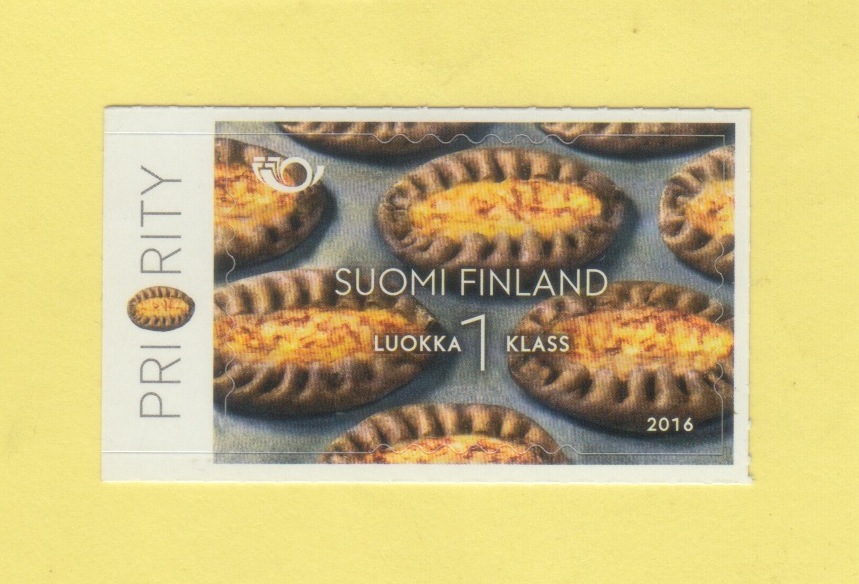
Finland 2016 - The Karelian Pasty
Technical Details:
Issue Date: 22 January 2016
Process: Offset
Colours: 4 Colours
Sunday, January 26, 2020
Malaysia 2019 - Our Food

Technical Details:
Date of Issue: 16 September 2019
Width: 35.00 mm
Height: 35.00 mm
Layout/Format: Sheet of 20
Perforations: 14 by 14
Stamp Issuing Authority: POS Malaysia
Printer: Percetakan Keselamatan Nasional Sdn Bhd
0.60 Malaysian Ringgit - Teh Tarik, Puding Kelapa, Ais Krim Gula Apong, Bubur Cha-cha
0.80 Malaysian Ringgit - Kuih Cincin, Kuih Ketayap, Apam Balik, Kek Lapis
1.00 Malaysian Ringgit - Roti Canai, Hinava, Mi Kolok, Nasi Lemak Bungkus
5.00 Malaysian RInggit - Air Batu Campur (ABC)
Date of Issue: 16 September 2019
Width: 35.00 mm
Height: 35.00 mm
Layout/Format: Sheet of 20
Perforations: 14 by 14
Stamp Issuing Authority: POS Malaysia
Printer: Percetakan Keselamatan Nasional Sdn Bhd
0.60 Malaysian Ringgit - Teh Tarik, Puding Kelapa, Ais Krim Gula Apong, Bubur Cha-cha
0.80 Malaysian Ringgit - Kuih Cincin, Kuih Ketayap, Apam Balik, Kek Lapis
1.00 Malaysian Ringgit - Roti Canai, Hinava, Mi Kolok, Nasi Lemak Bungkus
5.00 Malaysian RInggit - Air Batu Campur (ABC)


Saturday, January 18, 2020
Portugal 2019 - About Traditional Sweets of Portugal

Technical Details:
Issue Date: 01 October 2019
Designer: Atelier Design & etc
Printer: INCM
Process: Offset
Size: 30.6 x 27.7 mm
Values: €0.10, €0.53, €0.65, €0.86, €0.91
About Traditional Sweets of Portugal - 3rd Group
Queijadas de Sintra
Sometimes the history of a sweet seems monotonous, punctuated here and there by an episode marking a point in its evolution. After all, sweets are made every day. It is only the people who make them who are aware of their circumstances, who know about the ups and downs of their history. In the long life cycle of queijadas de Sintra, we get a sense of the timelessness of the recipe constantly changing hands. Thus, its history is made up of all the stories that compose the everyday lives of those who have made them, from the days they were used as payment of rent, until a distinction was made between ne queijadas and the queijadas sold in the market. It would be di cult and unfair to try and mention the names behind the houses that, over the centuries, excelled in the production of this unique sweet that always travelled beyond the geographical limits of the town of Sintra. Di cult because the list of names is so long, unfair because we would, almost certainly, fail to mention at least one, including the anonymous people who contributed to the extensive reputation of a sweet that bene ted so much from tourism in the romantic town of Sintra. Instead, we should talk about the intentions, everyday occurrences and culinary practices that made the flavour of queijadas universal, while always varied and distinct, like the various hands that made them, shaping their crisp shell countless times and preparing their unique lling, which in Sintra is calledmiolo. The cheese is the main protagonist in the latter, leading to attempts, at times, to regulate its supply through the Association for the Provision of Cheese to the Sintra Queijada Industry. Sugar, eggs, our and cinnamon would always be used in the mixture to accompany the cheese. However, while the ingredients are always the same, there are an in nite number of ways in which they can be used. This is what leads to the multiplicity of flavour, texture and aromas that melt together in the rich imagination of queijadas de Sintra, a sweet treasure so frequently mentioned in literature that it has almost turned into poetry. Even when described as an unmissable element in the context of tourism, queijadas de Sintraare assigned a kind of celebrity status that is equally appealing to royal, erudite and common palates. Queijadas are a rare example of a national sweet that confuses us with its journey through time and space. Our palate is in uenced by the flavour of the queijadawe taste today, but our memory recalls the numerous additions that so many hands have made to it. We could even say that queijadasde Sintra, more than just an icon of local confectionery, are today a tribute to all the queijadeiros and queijadeiras who, in their time, succeeded in creating magic with this mixture of ingredients.
Fatias do Freixo
The first thing fatias do Freixo [Freixo Slices] impress us with is their colour. Their honest, strong yellow reinforces our certainty that, in the history of confectionery, the choice of egg yolks as a main ingredient and eternal companion of sugar was not, in any way, a coincidence. Yellow is striking and hints at the sweetness of what we are about to taste. It is perhaps for this reason that yellow is the main colour in Portuguese confectionery, at least when it comes to making an eye-catching sweet that awakens our appetite. This is exactly the case for fatias do Freixo. The yellow not only catches our eye but makes us anticipate the delicacy we are about to experience. It is a sumptuous yellow, a yellow that xates, a yellow that oozes. Luis I of Portugal was indeed wise to always have these sweets on his table. An orderly and very regimented mixture of eggs, sugar, our and water reminding us that the most beautiful compositions are made from the simplest ingredients, fatias do Freixo pleasantly surprise us with their precise measure of sugar,not so much to be imposing, but providing enough sweetness to satisfy us. Because they are not overly sweet, the perfection of fatias do Freixo depends precisely on the fact that sugar is not the main protagonist, but merely what allows the tempting yellow to come through and convince us of perfect harmony. These fatias are the legacy of the rich tradition of pão-de-ló [Portuguese sponge cake] in the northern regions of Portugal. While in other places different sweets take centre stage on festive tables, in the North, and especially the Minho, pão-de-ló is the most prized offering in community festivities. For this reason, there are so many variations on the same recipe and so many varieties of this sweet, soft sponge cake. Fatias do Freixo are a classic example of this same tradition that trickled down as far as the Tâmega River and created a flavour that would make the people of Marco de Canavezes proud. While their flavour, texture and aroma can be experienced by all who try these fatias, it is in the Casa dos Lenteirões, in Freixo, that we nd the expertise and knowledge of the correct proportion of ingredients used to make this sweet. Made with a family recipe,the impact they have on us, and the way they stand out from so many others, leads us to believe that the rst hands to make them were inspired by noble sentiments capable of creating perfection through confectionery. This is a perfect sweet, perfection disguisedas fatias do Freixo.
Cavacas das Caldas da Rainha
Sometimes, the easiest way to understand a sweet is not by looking at its origin, but by considering the reasons for its shape and texture, as its flavour was accepted long ago and is generally consensual. This is true of cavacas das Caldas. Even before tasting one of these cavacas we immediately ask ourselves why the sweet itself is hollow. And why is it so hard? Perhaps because they originated as a pilgrim’s sweet, cavacas are very dry in textureso that they keep for a long time without going stale. As for the shape, this could perhaps be explained, like many other examples of confectionery in this sweet-loving country, by their double purpose, rstly as a receptacle for wine, which would moisten and soften them, and simultaneously as an accompaniment. This versatile sweet demonstrates the ingenuity of human beings who, in food, have always associated taste, function and form. A pilgrim’s sweet, with humble ingredients and a simple recipe, the cavaca looks to sugar syrup to grace it with sweet satisfaction, and while in the interior of Portugal the recipe for cavacas includes oil, on the coast, where Caldas cavacas are more common, it is butter which makes the connection between the eggs and the our. Once they are cooked, the cavacas are soaked in a sugar syrup where lemon is the element that gives them flavour and takes the edge o their sweetness. Taking into account the importance of tourism associated with the thermal springs and the presence of a social and aristocratic elite in the town of Caldas, especially during the19th century, many cavacarias appeared that made and sold cavacas, which due to their longevity, became unique souvenirs of tours around the city. At a time when travellers were the main vehicle of propaganda for Portuguese confectionery, the cavacas of Caldas bene ted from the constant passage of tourists through the city, and as time went by the recipe was gradually perfected. In 1924, perhaps for this reason, they were mentioned in the 1st volume of the Guide to Portugal. Whoever travelled to or went through Caldas could not leave without trying a cavaca. It is hard to believe that, while they originated as a pilgrim’s sweet, which explains their texture and form, in the town of Caldas cavacas became an icon of confectionery and, in a much more re ned social setting, the preferred accompaniment to tea and co ee. After all, it is the sugar and lemon combined with the light crunch of thecavaca before it melts in the mouth that leaves us with a taste that tempts and invites us to take another bite, just to hold on to the irresistible flavour of the cavacas das Caldas. The flavour requires no explanation, it should simply be celebrated in each cavaca.
Morgados do Algarve
Opulent in flavour and rich in form, the sumptuous morgado do Algarve [Algarve’s rstborn] is exemplary of the convergence of two confectionery traditions. On the one hand, the tradition of sugar and its use in combination with almonds, a practice introduced to the Al-Garb by the Moors, developed and established there during the extended presence of the latter in the southern Iberian Peninsula. On the other, complementing this knowledge and expertise, the lling of the morgado exhibits the noble confectionery tradition developed in the kitchens of Portuguese convents. Morgados therefore take after two distinguished traditions, which together have succeeded in achieving perfection, both in the pastry or alcofa [carrycot or basket], and in the lling. The alcofa illustrates theMoorish tradition of the art of sugar work, in this case combined with almonds, one of the main fruits cultivated in the Algarve region. Thus, the pastry is made with nely ground almonds, sugar and water and moulded into a receptacle for an elegant lling of the best that convent confectionery has to o er, doce de gila [malabargourd jam], ovos-moles [sweet egg yolk] and os de ovos [angel hair]. It is well known that the art of working with the various stages of sugar, combined with egg yolks, was practised in noble houses, where young girls were initiated into the secret alchemy of good confectionery. The system of primogeniture which drove many young women behind the high walls of convents and monasteries, combined with the availability of sugar in these religious spaces, gave us a rich and opulent confectionery. It is therefore thanks toprimogeniture that we have this richness in the art of confectionery that combines sugar with eggs and fruit, considering that a certain amount of expertise is required to make a good doce de gila so that the result does not discredit the intention. The combination, in thetradition of morgados, of doce de gila, ovos-moles, os de ovosand massa de amêndoa [almond paste], the latter so illustrative of the Moorish legacy, can only result in an excess of perfection in every aspect. Finally, morgados are meticulously decorated with owers and fruits made of the alcofa pastry and adorned with strips of coloured tissue paper in the traditional convent style of confectionery presentation. Undeniable proof that every single piece of our confectionery is the result of intersecting traditions, combined histories and reciprocal culinary arts, morgados demonstrate technique, presentation and flavour in abundance.
Cavacas de Resende
In the monograph he wrote on the Council of Resende, Joaquim Caetano Pinto, when talking about the famous cavacas de Resende, said that they were ‘very well presented, made almost entirely of eggs and sugar. The whites are used to make ocas’. Rather than just describing Resende’s most iconic sweet, the author wanted to establish the difference between cavacas de Resende and the other cavacas of Portuguese confectionery. While in the rest of the country a cavaca is a hollow sweet with a dry texture, in Resende it is brilliantly yellow, delightfully sweet and frankly irresistible due to the contrast of its white topping with the soft yellow pão-de-ló [sponge cake] beneath. In Resende, the white cavacas are called ocas [hollows]. In other words, what in the rest of the county is known as a cavaca, golden on the inside and painted with a white glaze, in Resende is an oca. Even the nameand its connotations demonstrate the contrast between the two sweets. Cavacas de Resende are slices of pão-de-ló made, almost entirely, of eggs and sugar, with our as a residual element, which used to be cut roughly, but are now sliced with perfect distinction. It is said that, in order for them to keep longer, these slices of soft sponge cake, called cavacas, are dipped in sugar syrup and dusted with our, acquiring an innocent white appearance that contrasts with the bright and tempting yellow of the sponge. Now that we have distinguished between the slices of soft sponge cake known as cavacas, and the so-called ocas, which are white and similar to other cavacas, it should be noted that this sweet has enjoyed enduring fame, with references dating from the 19th century. In 1889, the newspaper ‘O Baionense’ described how cavacas were an irresistible temptation for passing pilgrims who would nd them displayed by confectioners on white cloths with lace trim. Considering the strong tradition of pilgrimages to Santa Maria de Cárquere and Santa Maria de Barrô, the latter characterised by the pains and e orts of devotees to seek the image in stone found in a niche on the left bank of the Douro River, we can see that pilgrims on the path of devotion would, by the grace of God, be sweetened by the serene appearance and cheerful flavour of a cavaca de Resende, which would aid in igniting their religious zeal even further.
Issue Date: 01 October 2019
Designer: Atelier Design & etc
Printer: INCM
Process: Offset
Size: 30.6 x 27.7 mm
Values: €0.10, €0.53, €0.65, €0.86, €0.91
About Traditional Sweets of Portugal - 3rd Group
Queijadas de Sintra
Sometimes the history of a sweet seems monotonous, punctuated here and there by an episode marking a point in its evolution. After all, sweets are made every day. It is only the people who make them who are aware of their circumstances, who know about the ups and downs of their history. In the long life cycle of queijadas de Sintra, we get a sense of the timelessness of the recipe constantly changing hands. Thus, its history is made up of all the stories that compose the everyday lives of those who have made them, from the days they were used as payment of rent, until a distinction was made between ne queijadas and the queijadas sold in the market. It would be di cult and unfair to try and mention the names behind the houses that, over the centuries, excelled in the production of this unique sweet that always travelled beyond the geographical limits of the town of Sintra. Di cult because the list of names is so long, unfair because we would, almost certainly, fail to mention at least one, including the anonymous people who contributed to the extensive reputation of a sweet that bene ted so much from tourism in the romantic town of Sintra. Instead, we should talk about the intentions, everyday occurrences and culinary practices that made the flavour of queijadas universal, while always varied and distinct, like the various hands that made them, shaping their crisp shell countless times and preparing their unique lling, which in Sintra is calledmiolo. The cheese is the main protagonist in the latter, leading to attempts, at times, to regulate its supply through the Association for the Provision of Cheese to the Sintra Queijada Industry. Sugar, eggs, our and cinnamon would always be used in the mixture to accompany the cheese. However, while the ingredients are always the same, there are an in nite number of ways in which they can be used. This is what leads to the multiplicity of flavour, texture and aromas that melt together in the rich imagination of queijadas de Sintra, a sweet treasure so frequently mentioned in literature that it has almost turned into poetry. Even when described as an unmissable element in the context of tourism, queijadas de Sintraare assigned a kind of celebrity status that is equally appealing to royal, erudite and common palates. Queijadas are a rare example of a national sweet that confuses us with its journey through time and space. Our palate is in uenced by the flavour of the queijadawe taste today, but our memory recalls the numerous additions that so many hands have made to it. We could even say that queijadasde Sintra, more than just an icon of local confectionery, are today a tribute to all the queijadeiros and queijadeiras who, in their time, succeeded in creating magic with this mixture of ingredients.
Fatias do Freixo
The first thing fatias do Freixo [Freixo Slices] impress us with is their colour. Their honest, strong yellow reinforces our certainty that, in the history of confectionery, the choice of egg yolks as a main ingredient and eternal companion of sugar was not, in any way, a coincidence. Yellow is striking and hints at the sweetness of what we are about to taste. It is perhaps for this reason that yellow is the main colour in Portuguese confectionery, at least when it comes to making an eye-catching sweet that awakens our appetite. This is exactly the case for fatias do Freixo. The yellow not only catches our eye but makes us anticipate the delicacy we are about to experience. It is a sumptuous yellow, a yellow that xates, a yellow that oozes. Luis I of Portugal was indeed wise to always have these sweets on his table. An orderly and very regimented mixture of eggs, sugar, our and water reminding us that the most beautiful compositions are made from the simplest ingredients, fatias do Freixo pleasantly surprise us with their precise measure of sugar,not so much to be imposing, but providing enough sweetness to satisfy us. Because they are not overly sweet, the perfection of fatias do Freixo depends precisely on the fact that sugar is not the main protagonist, but merely what allows the tempting yellow to come through and convince us of perfect harmony. These fatias are the legacy of the rich tradition of pão-de-ló [Portuguese sponge cake] in the northern regions of Portugal. While in other places different sweets take centre stage on festive tables, in the North, and especially the Minho, pão-de-ló is the most prized offering in community festivities. For this reason, there are so many variations on the same recipe and so many varieties of this sweet, soft sponge cake. Fatias do Freixo are a classic example of this same tradition that trickled down as far as the Tâmega River and created a flavour that would make the people of Marco de Canavezes proud. While their flavour, texture and aroma can be experienced by all who try these fatias, it is in the Casa dos Lenteirões, in Freixo, that we nd the expertise and knowledge of the correct proportion of ingredients used to make this sweet. Made with a family recipe,the impact they have on us, and the way they stand out from so many others, leads us to believe that the rst hands to make them were inspired by noble sentiments capable of creating perfection through confectionery. This is a perfect sweet, perfection disguisedas fatias do Freixo.
Cavacas das Caldas da Rainha
Sometimes, the easiest way to understand a sweet is not by looking at its origin, but by considering the reasons for its shape and texture, as its flavour was accepted long ago and is generally consensual. This is true of cavacas das Caldas. Even before tasting one of these cavacas we immediately ask ourselves why the sweet itself is hollow. And why is it so hard? Perhaps because they originated as a pilgrim’s sweet, cavacas are very dry in textureso that they keep for a long time without going stale. As for the shape, this could perhaps be explained, like many other examples of confectionery in this sweet-loving country, by their double purpose, rstly as a receptacle for wine, which would moisten and soften them, and simultaneously as an accompaniment. This versatile sweet demonstrates the ingenuity of human beings who, in food, have always associated taste, function and form. A pilgrim’s sweet, with humble ingredients and a simple recipe, the cavaca looks to sugar syrup to grace it with sweet satisfaction, and while in the interior of Portugal the recipe for cavacas includes oil, on the coast, where Caldas cavacas are more common, it is butter which makes the connection between the eggs and the our. Once they are cooked, the cavacas are soaked in a sugar syrup where lemon is the element that gives them flavour and takes the edge o their sweetness. Taking into account the importance of tourism associated with the thermal springs and the presence of a social and aristocratic elite in the town of Caldas, especially during the19th century, many cavacarias appeared that made and sold cavacas, which due to their longevity, became unique souvenirs of tours around the city. At a time when travellers were the main vehicle of propaganda for Portuguese confectionery, the cavacas of Caldas bene ted from the constant passage of tourists through the city, and as time went by the recipe was gradually perfected. In 1924, perhaps for this reason, they were mentioned in the 1st volume of the Guide to Portugal. Whoever travelled to or went through Caldas could not leave without trying a cavaca. It is hard to believe that, while they originated as a pilgrim’s sweet, which explains their texture and form, in the town of Caldas cavacas became an icon of confectionery and, in a much more re ned social setting, the preferred accompaniment to tea and co ee. After all, it is the sugar and lemon combined with the light crunch of thecavaca before it melts in the mouth that leaves us with a taste that tempts and invites us to take another bite, just to hold on to the irresistible flavour of the cavacas das Caldas. The flavour requires no explanation, it should simply be celebrated in each cavaca.
Morgados do Algarve
Opulent in flavour and rich in form, the sumptuous morgado do Algarve [Algarve’s rstborn] is exemplary of the convergence of two confectionery traditions. On the one hand, the tradition of sugar and its use in combination with almonds, a practice introduced to the Al-Garb by the Moors, developed and established there during the extended presence of the latter in the southern Iberian Peninsula. On the other, complementing this knowledge and expertise, the lling of the morgado exhibits the noble confectionery tradition developed in the kitchens of Portuguese convents. Morgados therefore take after two distinguished traditions, which together have succeeded in achieving perfection, both in the pastry or alcofa [carrycot or basket], and in the lling. The alcofa illustrates theMoorish tradition of the art of sugar work, in this case combined with almonds, one of the main fruits cultivated in the Algarve region. Thus, the pastry is made with nely ground almonds, sugar and water and moulded into a receptacle for an elegant lling of the best that convent confectionery has to o er, doce de gila [malabargourd jam], ovos-moles [sweet egg yolk] and os de ovos [angel hair]. It is well known that the art of working with the various stages of sugar, combined with egg yolks, was practised in noble houses, where young girls were initiated into the secret alchemy of good confectionery. The system of primogeniture which drove many young women behind the high walls of convents and monasteries, combined with the availability of sugar in these religious spaces, gave us a rich and opulent confectionery. It is therefore thanks toprimogeniture that we have this richness in the art of confectionery that combines sugar with eggs and fruit, considering that a certain amount of expertise is required to make a good doce de gila so that the result does not discredit the intention. The combination, in thetradition of morgados, of doce de gila, ovos-moles, os de ovosand massa de amêndoa [almond paste], the latter so illustrative of the Moorish legacy, can only result in an excess of perfection in every aspect. Finally, morgados are meticulously decorated with owers and fruits made of the alcofa pastry and adorned with strips of coloured tissue paper in the traditional convent style of confectionery presentation. Undeniable proof that every single piece of our confectionery is the result of intersecting traditions, combined histories and reciprocal culinary arts, morgados demonstrate technique, presentation and flavour in abundance.
Cavacas de Resende
In the monograph he wrote on the Council of Resende, Joaquim Caetano Pinto, when talking about the famous cavacas de Resende, said that they were ‘very well presented, made almost entirely of eggs and sugar. The whites are used to make ocas’. Rather than just describing Resende’s most iconic sweet, the author wanted to establish the difference between cavacas de Resende and the other cavacas of Portuguese confectionery. While in the rest of the country a cavaca is a hollow sweet with a dry texture, in Resende it is brilliantly yellow, delightfully sweet and frankly irresistible due to the contrast of its white topping with the soft yellow pão-de-ló [sponge cake] beneath. In Resende, the white cavacas are called ocas [hollows]. In other words, what in the rest of the county is known as a cavaca, golden on the inside and painted with a white glaze, in Resende is an oca. Even the nameand its connotations demonstrate the contrast between the two sweets. Cavacas de Resende are slices of pão-de-ló made, almost entirely, of eggs and sugar, with our as a residual element, which used to be cut roughly, but are now sliced with perfect distinction. It is said that, in order for them to keep longer, these slices of soft sponge cake, called cavacas, are dipped in sugar syrup and dusted with our, acquiring an innocent white appearance that contrasts with the bright and tempting yellow of the sponge. Now that we have distinguished between the slices of soft sponge cake known as cavacas, and the so-called ocas, which are white and similar to other cavacas, it should be noted that this sweet has enjoyed enduring fame, with references dating from the 19th century. In 1889, the newspaper ‘O Baionense’ described how cavacas were an irresistible temptation for passing pilgrims who would nd them displayed by confectioners on white cloths with lace trim. Considering the strong tradition of pilgrimages to Santa Maria de Cárquere and Santa Maria de Barrô, the latter characterised by the pains and e orts of devotees to seek the image in stone found in a niche on the left bank of the Douro River, we can see that pilgrims on the path of devotion would, by the grace of God, be sweetened by the serene appearance and cheerful flavour of a cavaca de Resende, which would aid in igniting their religious zeal even further.
Portugal 2019 - About Traditional Sweets of Portugal (Self-Adhesive)

Technical Details:
Issue Date: 29 March 2019
Designer: Atelier Design & etc
Printer: Cartor
Process: Offset
Size: 25 x 30 mm
About Traditional Sweets of Portugal (Self-Adhesive)
Queijadas de Sintra
Sometimes the history of a sweet seems monotonous, punctuated here and there by an episode marking a point in its evolution. After all, sweets are made every day. It is only the people who make them who are aware of their circumstances, who know about the ups and downs of their history. In the long life cycle of queijadas de Sintra, we get a sense of the timelessness of the recipe constantly changing hands. Thus, its history is made up of all the stories that compose the everyday lives of those who have made them, from the days they were used as payment of rent, until a distinction was made between ne queijadas and the queijadas sold in the market. It would be di cult and unfair to try and mention the names behind the houses that, over the centuries, excelled in the production of this unique sweet that always travelled beyond the geographical limits of the town of Sintra. Di cult because the list of names is so long, unfair because we would, almost certainly, fail to mention at least one, including the anonymous people who contributed to the extensive reputation of a sweet that bene ted so much from tourism in the romantic town of Sintra. Instead, we should talk about the intentions, everyday occurrences and culinary practices that made the flavour of queijadas universal, while always varied and distinct, like the various hands that made them, shaping their crisp shell countless times and preparing their unique lling, which in Sintra is called miolo. The cheese is the main protagonist in the latter, leading to attempts, at times, to regulate its supply through the Association for the Provision of Cheese to the Sintra Queijada Industry. Sugar, eggs, our and cinnamon would always be used in the mixture to accompany the cheese. However, while the ingredients are always the same, there are an in nite number of ways in which they can be used. This is what leads to the multiplicity of flavour, texture and aromas that melt together in the rich imagination of queijadas de Sintra, a sweet treasure so frequently mentioned in literature that it has almost turned into poetry. Even when described as an unmissable element in the context of tourism, queijadas de Sintra are assigned a kind of celebrity status that is equally appealing to royal, erudite and common palates. Queijadas are a rare example of a national sweet that confuses us with its journey through time and space. Our palate is in uenced by the flavour of the queijada we taste today, but our memory recalls the numerous additions that so many hands have made to it. We could even say that queijadasde Sintra, more than just an icon of local confectionery, are today a tribute to all the queijadeiros and queijadeiras who, in their time, succeeded in creating magic with this mixture of ingredients.
Cavacas das Caldas da Rainha
Sometimes, the easiest way to understand a sweet is not by looking at its origin, but by considering the reasons for its shape and texture, as its flavour was accepted long ago and is generally consensual. This is true of cavacas das Caldas. Even before tasting one of these cavacas we immediately ask ourselves why the sweet itself is hollow. And why is it so hard? Perhaps because they originated as a pilgrim’s sweet, cavacas are very dry in texture so that they keep for a long time without going stale. As for the shape, this could perhaps be explained, like many other examples of confectionery in this sweet-loving country, by their double purpose, rstly as a receptacle for wine, which would moisten and soften them, and simultaneously as an accompaniment. This versatile sweet demonstrates the ingenuity of human beings who, in food, have always associated taste, function and form. A pilgrim’s sweet, with humble ingredients and a simple recipe, the cavaca looks to sugar syrup to grace it with sweet satisfaction, and while in the interior of Portugal the recipe for cavacas includes oil, on the coast, where Caldas cavacas are more common, it is butter which makes the connection between the eggs and the our. Once they are cooked, the cavacas are soaked in a sugar syrup where lemon is the element that gives them flavour and takes the edge o their sweetness. Taking into account the importance of tourism associated with the thermal springs and the presence of a social and aristocratic elite in the town of Caldas, especially during the 19th century, many cavacarias appeared that made and sold cavacas, which due to their longevity, became unique souvenirs of tours around the city. At a time when travellers were the main vehicle of propaganda for Portuguese confectionery, the cavacas of Caldas bene ted from the constant passage of tourists through the city, and as time went by the recipe was gradually perfected. In 1924, perhaps for this reason, they were mentioned in the 1st volume of the Guide to Portugal. Whoever travelled to or went through Caldas could not leave without trying a cavaca. It is hard to believe that, while they originated as a pilgrim’s sweet, which explains their texture and form, in the town of Caldas cavacas became an icon of confectionery and, in a much more re ned social setting, the preferred accompaniment to tea and co ee. After all, it is the sugar and lemon combined with the light crunch of the cavaca before it melts in the mouth that leaves us with a taste that tempts and invites us to take another bite, just to hold on to the irresistible flavour of the cavacas das Caldas. The flavour requires no explanation, it should simply be celebrated in each cavaca.
Fatias do Freixo
The first thing fatias do Freixo [Freixo Slices] impress us with is their colour. Their honest, strong yellow reinforces our certainty that, in the history of confectionery, the choice of egg yolks as a main ingredient and eternal companion of sugar was not, in any way, a coincidence. Yellow is striking and hints at the sweetness of what we are about to taste. It is perhaps for this reason that yellow is the main colour in Portuguese confectionery, at least when it comes to making an eye-catching sweet that awakens our appetite. This is exactly the case for fatias do Freixo. The yellow not only catches our eye but makes us anticipate the delicacy we are about to experience. It is a sumptuous yellow, a yellow that xates, a yellow that oozes. Luis I of Portugal was indeed wise to always have these sweets on his table. An orderly and very regimented mixture of eggs, sugar, our and water reminding us that the most beautiful compositions are made from the simplest ingredients, fatias do Freixo pleasantly surprise us with their precise measure of sugar, not so much to be imposing, but providing enough sweetness to satisfy us. Because they are not overly sweet, the perfection of fatias do Freixo depends precisely on the fact that sugar is not the main protagonist, but merely what allows the tempting yellow to come through and convince us of perfect harmony. These fatiasare the legacy of the rich tradition of pão-de-ló [Portuguese sponge cake] in the northern regions of Portugal. While in other places di erent sweets take centre stage on festive tables, in the North, and especially the Minho, pão-de-ló is the most prized o ering in community festivities. For this reason, there are so many variations on the same recipe and so many varieties of this sweet, soft sponge cake. Fatias do Freixo are a classic example of this same tradition that trickled down as far as the Tâmega River and created a flavour that would make the people of Marco de Canavezes proud. While their flavour, texture and aroma can be experienced by all who try these fatias, it is in the Casa dos Lenteirões, in Freixo, that we nd the expertise and knowledge of the correct proportion of ingredients used to make this sweet. Made with a family recipe, the impact they have on us, and the way they stand out from so many others, leads us to believe that the rst hands to make them were inspired by noble sentiments capable of creating perfection through confectionery. This is a perfect sweet, perfection disguised as fatias do Freixo.
Morgados do Algarve
Opulent in flavour and rich in form, the sumptuous morgado do Algarve [Algarve’s rstborn] is exemplary of the convergence of two confectionery traditions. On the one hand, the tradition of sugar and its use in combination with almonds, a practice introduced to the Al-Garb by the Moors, developed and established there during the extended presence of the latter in the southern Iberian Peninsula. On the other, complementing this knowledge and expertise, the lling of the morgado exhibits the noble confectionery tradition developed in the kitchens of Portuguese convents. Morgados therefore take after two distinguished traditions, which together have succeeded in achieving perfection, both in the pastry or alcofa [carrycot or basket], and in the lling. The alcofa illustrates the Moorish tradition of the art of sugar work, in this case combined with almonds, one of the main fruits cultivated in the Algarve region. Thus, the pastry is made with nely ground almonds, sugar and water and moulded into a receptacle for an elegant lling of the best that convent confectionery has to o er, doce de gila [malabar gourd jam], ovos-moles [sweet egg yolk] andos de ovos [angel hair]. It is well known that the art of working with the various stages of sugar, combined with egg yolks, was practised in noble houses, where young girls were initiated into the secret alchemy of good confectionery. The system of primogeniture which drove many young women behind the high walls of convents and monasteries, combined with the availability of sugar in these religious spaces, gave us a rich and opulent confectionery. It is therefore thanks to primogeniture that we have this richness in the art of confectionery that combines sugar with eggs and fruit, considering that a certain amount of expertise is required to make a good doce de gila so that the result does not discredit the intention. The combination, in the tradition of morgados, of doce de gila, ovos-moles, os de ovos and massa de amêndoa [almond paste], the latter so illustrative of the Moorish legacy, can only result in an excess of perfection in every aspect. Finally, morgados are meticulously decorated with owers and fruits made of the alcofa pastry and adorned with strips of coloured tissue paper in the traditional convent style of confectionery presentation. Undeniable proof that every single piece of our confectionery is the result of intersecting traditions, combined histories and reciprocal culinary arts, morgados demonstrate technique, presentation and flavour in abundance.
Issue Date: 29 March 2019
Designer: Atelier Design & etc
Printer: Cartor
Process: Offset
Size: 25 x 30 mm
About Traditional Sweets of Portugal (Self-Adhesive)
Queijadas de Sintra
Sometimes the history of a sweet seems monotonous, punctuated here and there by an episode marking a point in its evolution. After all, sweets are made every day. It is only the people who make them who are aware of their circumstances, who know about the ups and downs of their history. In the long life cycle of queijadas de Sintra, we get a sense of the timelessness of the recipe constantly changing hands. Thus, its history is made up of all the stories that compose the everyday lives of those who have made them, from the days they were used as payment of rent, until a distinction was made between ne queijadas and the queijadas sold in the market. It would be di cult and unfair to try and mention the names behind the houses that, over the centuries, excelled in the production of this unique sweet that always travelled beyond the geographical limits of the town of Sintra. Di cult because the list of names is so long, unfair because we would, almost certainly, fail to mention at least one, including the anonymous people who contributed to the extensive reputation of a sweet that bene ted so much from tourism in the romantic town of Sintra. Instead, we should talk about the intentions, everyday occurrences and culinary practices that made the flavour of queijadas universal, while always varied and distinct, like the various hands that made them, shaping their crisp shell countless times and preparing their unique lling, which in Sintra is called miolo. The cheese is the main protagonist in the latter, leading to attempts, at times, to regulate its supply through the Association for the Provision of Cheese to the Sintra Queijada Industry. Sugar, eggs, our and cinnamon would always be used in the mixture to accompany the cheese. However, while the ingredients are always the same, there are an in nite number of ways in which they can be used. This is what leads to the multiplicity of flavour, texture and aromas that melt together in the rich imagination of queijadas de Sintra, a sweet treasure so frequently mentioned in literature that it has almost turned into poetry. Even when described as an unmissable element in the context of tourism, queijadas de Sintra are assigned a kind of celebrity status that is equally appealing to royal, erudite and common palates. Queijadas are a rare example of a national sweet that confuses us with its journey through time and space. Our palate is in uenced by the flavour of the queijada we taste today, but our memory recalls the numerous additions that so many hands have made to it. We could even say that queijadasde Sintra, more than just an icon of local confectionery, are today a tribute to all the queijadeiros and queijadeiras who, in their time, succeeded in creating magic with this mixture of ingredients.
Cavacas das Caldas da Rainha
Sometimes, the easiest way to understand a sweet is not by looking at its origin, but by considering the reasons for its shape and texture, as its flavour was accepted long ago and is generally consensual. This is true of cavacas das Caldas. Even before tasting one of these cavacas we immediately ask ourselves why the sweet itself is hollow. And why is it so hard? Perhaps because they originated as a pilgrim’s sweet, cavacas are very dry in texture so that they keep for a long time without going stale. As for the shape, this could perhaps be explained, like many other examples of confectionery in this sweet-loving country, by their double purpose, rstly as a receptacle for wine, which would moisten and soften them, and simultaneously as an accompaniment. This versatile sweet demonstrates the ingenuity of human beings who, in food, have always associated taste, function and form. A pilgrim’s sweet, with humble ingredients and a simple recipe, the cavaca looks to sugar syrup to grace it with sweet satisfaction, and while in the interior of Portugal the recipe for cavacas includes oil, on the coast, where Caldas cavacas are more common, it is butter which makes the connection between the eggs and the our. Once they are cooked, the cavacas are soaked in a sugar syrup where lemon is the element that gives them flavour and takes the edge o their sweetness. Taking into account the importance of tourism associated with the thermal springs and the presence of a social and aristocratic elite in the town of Caldas, especially during the 19th century, many cavacarias appeared that made and sold cavacas, which due to their longevity, became unique souvenirs of tours around the city. At a time when travellers were the main vehicle of propaganda for Portuguese confectionery, the cavacas of Caldas bene ted from the constant passage of tourists through the city, and as time went by the recipe was gradually perfected. In 1924, perhaps for this reason, they were mentioned in the 1st volume of the Guide to Portugal. Whoever travelled to or went through Caldas could not leave without trying a cavaca. It is hard to believe that, while they originated as a pilgrim’s sweet, which explains their texture and form, in the town of Caldas cavacas became an icon of confectionery and, in a much more re ned social setting, the preferred accompaniment to tea and co ee. After all, it is the sugar and lemon combined with the light crunch of the cavaca before it melts in the mouth that leaves us with a taste that tempts and invites us to take another bite, just to hold on to the irresistible flavour of the cavacas das Caldas. The flavour requires no explanation, it should simply be celebrated in each cavaca.
Fatias do Freixo
The first thing fatias do Freixo [Freixo Slices] impress us with is their colour. Their honest, strong yellow reinforces our certainty that, in the history of confectionery, the choice of egg yolks as a main ingredient and eternal companion of sugar was not, in any way, a coincidence. Yellow is striking and hints at the sweetness of what we are about to taste. It is perhaps for this reason that yellow is the main colour in Portuguese confectionery, at least when it comes to making an eye-catching sweet that awakens our appetite. This is exactly the case for fatias do Freixo. The yellow not only catches our eye but makes us anticipate the delicacy we are about to experience. It is a sumptuous yellow, a yellow that xates, a yellow that oozes. Luis I of Portugal was indeed wise to always have these sweets on his table. An orderly and very regimented mixture of eggs, sugar, our and water reminding us that the most beautiful compositions are made from the simplest ingredients, fatias do Freixo pleasantly surprise us with their precise measure of sugar, not so much to be imposing, but providing enough sweetness to satisfy us. Because they are not overly sweet, the perfection of fatias do Freixo depends precisely on the fact that sugar is not the main protagonist, but merely what allows the tempting yellow to come through and convince us of perfect harmony. These fatiasare the legacy of the rich tradition of pão-de-ló [Portuguese sponge cake] in the northern regions of Portugal. While in other places di erent sweets take centre stage on festive tables, in the North, and especially the Minho, pão-de-ló is the most prized o ering in community festivities. For this reason, there are so many variations on the same recipe and so many varieties of this sweet, soft sponge cake. Fatias do Freixo are a classic example of this same tradition that trickled down as far as the Tâmega River and created a flavour that would make the people of Marco de Canavezes proud. While their flavour, texture and aroma can be experienced by all who try these fatias, it is in the Casa dos Lenteirões, in Freixo, that we nd the expertise and knowledge of the correct proportion of ingredients used to make this sweet. Made with a family recipe, the impact they have on us, and the way they stand out from so many others, leads us to believe that the rst hands to make them were inspired by noble sentiments capable of creating perfection through confectionery. This is a perfect sweet, perfection disguised as fatias do Freixo.
Morgados do Algarve
Opulent in flavour and rich in form, the sumptuous morgado do Algarve [Algarve’s rstborn] is exemplary of the convergence of two confectionery traditions. On the one hand, the tradition of sugar and its use in combination with almonds, a practice introduced to the Al-Garb by the Moors, developed and established there during the extended presence of the latter in the southern Iberian Peninsula. On the other, complementing this knowledge and expertise, the lling of the morgado exhibits the noble confectionery tradition developed in the kitchens of Portuguese convents. Morgados therefore take after two distinguished traditions, which together have succeeded in achieving perfection, both in the pastry or alcofa [carrycot or basket], and in the lling. The alcofa illustrates the Moorish tradition of the art of sugar work, in this case combined with almonds, one of the main fruits cultivated in the Algarve region. Thus, the pastry is made with nely ground almonds, sugar and water and moulded into a receptacle for an elegant lling of the best that convent confectionery has to o er, doce de gila [malabar gourd jam], ovos-moles [sweet egg yolk] andos de ovos [angel hair]. It is well known that the art of working with the various stages of sugar, combined with egg yolks, was practised in noble houses, where young girls were initiated into the secret alchemy of good confectionery. The system of primogeniture which drove many young women behind the high walls of convents and monasteries, combined with the availability of sugar in these religious spaces, gave us a rich and opulent confectionery. It is therefore thanks to primogeniture that we have this richness in the art of confectionery that combines sugar with eggs and fruit, considering that a certain amount of expertise is required to make a good doce de gila so that the result does not discredit the intention. The combination, in the tradition of morgados, of doce de gila, ovos-moles, os de ovos and massa de amêndoa [almond paste], the latter so illustrative of the Moorish legacy, can only result in an excess of perfection in every aspect. Finally, morgados are meticulously decorated with owers and fruits made of the alcofa pastry and adorned with strips of coloured tissue paper in the traditional convent style of confectionery presentation. Undeniable proof that every single piece of our confectionery is the result of intersecting traditions, combined histories and reciprocal culinary arts, morgados demonstrate technique, presentation and flavour in abundance.
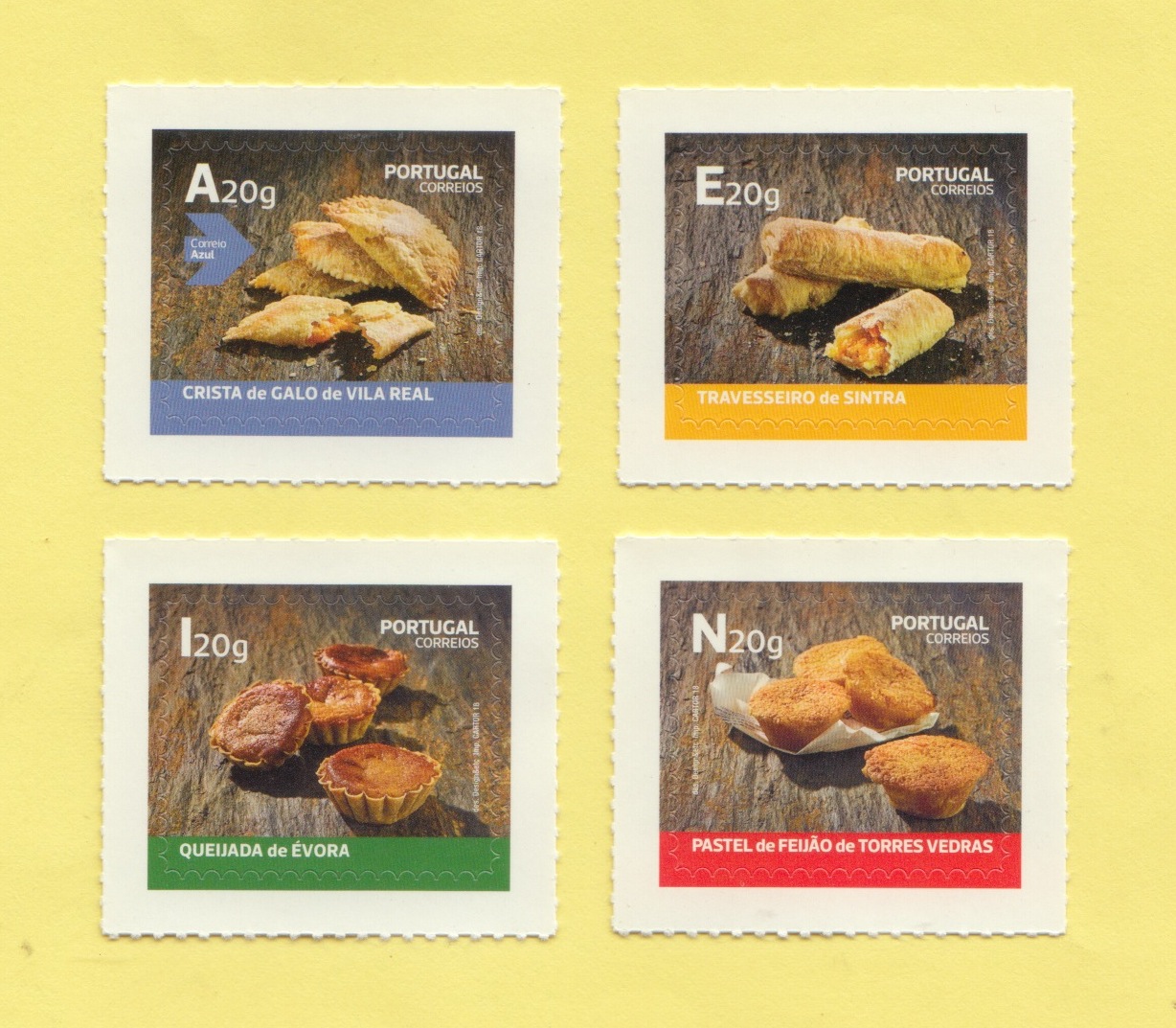
Portugal 2018 - Traditional Sweets of Portugal (Self Adhesive)
Technical Details:
Issue Date: 31 January 2018
Designer: Atelier Design & etc
Printer: Cartor
Process: Offset
Size: 25 x 30mm
About Self Adhesive - Traditional Sweets of Portugal
Bean Tarts
The tradition of making sweets from legumes combined with the ubiquitous bitterness of almonds was already well established long before the arrival of beans into Portuguese kitchens from the Americas. Appearing in the Tratado de Cozinha e Copa [Treaty on Food and Wine] by Carlos Bento da Maia, rst published in 1904, bean tarts were described in a recipe very similar to that for which Torres Vedras is famous. In his gastronomic tour of Portugal in 1940, Albino Forjaz de Sampaio was very taken by the Torres Vedras bean tarts and marked the town on the map as the birthplace of this pastry that is so fundamental to Portuguese confectionery. In terms of its history, more important than its origin are its protagonists, who through their re ned expertise and great attention to detail, transformed the pastry into a sweet symbol of Torres Vedras. Maria Adelaide Rodrigues da Silva, loyal depositary of this long-standing family secret, invested in their production and with her mastery and penchant for quality turned them into a popular pastry. Later on, members of her family continued the tradition of a secret whose alchemy was characterised by the delicacy and precision in the mixture of ingredients. As always, it is the hands, steady in their movements as if they are performing a ritual, that add a touch of perfection to this pastry, which gets its consistency from beans and has a moist and generous lling of almonds and eggs. Creating a sharp and wonderful contrast between diverse ingredients, bean tarts are a hearty and opulent pastry. It is a pleasure to bite into them and discover their distinct sweet lling.
Sintra Pillows
We owe the excellence of travesseiros de Sintra to Constança Luísa dos Santos Cunha, heiress of the art of confectionary of the prestigious Casa das Queijadas de Sintra. In the 1940s, in spite of the di culties felt in Portugal due to the scarcity of many foods after the Second World War, Constança Luísa found consolation for the ills of the world in confectionery. Inspired by a desire for perfection, she read and reread the old confectionery recipe books where the art of making egg custard was combined with new pastry-making techniques, resulting in the delicious travesseiro de Sintra. The egg custard stands out for its lightness and aroma, deriving from untold ancient wisdom, a family secret forever kept under lock and key. It is fair to say that not just any pu pastry will do when it comes to making an exceptional sweet. The best ingredients must be chosen in order to ensure that the travesseiro is both crisp and melt in the mouth. If you think the pastry is good, o ered up almost indecently to your palate, you’re in for a treat when you get to the delicious lling inside. It’s not di cult to invent a new pastry, as long as you’re willing to read the vast collection of recipes available and experiment with ingredients, techniques and expertise. The di cult part is creating a pastry that makes history, a taste that will be handed down through generations, that makes the moment you rst taste it stick in your memory. This is the magic of cooking; when something you create lives forever in the memories of others. We are indebted to Constança Luísa and are grateful to her heirs for keeping this excellent tradition alive. In each travesseiro de Sintra you can taste something that has been passed down through time, from the very rst one that was ever made, right down to the one which has just been eaten. This longevity can only be achieved when the art of confectionery is much more than a way of life, it is a way of paying respect and honouring those people who came before us and gave us the best they had to o er; the magic of confectionery.
Vila Real Cockerel’s Combs
Known as bacon pasteles (Pastéis de Toucinho) at the time of the Clarissan nuns of the Convent of St. Clare in Vila Real, these pastries were later nicknamed Cockerel’s Combs (Cristas de Galo) due to their similarity in appearance with the eshy comb on the head of cockerels. These pastries were blessed with the expertise that abounded in Portuguese convents, which were like alchemical laboratories where treasures of Portuguese confectionary were born from improbable mixtures of ingredients. Without a doubt, the hands that brought Cristas de Galo into being were blessed. If at rst glance you suspect that the lling is yet another variation of sweet egg custard, you will be pleasantly surprised by the ingenious and unexpected mixture of sugar, eggs, almonds, bacon, cinnamon and apple. Bacon the avour that lingers on your palate, but you only discover the perfection of the mixture in the second bite. The sugar in its lling is what gives it its sweetness, but the pastry is also unique, in this case so much more than a recipient for the lling. The pastry, on its own, is a tribute to the women that made it, doing what they do best. With a lightness that gives it a certain delicacy, the crisp pastry leaves you wanting more, making it hard to decide which part is more delicious, the lling or the pastry. Cristas de Galo are still made today by the mastery of the people of Vila Real, in honour of the history of the defunct Convent of St. Clare in Vila Real, devoted to Nossa Senhora do Amparo (Our Lady of Refuge). They are a gift from a happy time where perfection was not just about the sweetness of sugar, but also the perfect combination of pastry and lling and such varied ingredients as sugar and bacon. It almost seems as though, in the absence of words, due to their vow of perpetual silence, the nuns used these bacon pasteles to describe the moments of happiness that they would have liked to enjoy. It is a comfort to know that the world these nuns did not experience; the lands they abandoned early on, never to return; the lands they never had the chance to know, would come to experience the perfection of a moment of happiness through these pastries. How grateful we are to be able to taste them!
Évora Cheese Tarts
The Alentejo is a kind of sanctuary of traditional confectionary, and it is the home of one of the most famous recipes for Portuguese cheese tarts, the Queijadas de Évora. The distinct taste of cheese, which in the planes of the Alentejo usually comes from sheep’s milk, derives from the (dis)proportionate ratio of cheese to sugar, where the balance tips in favour of the former. It is perhaps for this reason, because they only have a delicate hint of sugar in them, that these cheese tarts make one forget one’s gluttony when eating them. Their subtle sweetness, which results from the small quantity of sugar involved, but more predominantly from the amount of full- fat sheep’s cheese, tricks our palate to think it less of a sin. The sheep’s cheese is well strained to ensure a smooth mixture with the egg yolks, sugar, and a little our, and its strong avour makes the pastry live up to its name. The need to preserve foods in order for them to keep longer, especially in the case of milk with its limited shelf life, led to the discovery of cheese and its transformation into a delicacy. We owe the cheese tarts to this need for preservation and the type and abundance of milk available, ready to be transformed into cheese. It is not surprising that the recipe book that Princess Maria, granddaughter of King Manuel I, had in her trousseau on her marriage to the 3rd Duke of Parma, Alexander Farnese, included a recipe for alvojávenas de Dona Isabel de Vilhena for which the mixture and quantities of ingredients were very similar to the Évora cheese tarts. Furthermore, a recipe book compiled by Friar Manuel de Santa Teresa (from the 18th century) included various recipes for cheese tarts with mouth-watering references to the techniques and expertise used in their confection and the re nement and care taken by those in charge of confectionery. In the midst of the planes of the Alentejo, our eyes are dazzled by the hot sun and we cast them over the open horizon, awakening dreams of far-away places. On this journey, we come across the subtle sweetness of an Évora cheese tart which reminds us that we are at our best and happiest when dreams appear in the form of sweets on our palate.
Issue Date: 31 January 2018
Designer: Atelier Design & etc
Printer: Cartor
Process: Offset
Size: 25 x 30mm
About Self Adhesive - Traditional Sweets of Portugal
Bean Tarts
The tradition of making sweets from legumes combined with the ubiquitous bitterness of almonds was already well established long before the arrival of beans into Portuguese kitchens from the Americas. Appearing in the Tratado de Cozinha e Copa [Treaty on Food and Wine] by Carlos Bento da Maia, rst published in 1904, bean tarts were described in a recipe very similar to that for which Torres Vedras is famous. In his gastronomic tour of Portugal in 1940, Albino Forjaz de Sampaio was very taken by the Torres Vedras bean tarts and marked the town on the map as the birthplace of this pastry that is so fundamental to Portuguese confectionery. In terms of its history, more important than its origin are its protagonists, who through their re ned expertise and great attention to detail, transformed the pastry into a sweet symbol of Torres Vedras. Maria Adelaide Rodrigues da Silva, loyal depositary of this long-standing family secret, invested in their production and with her mastery and penchant for quality turned them into a popular pastry. Later on, members of her family continued the tradition of a secret whose alchemy was characterised by the delicacy and precision in the mixture of ingredients. As always, it is the hands, steady in their movements as if they are performing a ritual, that add a touch of perfection to this pastry, which gets its consistency from beans and has a moist and generous lling of almonds and eggs. Creating a sharp and wonderful contrast between diverse ingredients, bean tarts are a hearty and opulent pastry. It is a pleasure to bite into them and discover their distinct sweet lling.
Sintra Pillows
We owe the excellence of travesseiros de Sintra to Constança Luísa dos Santos Cunha, heiress of the art of confectionary of the prestigious Casa das Queijadas de Sintra. In the 1940s, in spite of the di culties felt in Portugal due to the scarcity of many foods after the Second World War, Constança Luísa found consolation for the ills of the world in confectionery. Inspired by a desire for perfection, she read and reread the old confectionery recipe books where the art of making egg custard was combined with new pastry-making techniques, resulting in the delicious travesseiro de Sintra. The egg custard stands out for its lightness and aroma, deriving from untold ancient wisdom, a family secret forever kept under lock and key. It is fair to say that not just any pu pastry will do when it comes to making an exceptional sweet. The best ingredients must be chosen in order to ensure that the travesseiro is both crisp and melt in the mouth. If you think the pastry is good, o ered up almost indecently to your palate, you’re in for a treat when you get to the delicious lling inside. It’s not di cult to invent a new pastry, as long as you’re willing to read the vast collection of recipes available and experiment with ingredients, techniques and expertise. The di cult part is creating a pastry that makes history, a taste that will be handed down through generations, that makes the moment you rst taste it stick in your memory. This is the magic of cooking; when something you create lives forever in the memories of others. We are indebted to Constança Luísa and are grateful to her heirs for keeping this excellent tradition alive. In each travesseiro de Sintra you can taste something that has been passed down through time, from the very rst one that was ever made, right down to the one which has just been eaten. This longevity can only be achieved when the art of confectionery is much more than a way of life, it is a way of paying respect and honouring those people who came before us and gave us the best they had to o er; the magic of confectionery.
Vila Real Cockerel’s Combs
Known as bacon pasteles (Pastéis de Toucinho) at the time of the Clarissan nuns of the Convent of St. Clare in Vila Real, these pastries were later nicknamed Cockerel’s Combs (Cristas de Galo) due to their similarity in appearance with the eshy comb on the head of cockerels. These pastries were blessed with the expertise that abounded in Portuguese convents, which were like alchemical laboratories where treasures of Portuguese confectionary were born from improbable mixtures of ingredients. Without a doubt, the hands that brought Cristas de Galo into being were blessed. If at rst glance you suspect that the lling is yet another variation of sweet egg custard, you will be pleasantly surprised by the ingenious and unexpected mixture of sugar, eggs, almonds, bacon, cinnamon and apple. Bacon the avour that lingers on your palate, but you only discover the perfection of the mixture in the second bite. The sugar in its lling is what gives it its sweetness, but the pastry is also unique, in this case so much more than a recipient for the lling. The pastry, on its own, is a tribute to the women that made it, doing what they do best. With a lightness that gives it a certain delicacy, the crisp pastry leaves you wanting more, making it hard to decide which part is more delicious, the lling or the pastry. Cristas de Galo are still made today by the mastery of the people of Vila Real, in honour of the history of the defunct Convent of St. Clare in Vila Real, devoted to Nossa Senhora do Amparo (Our Lady of Refuge). They are a gift from a happy time where perfection was not just about the sweetness of sugar, but also the perfect combination of pastry and lling and such varied ingredients as sugar and bacon. It almost seems as though, in the absence of words, due to their vow of perpetual silence, the nuns used these bacon pasteles to describe the moments of happiness that they would have liked to enjoy. It is a comfort to know that the world these nuns did not experience; the lands they abandoned early on, never to return; the lands they never had the chance to know, would come to experience the perfection of a moment of happiness through these pastries. How grateful we are to be able to taste them!
Évora Cheese Tarts
The Alentejo is a kind of sanctuary of traditional confectionary, and it is the home of one of the most famous recipes for Portuguese cheese tarts, the Queijadas de Évora. The distinct taste of cheese, which in the planes of the Alentejo usually comes from sheep’s milk, derives from the (dis)proportionate ratio of cheese to sugar, where the balance tips in favour of the former. It is perhaps for this reason, because they only have a delicate hint of sugar in them, that these cheese tarts make one forget one’s gluttony when eating them. Their subtle sweetness, which results from the small quantity of sugar involved, but more predominantly from the amount of full- fat sheep’s cheese, tricks our palate to think it less of a sin. The sheep’s cheese is well strained to ensure a smooth mixture with the egg yolks, sugar, and a little our, and its strong avour makes the pastry live up to its name. The need to preserve foods in order for them to keep longer, especially in the case of milk with its limited shelf life, led to the discovery of cheese and its transformation into a delicacy. We owe the cheese tarts to this need for preservation and the type and abundance of milk available, ready to be transformed into cheese. It is not surprising that the recipe book that Princess Maria, granddaughter of King Manuel I, had in her trousseau on her marriage to the 3rd Duke of Parma, Alexander Farnese, included a recipe for alvojávenas de Dona Isabel de Vilhena for which the mixture and quantities of ingredients were very similar to the Évora cheese tarts. Furthermore, a recipe book compiled by Friar Manuel de Santa Teresa (from the 18th century) included various recipes for cheese tarts with mouth-watering references to the techniques and expertise used in their confection and the re nement and care taken by those in charge of confectionery. In the midst of the planes of the Alentejo, our eyes are dazzled by the hot sun and we cast them over the open horizon, awakening dreams of far-away places. On this journey, we come across the subtle sweetness of an Évora cheese tart which reminds us that we are at our best and happiest when dreams appear in the form of sweets on our palate.
Portugal 2018 - Traditional Sweets of Portugal

Technical Details:
Issue Date: 06 July 2018
Designer: Atelier Design & etc
Printer: INCM
Process: Offset
Size: 30,6 x 27,7 mm
About 2018 Traditional Sweets of Portugal
Bean Tart
The tradition of making sweets from legumes combined with the ubiquitous bitterness of almonds was already well established long before the arrival of beans into Portuguese kitchens from the Americas. Appearing in the Tratado de Cozinha e Copa [Treaty onFood and Wine] by Carlos Bento da Maia, rst published in 1904, bean tarts were described in a recipe very similar to that for which Torres Vedras is famous. In his gastronomic tour of Portugal in 1940, Albino Forjaz de Sampaio was very taken by the Torres Vedras bean tarts and marked the town on the map as the birthplace of this pastry that is so fundamental to Portuguese confectionery. In terms of its history, more important than its origin are its protagonists, who through their re ned expertise and great attention to detail, transformed the pastry into a sweet symbol of Torres Vedras. Maria Adelaide Rodrigues da Silva, loyal depositary of this long-standing family secret, invested in their production and with her mastery and penchant for quality turned them into a popular pastry. Later on, members of her family continued the tradition of a secret whose alchemy was characterised by the delicacy and precision in the mixture of ingredients. As always, it is the hands, steady in their movements as if they are performing a ritual, that add a touch of perfection to this pastry, which gets its consistency from beans and has a moist and generous lling of almonds and eggs. Creatinga sharp and wonderful contrast between diverse ingredients, beantarts are a hearty and opulent pastry. It is a pleasure to bite into them and discover their distinct sweet lling.
Vila Real Cockerel’s Comb
Known as bacon pasteles (Pastéis de Toucinho) at the time of theClarissan nuns of the Convent of St. Clare in Vila Real, these pastrieswere later nicknamed Cockerel’s Combs (Cristas de Galo) due totheir similarity in appearance with the eshy comb on the headof cockerels. These pastries were blessed with the expertise thatabounded in Portuguese convents, which were like alchemical laboratories where treasures of Portuguese confectionary were born from improbable mixtures of ingredients. Without a doubt, thehands that brought Cristas de Galo into being were blessed. If at rst glance you suspect that the lling is yet another variation of sweetegg custard, you will be pleasantly surprised by the ingenious andunexpected mixture of sugar, eggs, almonds, bacon, cinnamon and apple. Bacon the avour that lingers on your palate, but you only discover the perfection of the mixture in the second bite. The sugar in its lling is what gives it its sweetness, but the pastry is also unique, in this case so much more than a recipient for the lling. The pastry, on its own, is a tribute to the women that made it, doing what they dobest. With a lightness that gives it a certain delicacy, the crisp pastryleaves you wanting more, making it hard to decide which part is more delicious, the lling or the pastry. Cristas de Galo are still made today by the mastery of the people of Vila Real, in honour of the historyof the defunct Convent of St. Clare in Vila Real, devoted to NossaSenhora do Amparo (Our Lady of Refuge). They are a gift from a happy time where perfection was not just about the sweetness of sugar, but also the perfect combination of pastry and lling and such varied ingredients as sugar and bacon. It almost seems as though, inthe absence of words, due to their vow of perpetual silence, the nuns used these bacon pasteles to describe the moments of happiness that they would have liked to enjoy. It is a comfort to know that the world these nuns did not experience; the lands they abandoned early on, never to return; the lands they never had the chance to know, would come to experience the perfection of a moment of happiness through these pastries. How grateful w e are to be able to taste them!
Sintra Pillow
We owe the excellence of travesseiros de Sintra to Constança Luísa dos Santos Cunha, heiress of the art of confectionary of the prestigious Casa das Queijadas de Sintra. In the 1940s, in spite ofthe di culties felt in Portugal due to the scarcity of many foods afterthe Second World War, Constança Luísa found consolation for the ills of the world in confectionery. Inspired by a desire for perfection, she read and reread the old confectionery recipe books where theart of making egg custard was combined with new pastry-makingtechniques, resulting in the delicious travesseiro de Sintra. The eggcustard stands out for its lightness and aroma, deriving from untold ancient wisdom, a family secret forever kept under lock and key. It is fair to say that not just any pu pastry will do when it comes to making an exceptional sweet. The best ingredients must be chosenin order to ensure that the travesseiro is both crisp and melt in the mouth. If you think the pastry is good, o ered up almost indecently to your palate, you’re in for a treat when you get to the delicious lling inside. It’s not di cult to invent a new pastry, as long as you’re willing to read the vast collection of recipes available and experiment with ingredients, techniques and expertise. The di cult part is creating a pastry that makes history, a taste that will be handed down through generations, that makes the moment you rst taste it stick in your memory. This is the magic of cooking; when something you create lives forever in the memories of others. We are indebtedto Constança Luísa and are grateful to her heirs for keeping this excellent tradition alive. In each travesseiro de Sintra you can tastesomething that has been passed down through time, from the very rst one that was ever made, right down to the one which has justbeen eaten. This longevity can only be achieved when the art ofconfectionery is much more than a way of life, it is a way of paying respect and honouring those people who came before us and gave us the best they had to o er; the magic of confectionery.
Évora Cheese Tart
The Alentejo is a kind of sanctuary of traditional confectionary, andit is the home of one of the most famous recipes for Portuguesecheese tarts, the Queijadas de Évora. The distinct taste of cheese,which in the planes of the Alentejo usually comes from sheep’s milk, derives from the (dis)proportionate ratio of cheese to sugar, where the balance tips in favour of the former. It is perhaps for this reason, because they only have a delicate hint of sugar in them, that these cheese tarts make one forget one’s gluttony when eating them. Their subtle sweetness, which results from the small quantity of sugar involved, but more predominantly from the amount of full-fat sheep’s cheese, tricks our palate to think it less of a sin. Thesheep’s cheese is well strained to ensure a smooth mixture with the egg yolks, sugar, and a little our, and its strong avour makes the pastry live up to its name. The need to preserve foods in order for them to keep longer, especially in the case of milk with its limited shelf life, led to the discovery of cheese and its transformation intoa delicacy. We owe the cheese tarts to this need for preservation andthe type and abundance of milk available, ready to be transformed into cheese. It is not surprising that the recipe book that PrincessMaria, granddaughter of King Manuel I, had in her trousseau on hermarriage to the 3rd Duke of Parma, Alexander Farnese, includeda recipe for alvojávenas de Dona Isabel de Vilhena for which themixture and quantities of ingredients were very similar to the Évora cheese tarts. Furthermore, a recipe book compiled by Friar Manuel de Santa Teresa (from the 18th century) included various recipes for cheese tarts with mouth-watering references to the techniques and expertise used in their confection and the re nement and care taken by those in charge of confectionery. In the midst of the planes of the Alentejo, our eyes are dazzled by the hot sun and we cast them over the open horizon, awakening dreams of far-away places. On this journey, we come across the subtle sweetness of an Évora cheese tart which reminds us that we are at our best and happiest when dreams appear in the form of sweets on our palate.
Ançã Cake
The tradition of making sweet breads is widespread across the whole of Portugal. First there was bread, staple food of our culture. Then came honey and sugar, and this gave rise to the sweet dough that was baked and used as a popular o ering on saint’s days. It was an inexpensive way for the poor and middle classes to have something sweet on days of respite from the daily grind. The tradition evolvedin all villages and towns, but in Ançã it excelled and proved that theconfectionery of the masses could be extraordinary and deserving of utmost respect. Why this sweet bread, made from simple and common ingredients, tastes so good, one can only wonder. Maybe it is the way the our is mixed with the eggs and the butter, with the patience of someone who knows that it you cannot rush alchemy in the kitchen, or the rhythmic kneading of hands with noble intentions. Perhaps it is the wood oven that gives the bread its depth of avour. Or could it be the vendors, who sing announcements, selling theirAnçã sweet bread wherever they go? Who knows why, but theappeal of its simplicity is irresistible. It is also di cult to explain why the tradition of sweet breads in the village of Ançã grew so much and gained such a following, since the circumstances and availability of our also led to the creation of the bolo de cornos [horned cake] and bolo no [ ne cake] as well as the traditional bolo de Ançã [Ançã cake], whose crown, which opens up well into the baking time, seems to hold all of the splendour of the moist and delicious dough inside of it. Di erent purities of our, some ne, some coarse, produce di erent textures; and all the admirers of this cake have their own personal preference. In 1933, Jaime Cortesão wrote in the Comarca de Cantanhede that “Ançã is the talk of the town in Lisbon (...) thanks to its magni cent sweet breads (...)”. There is nothing like experiencing the purity of avour of an egg cake, a horn or a ne cake, to the sound of the alternating rhythm of the clear andcrystalline water of the Ribeira de Ança, which you can’t help but feel cleansing your soul as it runs through the village.
Odivelas White Quince Jam
In times gone by, when an abundant supply of sugar made miracles of confectionery possible in convents and monasteries, a well known recipe was given a new twist when the Odivelas Monastery o ered the world Marmelada Branca. Presented in small cubes, the Odivelas quince jam stands out from others due to its white colour,which hints at the innocent and delicate secrets of its confection.The Bernardine nuns of the Cistercian Order knew to take great care over the smallest details, so that the fame of this sweet quince jam spread throughout the kingdom, leading greedy palates to ock to the convent’s turn-box to acquire it. This quince jam became famous,above all, for its white colour, however, those who have grown upeating it say that no other jam has such intense taste of quince, whichis regarded as the greatest fruit of a season of plenty. The convent’slast nun left a written record of the recipe: “peel the quinces and put them into cold water. Bring them to simmer on a low heat and when they are well cooked pass them through a sieve. For 1kg of pulp, heat 2kg of sugar until it bubbles up in the pan, so that a drop of it in a glass of water becomes rm: take the pan o the heat and stir in the pulp with a spoon until the mixture is smooth, then put it back on the heat until it bubbles. Remove the pan from the heat and beat the jelly until it cools, then put it on plates to dry.” Told as if telling a storyto a friend, this recipe tells us that the secret was kept by the personwho used it every autumn and had mastered the art of making a white quince jam, so di erent from the others that were commonly made throughout the region. The record in the recipe book wasn’t so much an attempt to ensure the recipe’s survival, but rather a story from the kitchen entrusted to people who knew all the secrets of confectionery, forging a relationship that would last for all time. Asecret whispered between everyday conversations, this recipe leadsus to assume that the secret to a good white quince jam rests, then as it does now, upon the desire to achieve perfection by transforming a fruit with sour skin and esh into small silky cubes that melt in the mouth.
Caniço Doll Biscuits
We must trace our steps back to the 19th century to nd the rst signs of the doll biscuit tradition in Caniço. Oral history identi es António Correia, born in Mãe de Deus, in Caniço, as the rst person to make Bonecas de Massa, as a way of providing extra income for his family. In 1916, one of his sons, Alexandre Correia, known as ‘Old Father’, married Ludvina, in the area of Serralhal, and together the large family adopted the tradition when it became impossible to maintain the couple and their nine children with agriculture alone. They made the dollsat home on their farm, the Sítio dos Barreiros.
The Bonecas de Massa, representations of human gures made outof dough, began to gain popularity at street parties and Alexandre would follow the trails around the island with a basket on his back,laden with Bonecas to sell in the big religious festivals: the Bom Jesus festival in Ponta Delgada; the Sr. Dos Milagres festival in Machico; the Senhora do Monte festival in Monte; the Senhora da Piedade festival in Caniçal; and the Livramento and Santíssimo Sacramento festivitiesin Caniço.
The production of the doll biscuits was an important event for children and when word spread that Ludvina was about to make them, her grandchildren and their friends would come from all around and show up at the house to o er their help. The children were in chargeof putting on the eyes, using the seeds of a herb known as balloonvine or love in a pu (Cardiospermum), that grows on the shore of the island, Indian shot (Canna indica), chive seeds or cloves, thatthey would break in half with a stone and put in place of the eyes. They would also help to put on the red, blue or green tissue paperdecoration (papelinhos). The colours don’t have any special meaning; they were the colours that were available at the time. There isphotographic evidence of the use of green. The children would carrythe raw dolls in their arms up to the oven door, where Ludvina would use an oven peel to put them in the oven. The children would wait eagerly for the 15 or 20 minutes it took to bake them, to receive the broken ones, which could not be sold. They would gather plums and pears with a stick or by climbing trees and would eat them with thepieces of broken doll biscuits. When Alexandre passed away, Ludvinacontinued to make the dolls with the help of her two daughters, Elisa and Glória. Glória followed in the footsteps of her father and would go to the street parties, together with her cousin, Salomé Teixeira, who would later continue with the tradition of making the Bonecas de Massa. Thanks to Salomé Teixeira, the Bonecas de Massa or Bonecasde Maçapão earned a place in Madeiran popular art and variousexhibitions were held to promote the art form.
The gures each had di erent characteristics; they came in di erent shapes and sizes: male and female, holding hoops or nests and cockerels or hens. Each stage of their preparation requires a great amount of skill. The process begins with the preparation of the dough, in which water is mixed with salt and yellow egg colouring before adding the our, which sometimes is mixed with yeast. Once the dough is well kneaded, like bread, it rests. It is then cut into small pieces and moulded into the desired shape. After the moulding comes the decorating stage when the necklaces are added: poor/ traditional girl dolls get 3 necklaces and rich girl dolls get 5 necklaces and a more detailed skirt. Then comes the red or blue paper. Usually red is used on their heads, shoulders and the hem of their skirts, while the blue is used on their arms; crossing from one arm to the other below the neck. The number of necklaces and the amount of tissue paper used makes the distinction between the poor/traditional and the rich dolls. Other shapes like nests/hoops with 3 hens, a cockerel or hen are also made and adorned with tissue paper.
Issue Date: 06 July 2018
Designer: Atelier Design & etc
Printer: INCM
Process: Offset
Size: 30,6 x 27,7 mm
About 2018 Traditional Sweets of Portugal
Bean Tart
The tradition of making sweets from legumes combined with the ubiquitous bitterness of almonds was already well established long before the arrival of beans into Portuguese kitchens from the Americas. Appearing in the Tratado de Cozinha e Copa [Treaty onFood and Wine] by Carlos Bento da Maia, rst published in 1904, bean tarts were described in a recipe very similar to that for which Torres Vedras is famous. In his gastronomic tour of Portugal in 1940, Albino Forjaz de Sampaio was very taken by the Torres Vedras bean tarts and marked the town on the map as the birthplace of this pastry that is so fundamental to Portuguese confectionery. In terms of its history, more important than its origin are its protagonists, who through their re ned expertise and great attention to detail, transformed the pastry into a sweet symbol of Torres Vedras. Maria Adelaide Rodrigues da Silva, loyal depositary of this long-standing family secret, invested in their production and with her mastery and penchant for quality turned them into a popular pastry. Later on, members of her family continued the tradition of a secret whose alchemy was characterised by the delicacy and precision in the mixture of ingredients. As always, it is the hands, steady in their movements as if they are performing a ritual, that add a touch of perfection to this pastry, which gets its consistency from beans and has a moist and generous lling of almonds and eggs. Creatinga sharp and wonderful contrast between diverse ingredients, beantarts are a hearty and opulent pastry. It is a pleasure to bite into them and discover their distinct sweet lling.
Vila Real Cockerel’s Comb
Known as bacon pasteles (Pastéis de Toucinho) at the time of theClarissan nuns of the Convent of St. Clare in Vila Real, these pastrieswere later nicknamed Cockerel’s Combs (Cristas de Galo) due totheir similarity in appearance with the eshy comb on the headof cockerels. These pastries were blessed with the expertise thatabounded in Portuguese convents, which were like alchemical laboratories where treasures of Portuguese confectionary were born from improbable mixtures of ingredients. Without a doubt, thehands that brought Cristas de Galo into being were blessed. If at rst glance you suspect that the lling is yet another variation of sweetegg custard, you will be pleasantly surprised by the ingenious andunexpected mixture of sugar, eggs, almonds, bacon, cinnamon and apple. Bacon the avour that lingers on your palate, but you only discover the perfection of the mixture in the second bite. The sugar in its lling is what gives it its sweetness, but the pastry is also unique, in this case so much more than a recipient for the lling. The pastry, on its own, is a tribute to the women that made it, doing what they dobest. With a lightness that gives it a certain delicacy, the crisp pastryleaves you wanting more, making it hard to decide which part is more delicious, the lling or the pastry. Cristas de Galo are still made today by the mastery of the people of Vila Real, in honour of the historyof the defunct Convent of St. Clare in Vila Real, devoted to NossaSenhora do Amparo (Our Lady of Refuge). They are a gift from a happy time where perfection was not just about the sweetness of sugar, but also the perfect combination of pastry and lling and such varied ingredients as sugar and bacon. It almost seems as though, inthe absence of words, due to their vow of perpetual silence, the nuns used these bacon pasteles to describe the moments of happiness that they would have liked to enjoy. It is a comfort to know that the world these nuns did not experience; the lands they abandoned early on, never to return; the lands they never had the chance to know, would come to experience the perfection of a moment of happiness through these pastries. How grateful w e are to be able to taste them!
Sintra Pillow
We owe the excellence of travesseiros de Sintra to Constança Luísa dos Santos Cunha, heiress of the art of confectionary of the prestigious Casa das Queijadas de Sintra. In the 1940s, in spite ofthe di culties felt in Portugal due to the scarcity of many foods afterthe Second World War, Constança Luísa found consolation for the ills of the world in confectionery. Inspired by a desire for perfection, she read and reread the old confectionery recipe books where theart of making egg custard was combined with new pastry-makingtechniques, resulting in the delicious travesseiro de Sintra. The eggcustard stands out for its lightness and aroma, deriving from untold ancient wisdom, a family secret forever kept under lock and key. It is fair to say that not just any pu pastry will do when it comes to making an exceptional sweet. The best ingredients must be chosenin order to ensure that the travesseiro is both crisp and melt in the mouth. If you think the pastry is good, o ered up almost indecently to your palate, you’re in for a treat when you get to the delicious lling inside. It’s not di cult to invent a new pastry, as long as you’re willing to read the vast collection of recipes available and experiment with ingredients, techniques and expertise. The di cult part is creating a pastry that makes history, a taste that will be handed down through generations, that makes the moment you rst taste it stick in your memory. This is the magic of cooking; when something you create lives forever in the memories of others. We are indebtedto Constança Luísa and are grateful to her heirs for keeping this excellent tradition alive. In each travesseiro de Sintra you can tastesomething that has been passed down through time, from the very rst one that was ever made, right down to the one which has justbeen eaten. This longevity can only be achieved when the art ofconfectionery is much more than a way of life, it is a way of paying respect and honouring those people who came before us and gave us the best they had to o er; the magic of confectionery.
Évora Cheese Tart
The Alentejo is a kind of sanctuary of traditional confectionary, andit is the home of one of the most famous recipes for Portuguesecheese tarts, the Queijadas de Évora. The distinct taste of cheese,which in the planes of the Alentejo usually comes from sheep’s milk, derives from the (dis)proportionate ratio of cheese to sugar, where the balance tips in favour of the former. It is perhaps for this reason, because they only have a delicate hint of sugar in them, that these cheese tarts make one forget one’s gluttony when eating them. Their subtle sweetness, which results from the small quantity of sugar involved, but more predominantly from the amount of full-fat sheep’s cheese, tricks our palate to think it less of a sin. Thesheep’s cheese is well strained to ensure a smooth mixture with the egg yolks, sugar, and a little our, and its strong avour makes the pastry live up to its name. The need to preserve foods in order for them to keep longer, especially in the case of milk with its limited shelf life, led to the discovery of cheese and its transformation intoa delicacy. We owe the cheese tarts to this need for preservation andthe type and abundance of milk available, ready to be transformed into cheese. It is not surprising that the recipe book that PrincessMaria, granddaughter of King Manuel I, had in her trousseau on hermarriage to the 3rd Duke of Parma, Alexander Farnese, includeda recipe for alvojávenas de Dona Isabel de Vilhena for which themixture and quantities of ingredients were very similar to the Évora cheese tarts. Furthermore, a recipe book compiled by Friar Manuel de Santa Teresa (from the 18th century) included various recipes for cheese tarts with mouth-watering references to the techniques and expertise used in their confection and the re nement and care taken by those in charge of confectionery. In the midst of the planes of the Alentejo, our eyes are dazzled by the hot sun and we cast them over the open horizon, awakening dreams of far-away places. On this journey, we come across the subtle sweetness of an Évora cheese tart which reminds us that we are at our best and happiest when dreams appear in the form of sweets on our palate.
Ançã Cake
The tradition of making sweet breads is widespread across the whole of Portugal. First there was bread, staple food of our culture. Then came honey and sugar, and this gave rise to the sweet dough that was baked and used as a popular o ering on saint’s days. It was an inexpensive way for the poor and middle classes to have something sweet on days of respite from the daily grind. The tradition evolvedin all villages and towns, but in Ançã it excelled and proved that theconfectionery of the masses could be extraordinary and deserving of utmost respect. Why this sweet bread, made from simple and common ingredients, tastes so good, one can only wonder. Maybe it is the way the our is mixed with the eggs and the butter, with the patience of someone who knows that it you cannot rush alchemy in the kitchen, or the rhythmic kneading of hands with noble intentions. Perhaps it is the wood oven that gives the bread its depth of avour. Or could it be the vendors, who sing announcements, selling theirAnçã sweet bread wherever they go? Who knows why, but theappeal of its simplicity is irresistible. It is also di cult to explain why the tradition of sweet breads in the village of Ançã grew so much and gained such a following, since the circumstances and availability of our also led to the creation of the bolo de cornos [horned cake] and bolo no [ ne cake] as well as the traditional bolo de Ançã [Ançã cake], whose crown, which opens up well into the baking time, seems to hold all of the splendour of the moist and delicious dough inside of it. Di erent purities of our, some ne, some coarse, produce di erent textures; and all the admirers of this cake have their own personal preference. In 1933, Jaime Cortesão wrote in the Comarca de Cantanhede that “Ançã is the talk of the town in Lisbon (...) thanks to its magni cent sweet breads (...)”. There is nothing like experiencing the purity of avour of an egg cake, a horn or a ne cake, to the sound of the alternating rhythm of the clear andcrystalline water of the Ribeira de Ança, which you can’t help but feel cleansing your soul as it runs through the village.
Odivelas White Quince Jam
In times gone by, when an abundant supply of sugar made miracles of confectionery possible in convents and monasteries, a well known recipe was given a new twist when the Odivelas Monastery o ered the world Marmelada Branca. Presented in small cubes, the Odivelas quince jam stands out from others due to its white colour,which hints at the innocent and delicate secrets of its confection.The Bernardine nuns of the Cistercian Order knew to take great care over the smallest details, so that the fame of this sweet quince jam spread throughout the kingdom, leading greedy palates to ock to the convent’s turn-box to acquire it. This quince jam became famous,above all, for its white colour, however, those who have grown upeating it say that no other jam has such intense taste of quince, whichis regarded as the greatest fruit of a season of plenty. The convent’slast nun left a written record of the recipe: “peel the quinces and put them into cold water. Bring them to simmer on a low heat and when they are well cooked pass them through a sieve. For 1kg of pulp, heat 2kg of sugar until it bubbles up in the pan, so that a drop of it in a glass of water becomes rm: take the pan o the heat and stir in the pulp with a spoon until the mixture is smooth, then put it back on the heat until it bubbles. Remove the pan from the heat and beat the jelly until it cools, then put it on plates to dry.” Told as if telling a storyto a friend, this recipe tells us that the secret was kept by the personwho used it every autumn and had mastered the art of making a white quince jam, so di erent from the others that were commonly made throughout the region. The record in the recipe book wasn’t so much an attempt to ensure the recipe’s survival, but rather a story from the kitchen entrusted to people who knew all the secrets of confectionery, forging a relationship that would last for all time. Asecret whispered between everyday conversations, this recipe leadsus to assume that the secret to a good white quince jam rests, then as it does now, upon the desire to achieve perfection by transforming a fruit with sour skin and esh into small silky cubes that melt in the mouth.
Caniço Doll Biscuits
We must trace our steps back to the 19th century to nd the rst signs of the doll biscuit tradition in Caniço. Oral history identi es António Correia, born in Mãe de Deus, in Caniço, as the rst person to make Bonecas de Massa, as a way of providing extra income for his family. In 1916, one of his sons, Alexandre Correia, known as ‘Old Father’, married Ludvina, in the area of Serralhal, and together the large family adopted the tradition when it became impossible to maintain the couple and their nine children with agriculture alone. They made the dollsat home on their farm, the Sítio dos Barreiros.
The Bonecas de Massa, representations of human gures made outof dough, began to gain popularity at street parties and Alexandre would follow the trails around the island with a basket on his back,laden with Bonecas to sell in the big religious festivals: the Bom Jesus festival in Ponta Delgada; the Sr. Dos Milagres festival in Machico; the Senhora do Monte festival in Monte; the Senhora da Piedade festival in Caniçal; and the Livramento and Santíssimo Sacramento festivitiesin Caniço.
The production of the doll biscuits was an important event for children and when word spread that Ludvina was about to make them, her grandchildren and their friends would come from all around and show up at the house to o er their help. The children were in chargeof putting on the eyes, using the seeds of a herb known as balloonvine or love in a pu (Cardiospermum), that grows on the shore of the island, Indian shot (Canna indica), chive seeds or cloves, thatthey would break in half with a stone and put in place of the eyes. They would also help to put on the red, blue or green tissue paperdecoration (papelinhos). The colours don’t have any special meaning; they were the colours that were available at the time. There isphotographic evidence of the use of green. The children would carrythe raw dolls in their arms up to the oven door, where Ludvina would use an oven peel to put them in the oven. The children would wait eagerly for the 15 or 20 minutes it took to bake them, to receive the broken ones, which could not be sold. They would gather plums and pears with a stick or by climbing trees and would eat them with thepieces of broken doll biscuits. When Alexandre passed away, Ludvinacontinued to make the dolls with the help of her two daughters, Elisa and Glória. Glória followed in the footsteps of her father and would go to the street parties, together with her cousin, Salomé Teixeira, who would later continue with the tradition of making the Bonecas de Massa. Thanks to Salomé Teixeira, the Bonecas de Massa or Bonecasde Maçapão earned a place in Madeiran popular art and variousexhibitions were held to promote the art form.
The gures each had di erent characteristics; they came in di erent shapes and sizes: male and female, holding hoops or nests and cockerels or hens. Each stage of their preparation requires a great amount of skill. The process begins with the preparation of the dough, in which water is mixed with salt and yellow egg colouring before adding the our, which sometimes is mixed with yeast. Once the dough is well kneaded, like bread, it rests. It is then cut into small pieces and moulded into the desired shape. After the moulding comes the decorating stage when the necklaces are added: poor/ traditional girl dolls get 3 necklaces and rich girl dolls get 5 necklaces and a more detailed skirt. Then comes the red or blue paper. Usually red is used on their heads, shoulders and the hem of their skirts, while the blue is used on their arms; crossing from one arm to the other below the neck. The number of necklaces and the amount of tissue paper used makes the distinction between the poor/traditional and the rich dolls. Other shapes like nests/hoops with 3 hens, a cockerel or hen are also made and adorned with tissue paper.
Subscribe to:
Posts (Atom)


