Sunday, June 3, 2018

Costa Rica - Traditional Foods 2014


65 Costa Rican Colones - Gallo Pinto (Costa Rican Beans & Rices)
65 Costa Rican Colones - Casado con Pollo (Chicken mixed vegetables, casado is not a singular dish, but a dish made up of many foods)
65 Costa Rican Colones - Olla de Carne (Meat Pot)
65 Costa Rican Colones - Picadillo de Vainicas (Minced Hash)

Date of Issue: 01 December 2014
Face Values: 65 Costa Rican Colones
Stamp Number: 1000000
Seals Reason: Photographs of traditional foods such as Meat Pot, Chopped Vainica, Gallo Pinto and Married Chicken.
Photos by the Center for Research and Conservation of Cultural Heritage and Flavors Magazine images.

Saturday, June 2, 2018

Finland - Finnish Taste 2018


Product description:
DESIGN: Klaus Welp
DATE OF ISSUE: 06.06.2018
SIZE OF STAMPS: Booklet, 6 motifs
DESCRIPTION: Among the most favourite Finnish tastes we find coffee and salty liquorice featured on two of the stamps in this booklet.

Aland - Aland Cakes 2011


The 2011 pack of exhibition cards will be available from 2 December. The theme for the 2011 exhibition cards is pastry, and artist Alexander Lindén made all the illustrations.

Åland exhibition cards are issued with a specially designed exhibition stamp and cancelled with the relevant exhibition cancel. The 2011 pack costs €22.80. Also available from 4 December at the price €81.60 is the 2011 Exhibition Stamp Pack holding all 12 mini-sheets of exhibition stamps.

“I googled for pictures, studied Wikipedia and read various bakery pages on the Internet. I even contacted a local bakery in Helsingborg, Sweden, that made a special piece of pastry.” Alexander has not previously designed motifs for postcards; he has primarily been working with graphic art for computer games.

One year ago, Alexander Lindén had not yet cooperated with the Åland Post. H e is now of great immediate interest with quite a few and very different projects for the Post. Exhibition cards, christmas decorations, stamps and an animated film.

Alexander was first contacted as potential artist for this year’s exhibition cards on a pastry theme. He was commissioned with the task of designing 14 cards featuring pastry local to the cities where exhibitions in which the Post participates in 2011 are arranged. “It was quite a lot of work to figure out which type of pastry should represent each city”, Alexander describes his first commission. Certain types of pastry had been predetermined by the Post’s Stamp Committee while others were developed on the proposal of Alexander.

PONDERED BEFORE FINAL TOUCH
“This job was quite different; I now got the chance to dwell on a design. I had time to ponder before putting that finishing touch to my designs, a fact that I was quite comfortable with”, says Alexander, alternating his work on the exhibition cards with other jobs.
“The pastry designs were like dessert; a dessert that I could work on in peace and quiet.” 
Producing graphic art for computer games also included designing icons depicting fruits, but that was as close as he got to food and pastry designs prior to his exhibition card task.

PYRAMID CAKE MOST DIFFICULT
“I realized that there was a risk of creating something unappetizing. Designing whipped cream was particularly difficult. At first, it simply looked as if it were cast in cement and, when I attempted to obtain a more creamy look, it turned out more blurred”, reveals Alexander, who edited the images in Photoshop.
Even so, he found the pyramid cake illustrated on the exhibition card for Svedala most difficult.
“I believe I made five attempts before I was satisfied with that particular image. I first shaded every thread of pastry, but it didn’t turn out well so I had to rethink. Instead, I painted a cylinder sculpture in which I punched small holes.”

MIND-TWISTING DOUGHNUTS
The motif for the Nordia 2011 card, the “grismunk”, a Finnish type of doughnut, was another mind-twisting motif.
“I was quite pleased with my doughnuts until my uncle saw them and found that the sugary surface looked odd. As a result of the extra time I spent on them, I discovered a new way of painting sugar that also came in helpful when I edited the other images.”

TRICKY BALANCE
Another project of immediate interest is this year’s Christmas decorations.
“I had my hands full with other jobs at the same time, so I worked with that commission on weekends.
It proved difficult to create all the frills that I wanted on my Christmas decorations. Finding a balance between all the gaps was tricky”, remembers Alexander, who had made pencil sketches of the motifs before starting.
“But it all became easier when I simplified the design. I realized that the thin lines would not appear anyway, when the decorations were finally punched in brass.”

BUSES TRUE TO REAL LIFE
Alexander is also the artist behind two stamps featuring buses to be issued in 2012.
“I made my fi rst sketches when I had just become a father and I was a bit stressed. My basic idea was to create the buses in an isometric perspective with a touch of console game. But the Post’s Stamp Committee asked me to rethink the design.”
Instead, Alexander made the buses more authentic.

USED TO SMALL FORMAT
Many new stamp artists are unaccustomed to create paintings in a very small format; however, Alexander is not.

Aland - Potato Chips 2011


Technical Details:
Date of Issue: 7 June 2011 
Photografer: Kjell Söderlund 
Edition: 180 000 
Denomination: €0.85 
Size of Stamp: 35 x 35 mm 
Size of Sheet: 2 x 15 stamps 
Perforation: 13 per 2 cm 
Paper: 102 g/m² 
Printing Method: 4-colour offset 
Printing House: Joh. Enschedé Stamps

Pioneers in Potato Chips in Finland

Chips Ab was founded in Åland in 1969. he founders then did not know that, 30 years later, the organization would consist of an international group of companies with more than 1300 employees in the Nordic countries, the Baltic states and Russia. 

The limited company Chips Ab was founded by three private initiators who wished to create a land-based industry to compensate for the considerable emigration from Åland at the time. Agriculture, fishing and commerce had long been the most important sources of income, and the initiators wanted to bring about an industry based on some type of local primary produce.

POTATOES CONSIDERED FOOD ONLY 
One of the promoters had come across potato chips (“crisps” in UK) during his years of studies in the USA. By then, chips were already known in Sweden and Denmark, but in Åland and Finland, potatoes were considered to be merely food. Chips Ab was the first producer of potato chips in Finland. Since then, the Taffel brand continues to be a leader on the Finnish market. 

HIGH QUALITY CHIPS POTATOES IN ÅLAND 
The Åland soil soon proved to be able to supply all the potatoes needed for the factory. The warming sea around Åland prolongs the growing season, an important factor for growing fine chips potatoes.

CONSIDERABLE VENTURES 
The Chips group got off the ground somewhat stumbling in the 1970s but, as of the 1980s, much happened when for example parts of the Swedish company OLW were acquired. In the 1990s, ventures were made in the Baltic and Russian markets. In 2005, Norwegian Orkla Asa took over the ownership for Chips Abp.

NORDIC COUNTRIES AND BALTIC STATES 
Today, the domestic market of Chips Ab lies in the Nordic countries and the Baltic states but with local companies and local brands. Some of these are Chips (Finland), OLW (Sweden), Kims (Denmark and Norway) and Latfood (the Baltic states). The operations of Chips Finland are run from a factory situated in Haraldsby, Åland, a sales and marketing office located in Helsinki and a finance and economy department also located in Åland.

✹ Sources: ”Från knölar i marken till miljoner på banken” by Jörgen Pettersson and Anders Mattsson and www. chips.fi

Greece - EUROPA, Gastronomy 2005


EUROPA - Gastronomy
Date of Issue: 19 May 2005

Dakos (Barley Rusk)

The most known Cretan salad is what we call kritikos dakos. It is delicious, it is healthy, it is the ultimate representation of the Mediterranean diet, straight from Crete.

First of all it’s been described as a Greek bruschetta, but it isn’t, it is a bit different. Here’s what it is: Dakos specifically refers to a recipe that uses the famous Cretan barley rusks. These rusks are made with whole grain barley flour, water and salt. They are super hard and super healthy. Also dakos includes olive oil, tomato, and crumbled cheese, traditionally this cheese is Cretan mitzithra but you often see it (outside of Crete) made with feta.

And that’s it. Sometimes there may be a few capers scattered around, but really it is just tomato, rusk and olive oil.

Nutrition wise, I cannot think of a better dish for anything really…salad, appetizer, meze, main course.

First of all let’s talk about the paximadi (rusk), these are traditionally made with barley flour (whole grain), salt and yeast. Barley contains a type of fiber known as soluble fiber that helps lower the bad cholesterol (LDL). But it also contains beta-glucan a component of carbohydrates found only in specific grains such as barley, that appear to also lower cholesterol but also lower blood sugar and provide better control of insulin. Barley has also been found to lower blood pressure and reduce hunger and increase satiety.

The tomato and olive oil as you may already know, are excellent sources of antioxidants (and the oregano if you add it). The olive oil also gives all that good fat (and favor) and the cheese is your source of protein and calcium.

Yes, this is a complete meal, but also a healthy meal for several reasons: It is a rich source of fiber, it fills you up, it provides antioxidants and vitamins, it contains good carbs, good fats and protein.

I will say that if you do not have Cretan rusks to use thick whole grain bread that is toasted. But to be honest, I strongly suggest that you get yourself some Cretan barley rusks. They are so healthy and can be used for the dakos, you can crumble them in salads or just eat them with a bit of olive oil and oregano. And they a have a long shelf life. I did a quick search and even Amazon carries several Greek brands.

The recipe is straightforward and only takes a few minutes. Make sure you grate the tomato, I’ve seen recipes with chopped tomato, but grated tomato is how it is usually served. This makes the dish even more enjoyable: you have the top layer with the soft and smooth tomato-cheese mixture and below a crunchy but juicy barley rusk crust. I also load these with a lot of tomato. I actually used almost one medium tomato for each dakos.

Belgium - Belgium Chocolate Taste 2013


Five Divine Chocolate Creations

In Britain we are one of the greatest consumers of chocolate so it’s not surprising we even have a week-long celebration dedicated to one of our favourite snacks made from cocoa beans. Yes it is National Chocolate Week, so for all the chocoholics out there we’ve discovered a few unexpected creations to share and admire.
Belgium’s Chocolate Stamps

Belgium is known for making some of the finest chocolates in the world. Indeed the country’s love of it goes back to the 19th century when cocoa was shipped there from Congo. It was the invention of a chocolate shell with a soft centre we all now call Praline way back in 1912 which led to the Belgian industry becoming world famous as it is today.

In 2013 they took things a whole lot further by issuing a limited edition of chocolate flavoured stamps with an aroma to match! More than 500,000 stamps were printed on special paper with a cocoa-scented varnish and glue that tasted and smelled like it when licked.

Friday, June 1, 2018

Papua New Guinea - Traditional Salt Making 2016


Technical Details:
Issue Date: 28 October 2016
Stamp Size: 38 mm x 50 mm
Souvenir Sheet Size: 175 mm x 90 mm
Sheetlet Size: 175 mm x 90 mm
Denomination: K1.45, K2.00, K5.00 & K6.60
Sheet Contents: 25
Format: Horizontal
Perforation: 2 mm
Colours: Full colour process
Paper: 102 gsm
Gum: Unwatered mark, PVA Gummed
Printing Technique: Multicolour Offset, Lithography
Designer: Kin Kaupa / Salvatore Brere
Printer: Southern Colour Print - NZ

Traditional Salt Making - Papua New Guinea

Post PNG in it’s continued effort to document traditions of Papua New Guinea, in this stamp issue of Traditional Salt Making features the traditional way of extracting salt from the Wara Sua (Pilme) area of Simbu Province. This process is by extracting natural salt from sulphuric creeks, and this method has been handed down from generations to generations. This method not only enriched their food but also lifted the Keri tribe’s social status in the area.

The process on how to go about extracting the salt happen through a dream by two brothers from their encounter with a ghost in the form of a beautiful maiden when returning from a courtship dance that night and discover the creek at Pilme where the sulphuric creek is.

That night after meeting the ghost in the form of the beautiful maiden, they both had the same dream about how to extract and make traditional salt from that strange tasting creek they discovered. In the morning they gather the villagers together and all went to the creek, and there they both demonstrated what they learn from their dreams. After weeks of trials and errors, at last they produce the finest white substance for the first time in the area. The villagers taste the white substance and also apply some to their freshly cooked pork and vegetables. Their food now tastes more delicious then before, from there-on the skills learn were shared among young men from Keri - the pioneer students to learn the trade of Traditional Salt making.

The process itself takes up to four weeks and requires careful attention in observing and handling throughout the process, until in the fourth week the white crystal cube product is produce.

The cubes are stored in smoked banana leafs and decorated with beautiful leaves before making them available for consuption and to trade for pigs, use for bride price and other important events.

Thursday, May 31, 2018

Papua New Guinea - Cooking Method 2013


Technical Details:
Issue Date: 06 November 2013
Stamp Size: 40mm x 30mmSOUVENIR
Sheet Size: 86mm x 116mm
SHEETLET SIZE86mm x 116mm
Denomination: K1.30, K1.30, K6.00 & K8.70
Sheet Content: S25 stamps
Format: Horizontal
Perforation: 2mm
Colours: 4 colour Process
Paper: Tullis Russel Non Phosphor
Gum: Unwatered mark, PVA Gummed
Printing Technique: Multicolour Offset, Lithography
Designer: Yang Yansom - Post PNG Philatelic Production
Printer: Henan Post Printer - China

Papua New Guinea Cooking Methods

Post PNG, in its effort to continually promote traditional methods, has released another stamp issue featuring cooking methods in Papua New Guinea. Cooking Methods, as featured are just a few of the many used. Their applications vary from area to area.

In this issue, featured on the four postage stamp sets are four different methods of cooking; boiling of food over open fire in clay pot, drying or smoking of fish on a raised bed of about a meter over open fire, drying of fish inside a clay jar with holes at side of the jar and roasting of food over very hot embers of an open fire.

In rural Papua New Guinea, majority in the very remote areas prefer the traditional methods to cook their food. Most cook over an open fire.

Food is either wrapped in leaves or placed directly into the fire. In some areas the food is cooked in clay pots or green bamboo placed in the fire.

Stamp Sets:
K1.30 – Food boiling in clay pot
K1.30 – Fish drying on platform
K6.00 – Fish drying in a clay jar
K8.70 – Corn roasting over the fire

Sheetlet:
K1.30 – Dugged mumu pit
K1.30 – Stones been heated
K6.00 – Food placed in mumu pit
K8.70 – Covered mumu with fire on top

Souvenir Sheet:
K10.00 – Aigir, hot stones steaming in pot

Vanuatu - Vanuatu Cocktails 2014


Technical Details:
Issued : 05 August 2014
Designer: Denise Durkin, Wellington, New Zealand
Printer: Southern Colour Print, Dunedin, New Zealand
Process: Offset Litho
Stamp Size: 41.00mm x 32.00mm 4 x vertical
Perforation: Gauge Die-cut only.
Paper: 210gsm Avery Dennison B90 Kraft Back Adhesive
Denominations: 70, 100, 180 and 250 vatu

Vanuatu Cocktails - Cocktails in Paradise

Your plane has landed, you have checked in to one of the stunning resorts – time to let the holiday begin! The white sand of the beautiful beaches or the turquoise pool beckons. The warmth of the sun is only surpassed by the cocktail you have ordered. This work of art tastes as good as it looks. 

Vanuatu is a land of diversity and amazing contrasting beauty – from clear coral seas and picturesque islands to rain forests and fiery volcanoes, the scenery of Vanuatu defies description. Picture the gentle swaying coconut palms framing the stunning sunsets. Imagine the rugged forests of the interior trying to hide the immense cascading waterfalls. Dream of the flora and fauna panoramas with colourful birds and flowers matching another world of tropical fish and coral underwater.

You have come for the clear blue water, the swaying palm trees, the friendly people, the astonishing scenery so toast the beginning of your holiday in Vanuatu ! Your stunning cocktail and beautiful Vanuatu. A taste of Paradise.

Vanuatu - Vanuatu Fine Cuisine 2015


Technical Details:
Issued : 11 November 2015
Designer Denise Durkin, Wellington, New ZealandPrinter: Southern Colour Print, Dunedin, New Zealand
Process: Offset Litho
Stamp Size: 50.00 mm x 25.00 mm vertical
Perforation Gauge: 14.00 x 14.40
Paper: 103gsm Tullis Russell Yellow/Green phosphor paper.
Denominations: 120 vatu x 4

Vanuatu’s restaurants have risen in stature to rightfully claim the reputation as the culinary capital of the Pacific. The showcasing of Vanuatu’s unique local organic produce, especially magnificent beef, indigenous fruit and vegetables and local seafood has seen tourism boom with many seeking a “gastronomic adventure”.

The gourmet dining cuisine set in beautiful open-air restaurants with al fresco dining overlooking Vanuatu’s stunning scenery has developed from a focus on excellence and help from the Vanuatu Chefs Association who encourage the employment of local staff. This direction led to an international judge in a recent hospitality competition describing his sentiments towards the competing Chefs as:

“I’m in awe of the creativity they are displaying within their culture and how all of them made dishes that are recognisably ni-Vanuatu. Chefs often feel they have to add something from outside. All the dishes told a story, with great counterpoints, contrasts, textures and flavours.” Featuring organic beef, lobster, deep sea poulet, crab, shellfish and unique Vanuatu pizza are all contributing to this highly respected international reputation. This distinctive cuisine, complemented by international wines, has made dining in Port Vila and surrounding area a must for any visitor. Eratap, Francesca’s, The Havannah and L’Houstalet are excellent examples of this fine cuisine and Vanuatu Post is proud to recognise them in this stamp issue.

Hospitality plays a major role within Vanuatu tourism and fine restaurant dining plays a key part in making this hospitality second-to-none in the South Pacific. This claim is proven when visitors participate in the many truly memorable dining experiences on offer.

Acknowledgment: The valuable assistance provided by the four restaurants - Eratap, Francesca's, The Havannah and L'Houstalet.

Tuesday, May 29, 2018

Bosnia & Herzegovina - World Food Day 2015


Technical Details
Issue Date: 16 October 2015
Designer: Siniša Skenderija
Printer: Zrinski d.d. Čakovec
Size: 35.50 x 29.82 mm
Values: 0.90 BAM

About World Food Day

This postage stamp celebrates a day which was established by member countries of the Food and Agriculture Organization (FAO) in 1979. The theme of World Food Day for the year 2015 is „Social protection and agriculture: breaking the cycle of rural poverty“ in order to emphasize the importance of measures that are being taken with the goal of reducing rural poverty and creating an approach to food and resources for buying food.

Researches show that a small number of countries through history has experienced a rapid economical development and poverty reduction, and that there has not preceded an agriculture development. Agriculture is not only an economic activity. It is a way of life, coexistence with nature, heritage of our ancestors and a cultural distinction. Its non-material contribution is immeasurable in preserving ecological bio-diversity, managing water resources and protecting habitation, landscapes and the earth.The most essential role of agriculture is solving the world famine problem, most commonly in rural areas. And the only way of solving this problem is that inhabitants of rural areas produce enough of their own food or that they have enough money to buy that food. That is why support is necessary at all levels, in order to encourage economic and technical cooperation in between non-developed countries and developing countries. It is especially necessary to stimulate participation of rural women in activities that affect their everyday life activities. (Željka Šaravanja)

Romania - Live healthy! Bible Food 2016


Technical Details:
Issue Date: 24 November 2016
Designer: Mihail Vamasescu
Process: Offset
Colours: 4
Size:Stamps size: 48 x 33 mm, 
Minisheet Size: 110 x 120 mm
Values: 1.60 Lei; 4.50 Lei; 8 Lei; 15 Lei

About Live healthy! Bible Food I

“And God said, Behold, I have given you every herb bearing seed, which is upon the face of all the earth, and every tree, in the which is the fruit of a tree yielding seed; to you it shall be for meat.” Genesis 1:29

The Bible gives us plenty of information about healthy foods and nutrition rules. These simple and seemingly modest foods can provide complete food, underlie a healthy diet, and are subject to the "Live Alive!" Postage stamps issue.

Since the tendency to return to nature and, more generally, to natural products, has been undergone in recent years, it is also necessary to adopt a diet that provides complete food for the maintenance of the body's energy, without leading to the weakness of body and soul.

God, addressing the chosen people, says to him, "The Lord your God will take you to a land where he is: wheat, barley, vine, figs and pomegranates; [...] where are the olive trees ... "Deuteronomy 8: 7-9

The use of grain from ancient times is also mentioned in the Bible. In ancient beliefs, the bread had the attribute of a living being, sometimes being even considered the embodiment of God.

Wheat, flour, dough, and bread are loaded with meanings and symbols as old as they are today, being, as the case may be, a sign of joy and abundance. In Biblical times the bread was made of wheat flour or barley. Both grains, rich in vitamins, in pulp and fiber, are symbols of life and rebirth, and are essential and primordial food for both humans and animals.

The fig tree is mentioned several times in the New Testament, but also in the Old Testament. The biblical references to the fig are symbolic and subject to many interpretations.

The Bible attests the value of the nutritional food of the figs, but also of the medical remedy. They can be eaten both fresh and dried and contain a very high level of potassium.

Since ancient times, pomegranate has been used for medicinal purposes because of its amazing properties. Parenthood was and is considered a symbol of health, fertility and eternal life.

Rich in antioxidants, these fruits, which have been attributed to curative qualities since antiquity, help to improve blood circulation and strengthen the immune system. Pomegranates are used as an ingredient for beverages or dishes in many countries, and pomegranate flowers are used in traditional medicine for their astringent effect.

People around the world, the vine is a symbol of life, health, and especially of joy. In the Bible, we come across many references to vine and wine, all of which have deep meanings, loaded with symbols.

In Christian worship, grape wine, transformed into the Divine Liturgy, into the Blood of Christ represents the source of life.

Wine, alongside bread, honey and oil, is considered a basic food, a symbol of wealth. 

Besides the very good taste, grapes are wonderful foods for the body. Vitamins and minerals make grapes an option that is beneficial to health and therefore it is advisable to consume them as often as possible.

Olive is considered to be the "everlasting tree", being a tree of extraordinary life, with an amazing regenerative power, remaining a symbol of peace, wisdom and purity over time. 

Considered some of the most nutritious fruits, olives are also true medicines. Olive, green, fleshy berries, which become black-purple when ripe, contain little carbohydrate, being an excellent source of monounsaturated fatty acids. That's why they can be a delicious and delicious snack, but they can also be used as ingredients for different meals. 

Since olive oil produces a rich and viscous oil that can be burned in lamps for religious rituals, the olive was considered sacred. Used daily in the diet, olive oil reduces the risk of heart disease and is also recommended in slimming belts. 

Romfilatelia thanks the Episcopate of Alexandria and Teleorman and Mr. photographer George Avanu for his support in the realization of this postage stamp issue.

Belgium - Belgian Beer Culture 2018


Technical Details:
Issue Date: 29 January 2018
Colours: 4 Colours
Layout: Leen De Pooter
Format of the Stamps: 40mm x 30mm, 40mm x 50mm
Size of the Leaf: 186mm x 152mm
Classification of the Leaf: 5 stamps
Paper: Gummed white FSC
Perforations: 11 1/2
Printing Process: Offset
Repro and Printing: Bpost Philately & Stamps Printing
Values: € 7,60

About Belgian Beer Culture
Evocation of beer : foam and bubbles

At the end of 2016, beer culture in Belgium was recognized as an intangible cultural heritage by Unesco. The unparalleled diversity of the brewing art and the intensity of the beer culture make it one of the identity and heritage of Belgium.

Slovenia - 110th Anniversary of Donat Mg Natural Mineral Water 2018


Technical Details: 
Issue Date: 25 May 2018
Designer: Ariana Noršić
Printer: Agencija za komercijalnu djelatnost d.o.o., Zagreb, Hrvaška / Croatia / Kroatien
Process: Offset
Colours: 4 Colours
Size: 29.82 x 42.60 mm
Values: €0.48

110th ANNIVERSARY OF DONAT Mg NATURAL MINERAL WATER 

This year marks exactly 110 years since Dr Josef Knett, a hydrogeologist from Karlovy Vary, discovered a new source of highly mineralised water in the spa park at Rogaška Slatina, while searching for new springs of natural mineral water. It was given the name Donat after the nearby Donačka Gora ("Mount Donatus"). 

The importance of the springs here is also apparent from the fact that one of them appeared in as early as the twelfth century, more precisely in 1141, and was described as a boundary marker in a deed on the transfer of estates. 

Natural mineral water is part of our natural heritage and also has a special legally defined status. Among the just over 2,000 recognised types of natural mineral water in the European Union, Donat Mg has the largest quantity of dissolved mineral substances (13 g/L) and the highest magnesium content (1 g/L). Precisely because of the unique qualities of Donat Mg, Rogaška is the only spa in Slovenia – and indeed the wider central European region – specialising in the prevention, follow-up treatment and rehabilitation of disorders of the digestive system and metabolic disorders. 

The development of the spa has also affected other sectors of the economy. Over the years Rogaška Slatina has become the largest and economically most developed settlement in the Sotla Valley, and an important municipality. Today Rogaška Slatina is known throughout Europe and Central Asia – thanks to Donat Mg natural mineral water, which Atlantic Grupa exports to almost every country in Europe. 

Aljaž Čoh

Saturday, May 26, 2018

Ireland - The Food Island 2015


On the 16th of July 2015, An Post issued four stamps recognising the importance of Ireland’s Agri-Food industry.

The manufacture of food and drink products is very important to Ireland’s economy and is our main indigenous industry in terms of direct economic activity. The sector has a gross annual turnover of approximately €25 billion and directly employs over 45,000 people on a fulltime basis. Approximately 230,000 people, or one in eight jobs in the economy, are linked to agri food, when agriculture and ancillary employment is included.

The Agri-Food sector accounts for half of purchased Irish goods and services by the manufacturing industry and just over half of exports by indigenous manufacturing industries.

Ireland has a great reputation all around the world for the quality of its food production, processing and preparation. We export food and drink to 175 countries and in 2012 this value surpassed €9 billion for the first time. The target is €12bn by 2020 and this looks very probable, according to projections in the Food Harvest report.

Sustainability is the keyword and a major priority for producers as their key customers want to align themselves with sustainable supply chains. Origin Green, a national sustainability programme initiated by Bord Bia – The Irish Food Board - is designed to help Ireland to become a world leader in sustainably produced food.

These four stamps were designed by Zinc Design Consultants and highlight Ireland’s excellence in food production, processing and preparation. The two 70 cent stamps feature a beef farmer and a cheesemaker and their products while the €1.05 stamps depict a fisherman and a tillage farmer alongside their quality produce.

Sunday, May 20, 2018

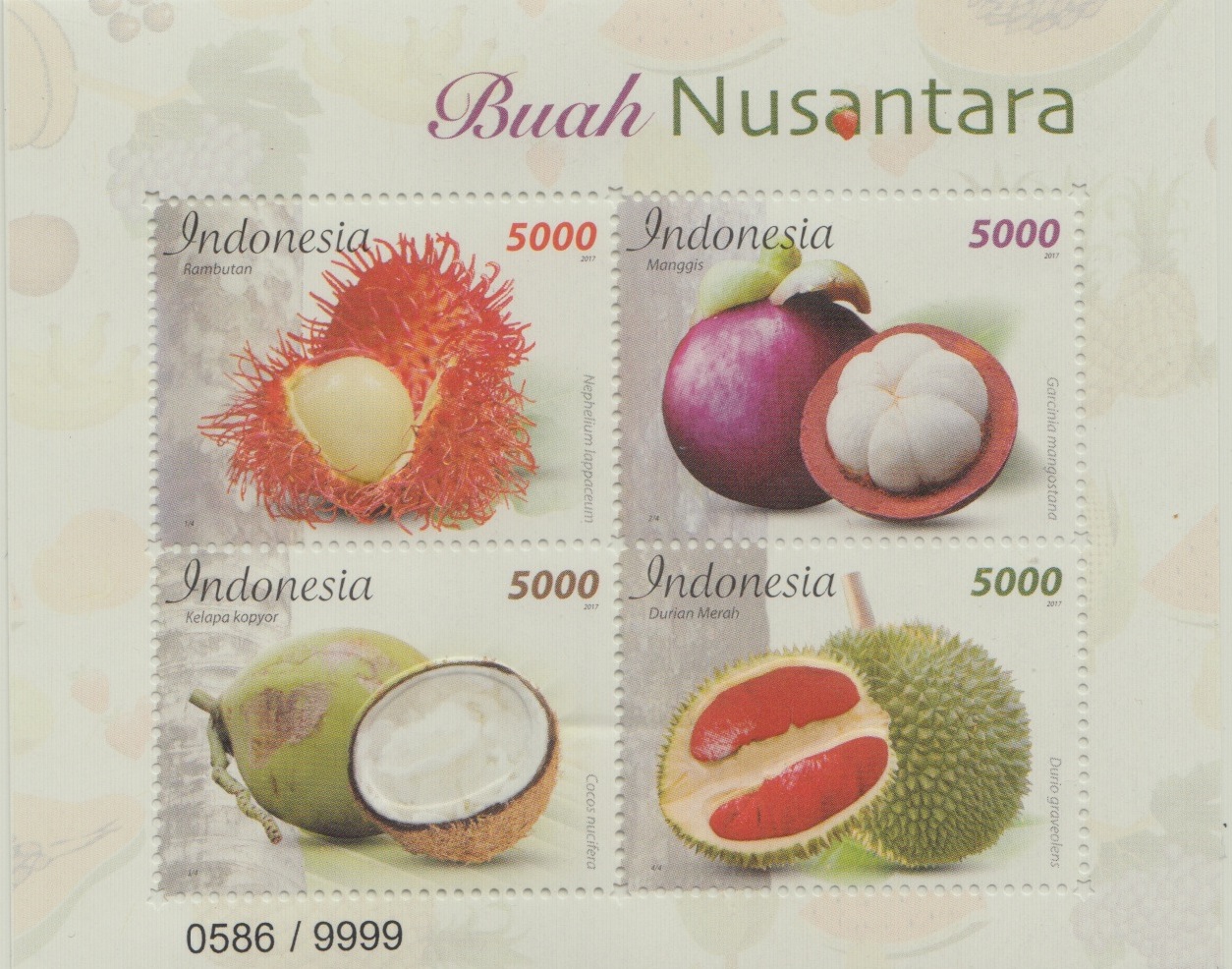
Indonesia - Indonesia Fruits 2017


1. Rambutan
2. Mangosteen
3. Kopyor Coconut
4. Red Durian

Monday, January 22, 2018

Japan - Traditional Dietary Culture of Japan 2017


IssueTraditional Dietary Culture of Japan Series 3
First DayOctober 24, 2017
Value¥82 x 10 (Self-adhesive)
DesignsC2338a - Futomaki (thick rolled sushi)C2338b - Rice ball (with kelp)
C2338c - Rice ball (with pickled plum)C2338d - Rice ball (salmon)
C2338e - Rice ball (with baby sardine)C2338f - Inarizushi
C2338g - Rice ball (with red beans)C2338h - Tempura rice ball
C2338i - Rice ball (sesame and salt)C2338j - Rice ball (with beans)
DesignerHoshiyama Ayaka (stamp designer)
PrintingOffset in 5 colors
Sizea : 27.0 x 27.0mm b-d,g,i : 29.7x27.2mm
e : 33.0 x 20.0mm f : 32.2x20.0mm
h : 29.9 x 27.0mm j : 30.0x30.0mm
Sheet10stamps

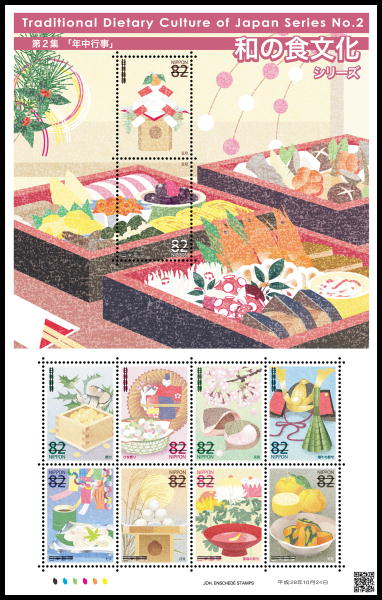
Japan - Traditional Dietary Culture of Japan 2016


IssueTraditional Dietary Culture of Japan Series 2
First DayOctober 24, 2016
Value¥82 x 10
DesignsC2290a - New Year's Holiday1
C2290b - New Year's Holiday2
C2290c - Setsubun(bean-throwing festival)
C2290d - Girl's Festival
C2290e - Cherry-blossom Viewing
C2290f - Boy's Festival
C2290g - Star Festival
C2290h - Full Moon Viewing
C2290i - Chrysanthemum Festival
C2290j - Winter Solstice Festival
DesignerHoshiyama Ayaka(stamp designer)
PrintingOffset in 6 colors
Sizea,b : 28.0 x 38.5mm,vertical
c-j : 25.0 x 35.5mm,vertical
Sheet10stampsSheet

Japan - Traditional Dietary Culture of Japan 2015


IssueTraditional Dietary Culture of Japan Series 1
First DayNovember 24, 2015
Value¥82 x 10
DesignsC2242a - Chestnuts Rice
C2242b - Miso Soup
C2242c - Tempura
C2242d - Rice and Narazuke (pickles)
C2242e - Miso soup and Hijiki no Nimono (simmered hijiki seaweed)
C2242f - Chawanmushi (steamed egg custard)
C2242g - Ajinohimono (dried horse mackerel)
C2242h - Gomokugohan (rice mixed with various ingredients) and Nukazuke
(pickles)
C2242 i - Kenchinjiru (vegetable soup)
C2242 j - Kabocha no nimono (simmered pumpkin) and Hiyayakko
(cold tofu)
DesignerHoshiyama Ayaka (stamp designer)
PrintingOffset in 6 colors
Sizea-b : 28.0mm x 38.5mm vertical
c- j : 25.0mm x 35.5mm vertical
Sheet10 stamps

Thursday, January 11, 2018

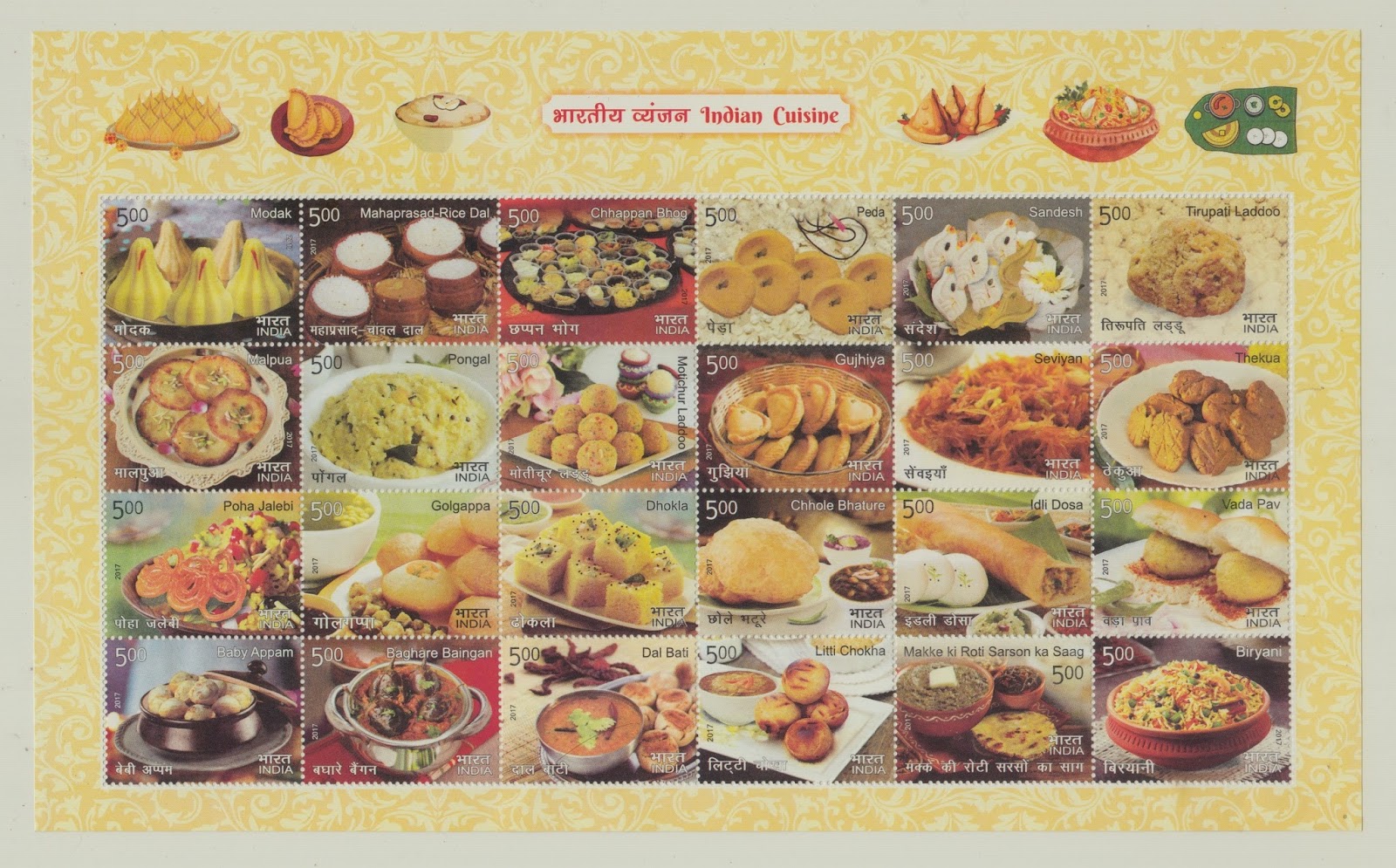
India - Indian Cuisine 2017


INDIAN CUISINE
Indian cuisine encompasses a wide variety of regional and traditional cuisines.  India cuisine reflects  an 8,000 year history ofvarious groups and cultures interacting with the subcontinent, leading to diversity of  flavours and regional cuisines found in modern-day India.  Later, trade with British and Portuguese influence added to the already diverse Indian cuisine.

The cuisine of India is one of the world's most diverse cuisines, characterized by its sophisticated and subtle use of the many spices, vegetables, grains and fruits accross India.  India's religious beliefs and culture have played an influential role in the evolution of its cuisine.  India cuisine is still evolving, as a result of the nation's cultural interactions with other societies.

Department of Posts is pleased to release a set of 24 Commemorative Postage stamps on the following four categories of Indian Cuisines in the form of Sheetlets and Miniature Sheets:

Bhog Prasad:
Some of these dishes are steeped in history while many of these special dishes are part of popular culture.  The recipes of Temple Bhog Prasad's have not changed over a long period of time which is high quality ingredients and large scale cooking.  But, the X-factor is probably the devotion and dedication of cooks at the temple kitchens.  The six types of Bhog Prasad's that are being decipted through postage stamps are Modak, Mahaprasad-Rice Dai, Chhappan Bhog, Peda, Sandesh & Tirupati Laddoo.

Modak is an Indian sweet which has a filling of freshly grated coconut and jaggery while the outer soft shell is made from rice flour or wheat flour mixed with khova or maida flour.  It is considered as favourite sweet of the Hindu deity, Ganesha.

Mahaprasad is the term applied to items offered to Lord Jagannath in the holy Temple of Puri, located in Odisha, India.  It includes different types of rice like ghee rice, mixed rice, cumin seed and ginger rice and Dai like sweet dal, plain dal mixed with vegetables, mixed Dai etc.

Chhappan Bhog means 56 dishes which are offered to deity.  The preparation of 56 different items for the occasion itself is a festival that enriches the culinary capacity of the region with amazing range of items and their variants.

In Mathura, the birthplace of Lord Krishna, "Mathura ke Peda" is the favorite offering.  These are made by cooking together fresh mawa, milk, sugar and ghee with cardamom power for flavour.

Sandesh is a Bengali dessert created with milk and sugar which is commonly known as Sondesh in Bengal.  Some recipes of Sandesh are prepared by chhena or paneer instead of milk itself.

The practice of offering laddoo to Lord Venkateswara at Tirumala Venkateswara Temple was started in 1715.  The items used for making Tirupati Laddoo's are Gram flour, cashew nuts, cardamom, ghee, sugar, sugar candy and raisins.  Tirupati Laddoo got geographical indication tag which entitles that only Tirumala Tirupati Devasthanams can make and sell it.

Festive Cuisine: 
Festivals are the identity of Indian Society.  The zeal of celebration and high spirits of enthusiasm is carried all over the festive season with some delectable festival dishes.  There is a huge variety of dishes prepared on most popular festive occasions in different regions of India.  The six type of Festive Cuisines that are being depicted through postage stamps are Malpua, Pongal, Motichur Laddoo, Gujhiya, Seviyan, & Thekua:

Malpua is a pancake served as a dessert or a snack originating from the India subcontinent.  Malpua is popualr in Odhisa, West Bengal, and Maharashtra where it is served during festivals such as Bhai Dooj, Ganesh Chaturathi, Holi and Raksha Bandhan along with other sweets.

Pongal is a rice dish popular in Tamil Nadu, Andhra Pradesh and Telanggana.  In Tamil "pongal" or in Telugu "pongu" means to "boil over" or "spill over".  In Kannada it is called Huggi.  Every year in January month, Tamils and Telugus celebrate the harvest fesitval Pongal/ Makar Sankranti during which Pongal is made.

Laddoos are the most poopular Indian sweet dish.  No festival or occasion can be considered to be complete without laddoos.  Amongst the enlarged variety of Laddoos, the most popular of all is Motichur Laddoo.  Motichur Laddoo is made from fine boondi where the balls are tiny and is cooked with ghee or oil.

Gujhiya is a sweet dumpling made with Suji/ Maida/ Wheat flour.  It is filled with a mixture of grated and roasted dry fruits, khoya & coconuts.  Gujhiyas are called Purukiya in Bihar.  It is usually prepared and consumed during the festival of Holi.

Seviyan is a traditional Indian sweet where sevai is cooked in milk till it yields a rich and creamy texture.  Seviyan garnished with saffron is usually served on the occasion of Eid.

Thekua is tradiitonal recipe of Bihar and Jharkhand.  It is Sweet to taste, crunchy, and crusty.  Thekua is prepared especially for Chhath puja for offering to god.

Popular Cuisine:
Indian streets are full of its popular cuisines and well famous for tasty food items.  These foods are considered to be favourite as all time snacks for its mouth-watering flavour.  The sic type of Popular Cuisines that are being depicted throught postage stamps are Poha Jalebi, Golgappa, Dhokia, Chhole Bhature, Idli-Dosa & Vada Pav:

Poha-Jalebi is the street food from Indore, Madthya Pradesh where it is usually served with a unique combination of Jalebi, Sev, Usai, sliced onions and tunnel seeds.

Golgappa is a common street snack in several regions of the country.  It consists of  a round, hollow puri, fried crisp and filled with a mixture of flavoured water (commonly known as imii pani), tamarind chutney, chili, chaat masala, potato, onion, and chickpeas.  It is called by different names in different regions such as it is called Panipuri in Maharashtra; paani ke batashe in Haryana, fuiki in Madhya Pradesh; golgappa in Uttar-Pradesh and Delhi; Phuchka in West Bengal and Bihar; Pakodi in Gujarat and Gup Chup in parts of Odisha, South Jharkhand and Chhattisgarh.

Dhokla is a vegetarian food item that originates from Gujarat.  It is made with a fermented  batter derived from rice and chickpeas.  Dhokla can be eaten for breakfast, as a main course, as a side dish, or as a snack.

Chhole Bhature is a combination of chana masala (spicy chickpeas) and fried bread called bhature made from maida flour.  Chhole Bhature is a world famous recipe from Punjabi cuisine.  It is very popular in major urban cities of India.  Delhi is well famous for its chhole bhature, commonly eaten for breakfast or snacks.
Idli-Dosa is a typical part of the South Indian diet and popular all over the Indian subcontinent.  Dosa, a type of pancake, is made from a fermented batter and served hot with sambar, stuffing of potatoes or paneer and chutney.  Idli is a savoury cake that are made by steaming a batter consisting of Urad dai and rice.

Vada Pay is a vegetarian fast food dish native to Maharashtra.  The dish consists of a deep fried potato dumpling placed inside a bread bun 9 pav) sliced almost in half through the middle.  It is generally accompanied with one or more chutneys and a green chili pepper.

Regional Cuisine:
Regional cuisines in India may vary based upon food availability and trade, varying climates, cooking traditions and practices, and cultural diversity.  The cuisine of each geographical region includes a wide assortment of dishes and cooking techniques reflecting the varied demographics of the ethnically diverse Indian subcontinent.  The six types of Regions Cuisines that are being depicted through postage stamps are Baby Appam, Baghare Baingan, Dal Bati, Litti Chokha, Makke Ki Roti Sarson Ka Saag & Biryani:

Baby Appam is a type of pancake made with fermented rice batter and coconut milk.  It is a common food in Kerala and Tamil Nadu.  It is eaten most frequently for breakfast dinner. 

Baghare Baingan is a popular Indian Cuisine of eggplants/ brinjal curry of Hyderabad.  It is also used as a side dish with the Hyderabadi biryani.  Baghare baingan was introduced during Mughal period from Tashkent, then became popular in HHyderabad.

Dal Balti is an Indian dish comprising dal (lentis) and Bati (hard wheat rolls).  It is popular in Rajasthan, Uttar Pradesh and Madhya Pradesh.  Dal is prepared using tur dal, chana dal etc, and Bati is a hard bread made up of wheat flour.

Litti along with chokha, is a complete meal popular in Indian states of Bihar, Jharkhand and parts of Eastern Uttar Pradesh.  It is a dough ball made up of whole wheat flour and stuffed with Sattu (roasted chickpea flour) mixed with herbs and spices and then roasted over coal or cow dung cakes or wood and tossed with lots of ghee.

Sarson Ka Saag is a popular dish from the Punjab regions made from mustard greens and spices.  The dish is regarded as the traditional way to prepare saag and is usually served with Makke ki Roti (unleavened com bread).  It is served with either butter or more traditionally with ghee.

Biryani is a South Asian mixed rice dish with its origin among the Muslims of the Indian subcontinent.  It is generally made with spices, rice, and meat.  Different varieties of biryani developed in Indian states are Mughlai cuisine of Delhi, Awadhi cuisine of Lucknow and Hyderabadi Biryani from Telangana.