Tuesday, May 29, 2018

Romania - Live healthy! Bible Food 2016


Technical Details:
Issue Date: 24 November 2016
Designer: Mihail Vamasescu
Process: Offset
Colours: 4
Size:Stamps size: 48 x 33 mm, 
Minisheet Size: 110 x 120 mm
Values: 1.60 Lei; 4.50 Lei; 8 Lei; 15 Lei

About Live healthy! Bible Food I

“And God said, Behold, I have given you every herb bearing seed, which is upon the face of all the earth, and every tree, in the which is the fruit of a tree yielding seed; to you it shall be for meat.” Genesis 1:29

The Bible gives us plenty of information about healthy foods and nutrition rules. These simple and seemingly modest foods can provide complete food, underlie a healthy diet, and are subject to the "Live Alive!" Postage stamps issue.

Since the tendency to return to nature and, more generally, to natural products, has been undergone in recent years, it is also necessary to adopt a diet that provides complete food for the maintenance of the body's energy, without leading to the weakness of body and soul.

God, addressing the chosen people, says to him, "The Lord your God will take you to a land where he is: wheat, barley, vine, figs and pomegranates; [...] where are the olive trees ... "Deuteronomy 8: 7-9

The use of grain from ancient times is also mentioned in the Bible. In ancient beliefs, the bread had the attribute of a living being, sometimes being even considered the embodiment of God.

Wheat, flour, dough, and bread are loaded with meanings and symbols as old as they are today, being, as the case may be, a sign of joy and abundance. In Biblical times the bread was made of wheat flour or barley. Both grains, rich in vitamins, in pulp and fiber, are symbols of life and rebirth, and are essential and primordial food for both humans and animals.

The fig tree is mentioned several times in the New Testament, but also in the Old Testament. The biblical references to the fig are symbolic and subject to many interpretations.

The Bible attests the value of the nutritional food of the figs, but also of the medical remedy. They can be eaten both fresh and dried and contain a very high level of potassium.

Since ancient times, pomegranate has been used for medicinal purposes because of its amazing properties. Parenthood was and is considered a symbol of health, fertility and eternal life.

Rich in antioxidants, these fruits, which have been attributed to curative qualities since antiquity, help to improve blood circulation and strengthen the immune system. Pomegranates are used as an ingredient for beverages or dishes in many countries, and pomegranate flowers are used in traditional medicine for their astringent effect.

People around the world, the vine is a symbol of life, health, and especially of joy. In the Bible, we come across many references to vine and wine, all of which have deep meanings, loaded with symbols.

In Christian worship, grape wine, transformed into the Divine Liturgy, into the Blood of Christ represents the source of life.

Wine, alongside bread, honey and oil, is considered a basic food, a symbol of wealth. 

Besides the very good taste, grapes are wonderful foods for the body. Vitamins and minerals make grapes an option that is beneficial to health and therefore it is advisable to consume them as often as possible.

Olive is considered to be the "everlasting tree", being a tree of extraordinary life, with an amazing regenerative power, remaining a symbol of peace, wisdom and purity over time. 

Considered some of the most nutritious fruits, olives are also true medicines. Olive, green, fleshy berries, which become black-purple when ripe, contain little carbohydrate, being an excellent source of monounsaturated fatty acids. That's why they can be a delicious and delicious snack, but they can also be used as ingredients for different meals. 

Since olive oil produces a rich and viscous oil that can be burned in lamps for religious rituals, the olive was considered sacred. Used daily in the diet, olive oil reduces the risk of heart disease and is also recommended in slimming belts. 

Romfilatelia thanks the Episcopate of Alexandria and Teleorman and Mr. photographer George Avanu for his support in the realization of this postage stamp issue.

Belgium - Belgian Beer Culture 2018


Technical Details:
Issue Date: 29 January 2018
Colours: 4 Colours
Layout: Leen De Pooter
Format of the Stamps: 40mm x 30mm, 40mm x 50mm
Size of the Leaf: 186mm x 152mm
Classification of the Leaf: 5 stamps
Paper: Gummed white FSC
Perforations: 11 1/2
Printing Process: Offset
Repro and Printing: Bpost Philately & Stamps Printing
Values: € 7,60

About Belgian Beer Culture
Evocation of beer : foam and bubbles

At the end of 2016, beer culture in Belgium was recognized as an intangible cultural heritage by Unesco. The unparalleled diversity of the brewing art and the intensity of the beer culture make it one of the identity and heritage of Belgium.

Slovenia - 110th Anniversary of Donat Mg Natural Mineral Water 2018


Technical Details: 
Issue Date: 25 May 2018
Designer: Ariana Noršić
Printer: Agencija za komercijalnu djelatnost d.o.o., Zagreb, Hrvaška / Croatia / Kroatien
Process: Offset
Colours: 4 Colours
Size: 29.82 x 42.60 mm
Values: €0.48

110th ANNIVERSARY OF DONAT Mg NATURAL MINERAL WATER 

This year marks exactly 110 years since Dr Josef Knett, a hydrogeologist from Karlovy Vary, discovered a new source of highly mineralised water in the spa park at Rogaška Slatina, while searching for new springs of natural mineral water. It was given the name Donat after the nearby Donačka Gora ("Mount Donatus"). 

The importance of the springs here is also apparent from the fact that one of them appeared in as early as the twelfth century, more precisely in 1141, and was described as a boundary marker in a deed on the transfer of estates. 

Natural mineral water is part of our natural heritage and also has a special legally defined status. Among the just over 2,000 recognised types of natural mineral water in the European Union, Donat Mg has the largest quantity of dissolved mineral substances (13 g/L) and the highest magnesium content (1 g/L). Precisely because of the unique qualities of Donat Mg, Rogaška is the only spa in Slovenia – and indeed the wider central European region – specialising in the prevention, follow-up treatment and rehabilitation of disorders of the digestive system and metabolic disorders. 

The development of the spa has also affected other sectors of the economy. Over the years Rogaška Slatina has become the largest and economically most developed settlement in the Sotla Valley, and an important municipality. Today Rogaška Slatina is known throughout Europe and Central Asia – thanks to Donat Mg natural mineral water, which Atlantic Grupa exports to almost every country in Europe. 

Aljaž Čoh

Saturday, May 26, 2018

Ireland - The Food Island 2015


On the 16th of July 2015, An Post issued four stamps recognising the importance of Ireland’s Agri-Food industry.

The manufacture of food and drink products is very important to Ireland’s economy and is our main indigenous industry in terms of direct economic activity. The sector has a gross annual turnover of approximately €25 billion and directly employs over 45,000 people on a fulltime basis. Approximately 230,000 people, or one in eight jobs in the economy, are linked to agri food, when agriculture and ancillary employment is included.

The Agri-Food sector accounts for half of purchased Irish goods and services by the manufacturing industry and just over half of exports by indigenous manufacturing industries.

Ireland has a great reputation all around the world for the quality of its food production, processing and preparation. We export food and drink to 175 countries and in 2012 this value surpassed €9 billion for the first time. The target is €12bn by 2020 and this looks very probable, according to projections in the Food Harvest report.

Sustainability is the keyword and a major priority for producers as their key customers want to align themselves with sustainable supply chains. Origin Green, a national sustainability programme initiated by Bord Bia – The Irish Food Board - is designed to help Ireland to become a world leader in sustainably produced food.

These four stamps were designed by Zinc Design Consultants and highlight Ireland’s excellence in food production, processing and preparation. The two 70 cent stamps feature a beef farmer and a cheesemaker and their products while the €1.05 stamps depict a fisherman and a tillage farmer alongside their quality produce.

Sunday, May 20, 2018

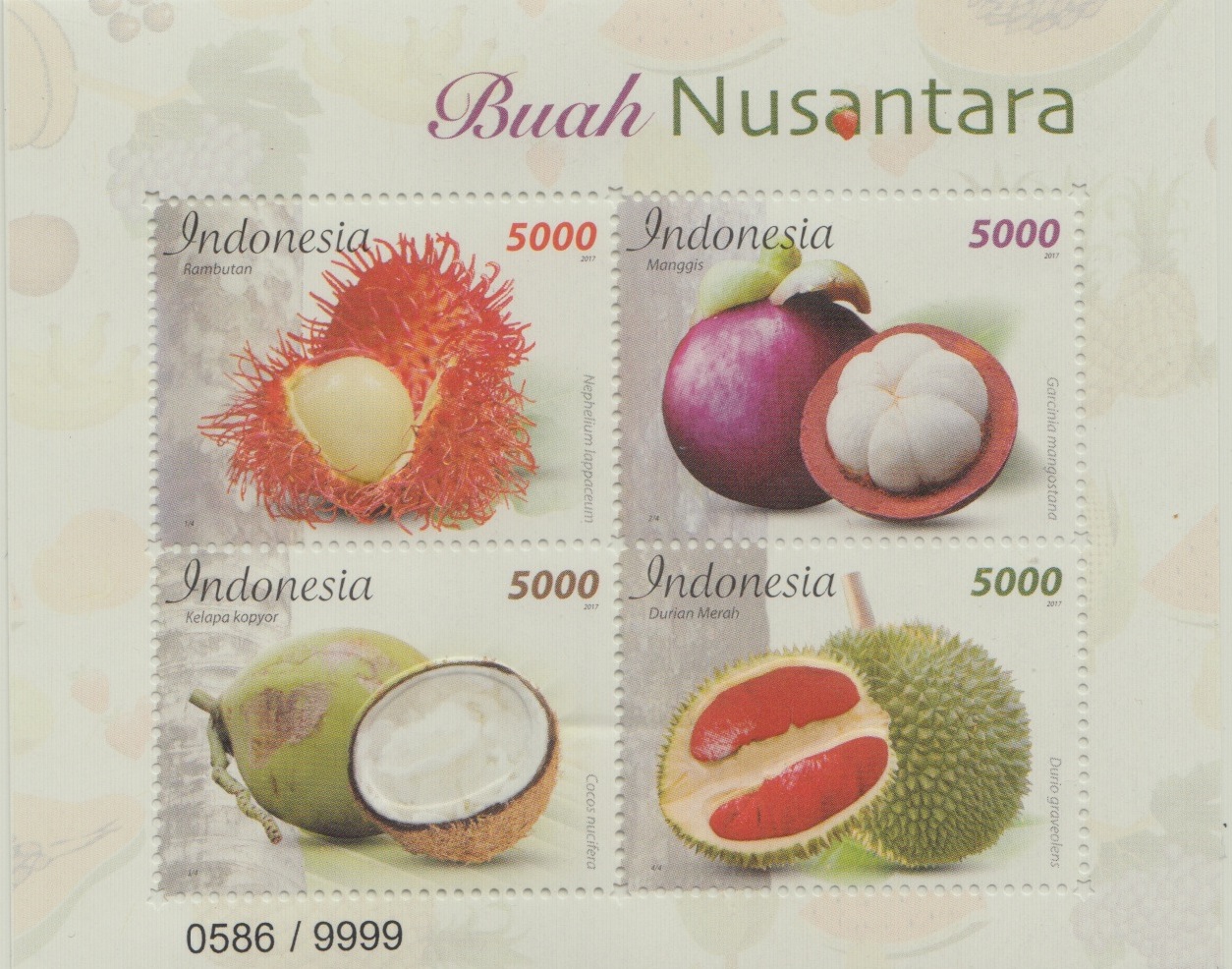
Indonesia - Indonesia Fruits 2017


1. Rambutan
2. Mangosteen
3. Kopyor Coconut
4. Red Durian

Monday, January 22, 2018

Japan - Traditional Dietary Culture of Japan 2017


IssueTraditional Dietary Culture of Japan Series 3
First DayOctober 24, 2017
Value¥82 x 10 (Self-adhesive)
DesignsC2338a - Futomaki (thick rolled sushi)C2338b - Rice ball (with kelp)
C2338c - Rice ball (with pickled plum)C2338d - Rice ball (salmon)
C2338e - Rice ball (with baby sardine)C2338f - Inarizushi
C2338g - Rice ball (with red beans)C2338h - Tempura rice ball
C2338i - Rice ball (sesame and salt)C2338j - Rice ball (with beans)
DesignerHoshiyama Ayaka (stamp designer)
PrintingOffset in 5 colors
Sizea : 27.0 x 27.0mm b-d,g,i : 29.7x27.2mm
e : 33.0 x 20.0mm f : 32.2x20.0mm
h : 29.9 x 27.0mm j : 30.0x30.0mm
Sheet10stamps

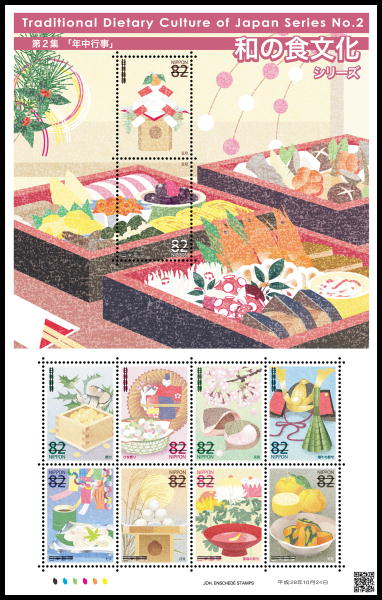
Japan - Traditional Dietary Culture of Japan 2016


IssueTraditional Dietary Culture of Japan Series 2
First DayOctober 24, 2016
Value¥82 x 10
DesignsC2290a - New Year's Holiday1
C2290b - New Year's Holiday2
C2290c - Setsubun(bean-throwing festival)
C2290d - Girl's Festival
C2290e - Cherry-blossom Viewing
C2290f - Boy's Festival
C2290g - Star Festival
C2290h - Full Moon Viewing
C2290i - Chrysanthemum Festival
C2290j - Winter Solstice Festival
DesignerHoshiyama Ayaka(stamp designer)
PrintingOffset in 6 colors
Sizea,b : 28.0 x 38.5mm,vertical
c-j : 25.0 x 35.5mm,vertical
Sheet10stampsSheet

Japan - Traditional Dietary Culture of Japan 2015


IssueTraditional Dietary Culture of Japan Series 1
First DayNovember 24, 2015
Value¥82 x 10
DesignsC2242a - Chestnuts Rice
C2242b - Miso Soup
C2242c - Tempura
C2242d - Rice and Narazuke (pickles)
C2242e - Miso soup and Hijiki no Nimono (simmered hijiki seaweed)
C2242f - Chawanmushi (steamed egg custard)
C2242g - Ajinohimono (dried horse mackerel)
C2242h - Gomokugohan (rice mixed with various ingredients) and Nukazuke
(pickles)
C2242 i - Kenchinjiru (vegetable soup)
C2242 j - Kabocha no nimono (simmered pumpkin) and Hiyayakko
(cold tofu)
DesignerHoshiyama Ayaka (stamp designer)
PrintingOffset in 6 colors
Sizea-b : 28.0mm x 38.5mm vertical
c- j : 25.0mm x 35.5mm vertical
Sheet10 stamps

Thursday, January 11, 2018

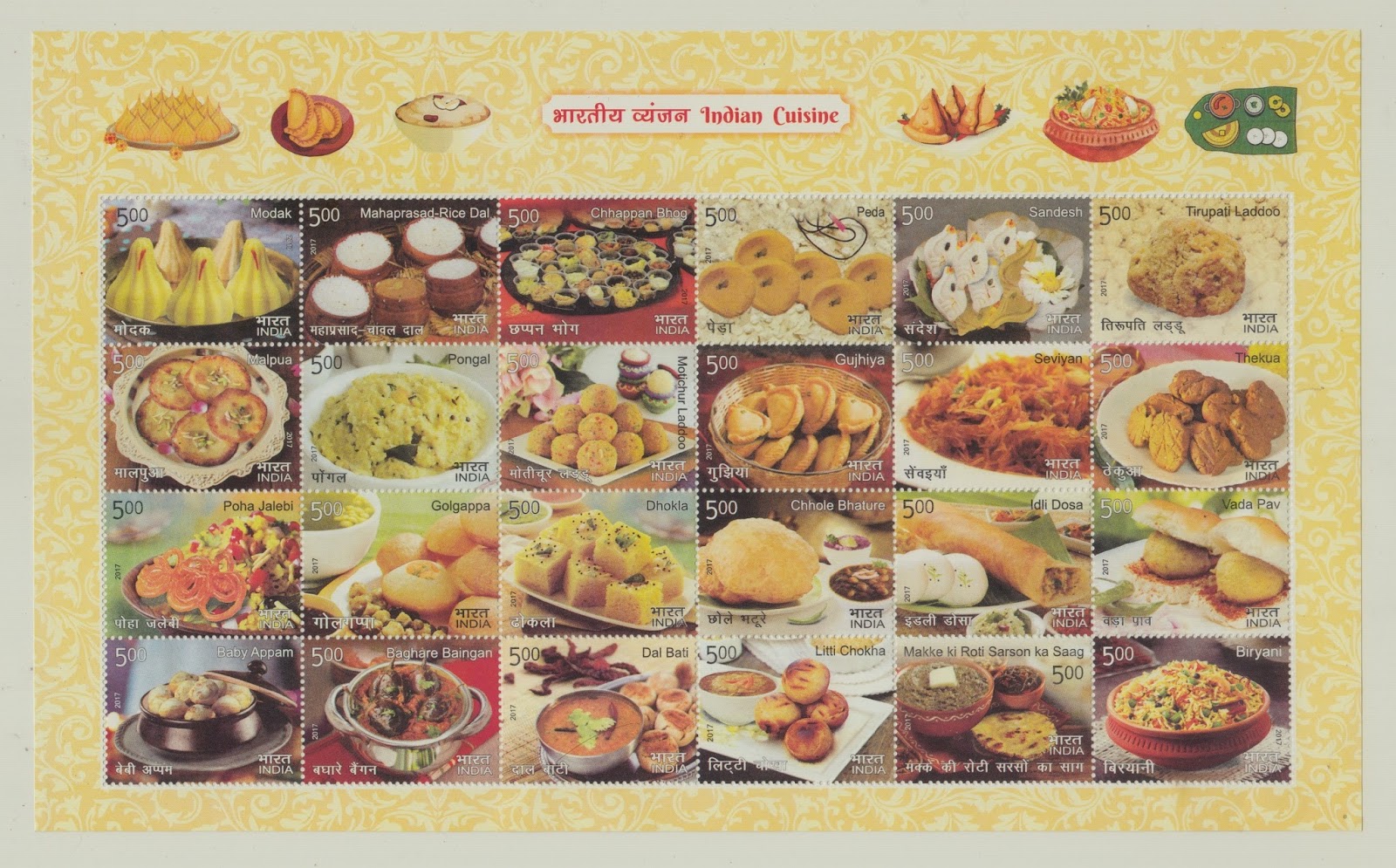
India - Indian Cuisine 2017


INDIAN CUISINE
Indian cuisine encompasses a wide variety of regional and traditional cuisines.  India cuisine reflects  an 8,000 year history ofvarious groups and cultures interacting with the subcontinent, leading to diversity of  flavours and regional cuisines found in modern-day India.  Later, trade with British and Portuguese influence added to the already diverse Indian cuisine.

The cuisine of India is one of the world's most diverse cuisines, characterized by its sophisticated and subtle use of the many spices, vegetables, grains and fruits accross India.  India's religious beliefs and culture have played an influential role in the evolution of its cuisine.  India cuisine is still evolving, as a result of the nation's cultural interactions with other societies.

Department of Posts is pleased to release a set of 24 Commemorative Postage stamps on the following four categories of Indian Cuisines in the form of Sheetlets and Miniature Sheets:

Bhog Prasad:
Some of these dishes are steeped in history while many of these special dishes are part of popular culture.  The recipes of Temple Bhog Prasad's have not changed over a long period of time which is high quality ingredients and large scale cooking.  But, the X-factor is probably the devotion and dedication of cooks at the temple kitchens.  The six types of Bhog Prasad's that are being decipted through postage stamps are Modak, Mahaprasad-Rice Dai, Chhappan Bhog, Peda, Sandesh & Tirupati Laddoo.

Modak is an Indian sweet which has a filling of freshly grated coconut and jaggery while the outer soft shell is made from rice flour or wheat flour mixed with khova or maida flour.  It is considered as favourite sweet of the Hindu deity, Ganesha.

Mahaprasad is the term applied to items offered to Lord Jagannath in the holy Temple of Puri, located in Odisha, India.  It includes different types of rice like ghee rice, mixed rice, cumin seed and ginger rice and Dai like sweet dal, plain dal mixed with vegetables, mixed Dai etc.

Chhappan Bhog means 56 dishes which are offered to deity.  The preparation of 56 different items for the occasion itself is a festival that enriches the culinary capacity of the region with amazing range of items and their variants.

In Mathura, the birthplace of Lord Krishna, "Mathura ke Peda" is the favorite offering.  These are made by cooking together fresh mawa, milk, sugar and ghee with cardamom power for flavour.

Sandesh is a Bengali dessert created with milk and sugar which is commonly known as Sondesh in Bengal.  Some recipes of Sandesh are prepared by chhena or paneer instead of milk itself.

The practice of offering laddoo to Lord Venkateswara at Tirumala Venkateswara Temple was started in 1715.  The items used for making Tirupati Laddoo's are Gram flour, cashew nuts, cardamom, ghee, sugar, sugar candy and raisins.  Tirupati Laddoo got geographical indication tag which entitles that only Tirumala Tirupati Devasthanams can make and sell it.

Festive Cuisine: 
Festivals are the identity of Indian Society.  The zeal of celebration and high spirits of enthusiasm is carried all over the festive season with some delectable festival dishes.  There is a huge variety of dishes prepared on most popular festive occasions in different regions of India.  The six type of Festive Cuisines that are being depicted through postage stamps are Malpua, Pongal, Motichur Laddoo, Gujhiya, Seviyan, & Thekua:

Malpua is a pancake served as a dessert or a snack originating from the India subcontinent.  Malpua is popualr in Odhisa, West Bengal, and Maharashtra where it is served during festivals such as Bhai Dooj, Ganesh Chaturathi, Holi and Raksha Bandhan along with other sweets.

Pongal is a rice dish popular in Tamil Nadu, Andhra Pradesh and Telanggana.  In Tamil "pongal" or in Telugu "pongu" means to "boil over" or "spill over".  In Kannada it is called Huggi.  Every year in January month, Tamils and Telugus celebrate the harvest fesitval Pongal/ Makar Sankranti during which Pongal is made.

Laddoos are the most poopular Indian sweet dish.  No festival or occasion can be considered to be complete without laddoos.  Amongst the enlarged variety of Laddoos, the most popular of all is Motichur Laddoo.  Motichur Laddoo is made from fine boondi where the balls are tiny and is cooked with ghee or oil.

Gujhiya is a sweet dumpling made with Suji/ Maida/ Wheat flour.  It is filled with a mixture of grated and roasted dry fruits, khoya & coconuts.  Gujhiyas are called Purukiya in Bihar.  It is usually prepared and consumed during the festival of Holi.

Seviyan is a traditional Indian sweet where sevai is cooked in milk till it yields a rich and creamy texture.  Seviyan garnished with saffron is usually served on the occasion of Eid.

Thekua is tradiitonal recipe of Bihar and Jharkhand.  It is Sweet to taste, crunchy, and crusty.  Thekua is prepared especially for Chhath puja for offering to god.

Popular Cuisine:
Indian streets are full of its popular cuisines and well famous for tasty food items.  These foods are considered to be favourite as all time snacks for its mouth-watering flavour.  The sic type of Popular Cuisines that are being depicted throught postage stamps are Poha Jalebi, Golgappa, Dhokia, Chhole Bhature, Idli-Dosa & Vada Pav:

Poha-Jalebi is the street food from Indore, Madthya Pradesh where it is usually served with a unique combination of Jalebi, Sev, Usai, sliced onions and tunnel seeds.

Golgappa is a common street snack in several regions of the country.  It consists of  a round, hollow puri, fried crisp and filled with a mixture of flavoured water (commonly known as imii pani), tamarind chutney, chili, chaat masala, potato, onion, and chickpeas.  It is called by different names in different regions such as it is called Panipuri in Maharashtra; paani ke batashe in Haryana, fuiki in Madhya Pradesh; golgappa in Uttar-Pradesh and Delhi; Phuchka in West Bengal and Bihar; Pakodi in Gujarat and Gup Chup in parts of Odisha, South Jharkhand and Chhattisgarh.

Dhokla is a vegetarian food item that originates from Gujarat.  It is made with a fermented  batter derived from rice and chickpeas.  Dhokla can be eaten for breakfast, as a main course, as a side dish, or as a snack.

Chhole Bhature is a combination of chana masala (spicy chickpeas) and fried bread called bhature made from maida flour.  Chhole Bhature is a world famous recipe from Punjabi cuisine.  It is very popular in major urban cities of India.  Delhi is well famous for its chhole bhature, commonly eaten for breakfast or snacks.

Idli-Dosa is a typical part of the South Indian diet and popular all over the Indian subcontinent.  Dosa, a type of pancake, is made from a fermented batter and served hot with sambar, stuffing of potatoes or paneer and chutney.  Idli is a savoury cake that are made by steaming a batter consisting of Urad dai and rice.

Vada Pay is a vegetarian fast food dish native to Maharashtra.  The dish consists of a deep fried potato dumpling placed inside a bread bun 9 pav) sliced almost in half through the middle.  It is generally accompanied with one or more chutneys and a green chili pepper.

Regional Cuisine:
Regional cuisines in India may vary based upon food availability and trade, varying climates, cooking traditions and practices, and cultural diversity.  The cuisine of each geographical region includes a wide assortment of dishes and cooking techniques reflecting the varied demographics of the ethnically diverse Indian subcontinent.  The six types of Regions Cuisines that are being depicted through postage stamps are Baby Appam, Baghare Baingan, Dal Bati, Litti Chokha, Makke Ki Roti Sarson Ka Saag & Biryani:

Baby Appam is a type of pancake made with fermented rice batter and coconut milk.  It is a common food in Kerala and Tamil Nadu.  It is eaten most frequently for breakfast dinner. 

Baghare Baingan is a popular Indian Cuisine of eggplants/ brinjal curry of Hyderabad.  It is also used as a side dish with the Hyderabadi biryani.  Baghare baingan was introduced during Mughal period from Tashkent, then became popular in HHyderabad.

Dal Balti is an Indian dish comprising dal (lentis) and Bati (hard wheat rolls).  It is popular in Rajasthan, Uttar Pradesh and Madhya Pradesh.  Dal is prepared using tur dal, chana dal etc, and Bati is a hard bread made up of wheat flour.

Litti along with chokha, is a complete meal popular in Indian states of Bihar, Jharkhand and parts of Eastern Uttar Pradesh.  It is a dough ball made up of whole wheat flour and stuffed with Sattu (roasted chickpea flour) mixed with herbs and spices and then roasted over coal or cow dung cakes or wood and tossed with lots of ghee.

Sarson Ka Saag is a popular dish from the Punjab regions made from mustard greens and spices.  The dish is regarded as the traditional way to prepare saag and is usually served with Makke ki Roti (unleavened com bread).  It is served with either butter or more traditionally with ghee.

Biryani is a South Asian mixed rice dish with its origin among the Muslims of the Indian subcontinent.  It is generally made with spices, rice, and meat.  Different varieties of biryani developed in Indian states are Mughlai cuisine of Delhi, Awadhi cuisine of Lucknow and Hyderabadi Biryani from Telangana.

Tuesday, December 26, 2017

Spain - Spanish Capital of Gastronomy 2015


Date of issue: 28 January 2015
Printing Procedure: Offset
Paper: Gummed
Seal size: 57.60 mm x 40.90 mm
Size of Sheet: 150 mm x 105.60 mm
Postal value of stamps: € 0.90 each stamp
Block turnover: 220,000

With images that invite the tasting and the delight of the palate, the series Gastronomy Española is broadcast in a leaf-block format, with two stamps that highlight the gastronomic titles of Vitoria and Cáceres.

Vitoria-Gasteiz has held the title of Spanish Capital of Gastronomy in 2014. The birthplace of great chefs and the headquarters of some of the most important training centers in the Basque Country, the capital of Alava has a hotel sector covering more than 300 restaurants and 1,200 bars and cafes. Its cuisine is based mainly on seasonal products, which give rise to traditional dishes and other more imaginative of the so-called "new Basque cuisine." Typical of this land, as well as the rest of the Basque Country and Navarre, are the gastronomic societies, which prove that the culinary art transcends from the stoves to social life. These societies were created in the mid-nineteenth century for the exclusive use of men. At present they have been accommodating to gender equality and admit women.

Among the types of gastronomic shops that are located in Vitoria-Gasteiz are: the bakeries and workshops, with exclusive sweets from the capital of Álava, such as the basquitos and nesquitas; the delicatessen shops, with specialties of preserves, cheeses and charcuterie, and the enotecas, with the txakolis and the wines of the Rioja Alavesa.

In 2015, the title of Spanish Capital of Gastronomy is held by Cáceres. The choice was made by a jury, composed of 12 professionals from the hotel, tourism and journalism, who highlighted "the importance and variety of agro-food products" of this land. With eight appellations of origin and two protected geographical indications, the products of Caceres present in common the quality, the natural origin and the traditional elaboration that has lasted over time. Casar cheese cheeses, Ibores cheeses, paprika de la Vera, and Iberian hams and sausages from dehesas are some of the genuine products of the region.

In the seals they present, respectively, a bar of varied pinchos characteristic of Vitoria, Capital of the Gastronomy 2014; and a still life of typical products of Cáceres, Capital of Gastronomy in 2015. The images are prolonged in the block sheet giving continuity to the composition.

Yolanda Estefanía. Library of the Postal and Telegraphic Museum

Spain - Gastronomy, Protected Designation of Origin of Galicia 2015


Date of issue: 25 September 2015
Printing Procedure: Offset
Paper: Gummed
Stamp Size: 40.90 mm x 28.80 mm
Size of Sheet: 133.00 mm x 99.00 mm
Value of Stamps: € 1 each stamp
Block turnover: 220, 000

A new theme dedicated to Protected Designations of Origin (PDO) is initiated, which disseminates those products that have that nomination. The broadcast will continue in the coming years and, on this occasion, is dedicated to Galicia and the"Pemento de Herbón" and the "Mexillón de Galicia / Mejillón de Galicia" . Both products are reproduced in the block sheet and in the two seals that form it.

"Some stings and others do not", say of the well-known Pimientos de Padrón . It all depends on the amount of capsaicin they contain, which is the component that provides the most spicy. This small green fruit was recognized with the Protected Designation of Origin on July 1, 2009 as Pemento de Herbón . Its production is limited to an area of ​​the Atlantic slope that includes a set of valleys of low altitude, delimited by the Ulla and Sar rivers, and protected by several mountain ranges that isolate the area and provide the suitable climate for the crop. This variety of pepper was introduced by the Franciscan monks of the convent of San Antonio de Herbón, of Padrón City Council, in the 17th century, who brought the seeds from the Mexican state of Tabasco and started their cultivation.

The Galician Mussel / Galician Mussel , rich in minerals (iron, phosphate and zinc) and in vitamins, is a mollusk of appreciated gastronomic flavor that admits multiple recipes. The Galician Mussel Regulatory Council began its activities in 1994 with the aim of promoting the quality of this product so well known today. Due to its geographical location, the Galician estuaries constitute a special environment for mussel farming, since they concentrate an important source of nutrients caused by the confluence of ocean and river currents. The culture of the mollusk is done in rafts and, practically, most of the producers and of the companies that commercialize the mussel, both fresh and processed, are attached to the Denomination of Origin.

In 1945 the first punt was anchored in the Ría de Arousa. A few years later it became a cultivation of great development in the world of aquaculture, being one of the most important economic resources for the people of the area.

Yolanda Estefanía. Library of the Postal and Telegraphic Museum

Spain - Gastronomy, Protected Designation of Origin of Castilla la Mancha 2016


Date of Issue: 09 June 2016
Printing Procedure: Offset
Paper: Gummed
Stamp Size: 40.90 mm x 28.80 mm
Size of Sheet: 133.00 mm x 99.00 mm
Value of the stamps: 1.30 € each reason
Block turnover: 200,000

To say that a product has a "denomination of origin" means that it is subject to localized production in a specific area, with unique environmental characteristics and from which limited units are generated.

Producers who benefit from the designation of origin, are committed to maintaining product quality as high as possible and follow production protocols.

There are regulatory bodies that monitor compliance with the rules and authorize the display of the corresponding label that grants that category.

This year Correos continues with the series Gastronomy and issues a block sheet dedicated to the Protected Designation of Origin of Castilla la Mancha , where the Manchego cheese and saffron are the protagonists.

Manchego cheese . Manchego cheese is made with sheep's milk of the Manchego breed that feeds on grass throughout the year. It is subjected to a minimum maturation of 30 days for small cheeses, and 60 days for larger cheeses. It is done well with pasteurized milk or raw milk, although in the latter case, it must be labeled as "artisan". It is a pressed cheese, hard crust and firm and compact, with a color ranging from white to yellow. Its smell is intense and easy to identify. Its taste is something acidic, strong and very characteristic.

The saffron of La Mancha. The saffron comes from the stigmas of the flower that bears the same name after drying them through a process of roasting over low heat. It was introduced by the Arabs in the Iberian Peninsula around the 11th century. The first written reference on this product, dates from the year 1720.

The importance of saffron in Castilla la Mancha is reinforced by works of a pedagogical nature such as Jiménez Martín's practical azafranero, and has even given rise to a vocabulary of his own collected in works such as The Lexicon of Saffron in La Mancha speech. Saffron from La Macha is considered the best in Spain and one of the best in the world.

Spain - Toledo, Spanish Capital of Gastronomy 2016


Date of issue: 20 January 2016
Printing Procedure: Offset
Paper: Gummed
Seal size: 57.60 mm x 40.90 mm
Value of the stamps: EUR 0.57 
Production: 220,000

Toledo has been elected Spanish Capital of Gastronomy during 2016, year in which, in addition, the 30th anniversary of its declaration as a World Heritage City and the 400th anniversary of the death of Cervantes is commemorated.

The Capital of Gastronomy choice has been based, above all, on the creative combination between heritage, culture and gastronomy, which is full of mixed recipes and inheritance of the three cultures that coexisted for centuries: the Jewish, the Christian and the Muslim

The cuisine of the imperial capital was already praised historically by the greatest writers such as Cervantes or Pérez Galdós, even by foreign authors such as Alexandre Dumas or Theophile Gautier. It was in Toledo also where the first cooking treat in Spanish was published, Libro de Guisados , by Ruperto Nola, in the year 1529.

Its cuisine is nourished by simple and humble products, which give rise to recipes such as stew, porridge, crumbs or pot. Among its typical dishes is hunting, both stews and pickles. It has a great wine tradition worthy of three Designations of Origin, such as La Mancha, Méntrida and Uclés.

One of the products of La Mancha known worldwide is Manchego cheese, made with sheep's milk native to the community and very present in the menus of Toledo.

Toledo presumes, in addition, to be the birthplace of great chefs that shine in its Michelin Stars restaurants and that elaborate a modern cuisine that is reinvented from tradition, local products and a unique heritage.

The current issue includes the image of marzipan, a typical Toledan sweet, much appreciated at Christmas, with a Protected Geographical Indication and which has been produced since the 8th century. Its main ingredients are sugar and almond, marcona or largueta.

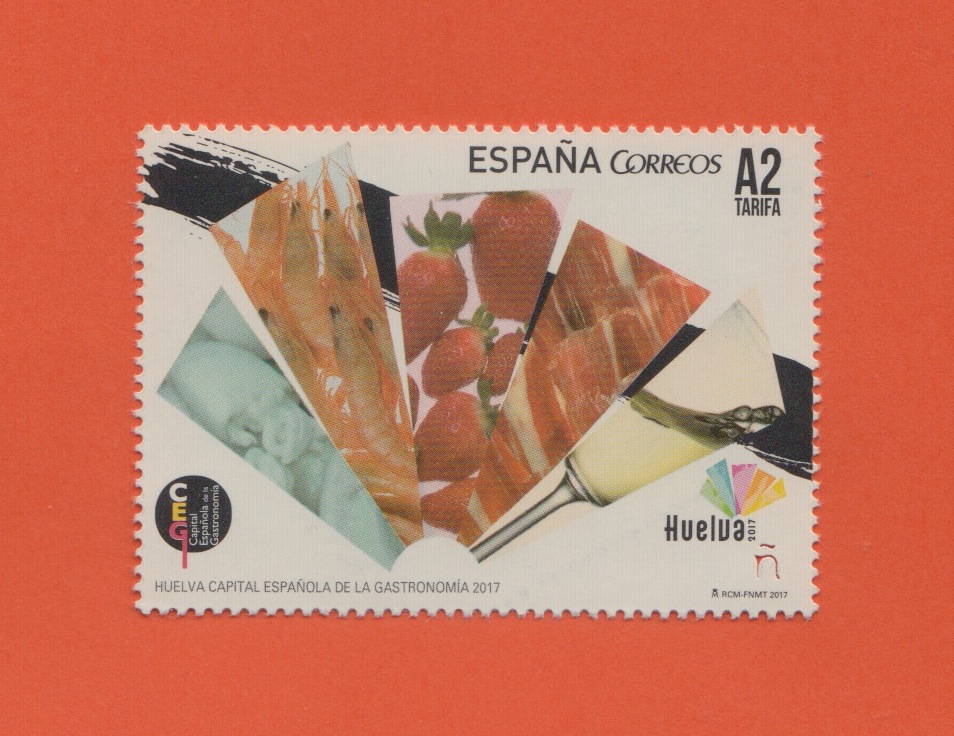
Spain - Huelva, Spanish Capital of Gastronomy 2017


Technical Details:
Issue Date: 20 January 2017
Printer: Offset
Size: 57.60 mm x 40.90 mm
Values: Tarifa A2

About Huelva - Spanish Capital of Gastronomy 2017:

As in previous years, a province of our country has been chosen as the Spanish Capital of Gastronomy during 2017. This year, Huelva has been selected.

For the first time a coastal province has been chosen. The jury has recognized the cuisine of the sea, all those products that every morning arrive in boats to the market where they are selected to become exquisite dishes.

We can not stop talking about white shrimp, coquinas and puntillitas, or cuttlefish, a select ingredient to prepare dishes such as meatballs.

But Huelva is not only sea, also, its products of interior like the ham of Jabugo, the slaughterings of the Mountain range of Aracena; Also the famous strawberries known in the whole world.

The vegetable garden offers us typical dishes like chickpeas with spinach, beans "enzapatás" or the game dishes and mushrooms of the area as the gurumelos.

But not everything is to eat, Huelva also has wines worthy of mention as the Orange Wine of the County of Huelva that owns the Denomination of Origin.

The pastries also give us irresistible recipes such as chestnut stew, "pulleys" or snowy eggs.

For all this and much more, Huelva deserves to carry throughout the year the title of gastronomic capital of Spain around the world, and Correos, by dedicating a stamp to this event, as in previous years, intends to spread our gastronomy through a stamp that can travel and be showcase and promotion of the same.

The stamp that is issued, includes the image of the logo of Huelva Spanish Capital of Gastronomy 2017, which forms a fan with some of the typical products of the place: choco, ham, strawberries, prawns and wine. On a white background, these products take all the protagonism on a trace of black ink, sepia, that always gives a touch of elegance to the dishes.

Tuesday, November 21, 2017

Netherlands - Dutch Treat 2017


Dutch Treat
On the stamp sheetlet 'Dutch Treats "the following typical Dutch treats are shown: Bossche bulb, Limburg flan, Drents Krumkake, Frisian sugar, Zwolle balls, Gouda stroopwafel, Zeeland bolus, Groningen eierbal, Amsterdam onion and Tielse fairground cake. Most foods are also outside the area of ​​origin for sale, but some do not. So Zwolle balls are available in the city of origin. The ten treats are chosen in consultation with the Knowledge Intangible Heritage Netherlands in Utrecht. The ten treats with full-screen color photos appear Dutch delicacies on the stamp. Each delicacy is held in the picture with one or two hands, in most cases combined with a dish, plate, bowl, cloth, box or jar. The person behind it is visible, but not pictured recognizable. All pictures run through the tabs above and below the stamps. Each delicacy is depicted in the center of the picture and each stamp has been given his own background color. On the tabs in addition to the postage stamps is a brief description. The stamps itself is listed right below the name of the delicacy. The font used is the Neutraface, designed by Christian Schwartz of House Industries from 2002. The stamps itself is listed right below the name of the delicacy. The font used is the Neutraface, designed by Christian Schwartz of House Industries from 2002. The stamps itself is listed right below the name of the delicacy. The font used is the Neutraface, designed by Christian Schwartz of House Industries from 2002.

Stamp Size: 36 x 25 mm
Perforation: 36 x 25 mm
Paper: Normal with phosphor tagging Gum Synthetic, Printing Synthetic
Circulation: 130,000 sheetlets
Printing House: Joh. Enschedé Security Print, Haarlem
Print Colors Stamp: Yellow, Magenta, Cyan and Black

About The Design
The ten treats are depicted using colour photos that fill the Dutch Treats stamp sheetlets. Each treat is photographed held in one or two hands, mostly in combination with a dish, plate, cloth, box or pot. The person behind the treat is visible, but not recognisably so. All the photos overlap onto the tabs above and below the stamps. Each treat is depicted in the centre of the photo and each stamp has been given a different background colour. The tabs next to the stamps contain a brief description. The name of the treat is given in the bottom right-hand corner of each stamp. The font used is Neutraface, a design by Christian Schwartz for House Industries dating from 2002.

About The Designer
Joost Overbeek of studio Overburen in Amsterdam lives in Arnhem. He therefore thought it a great shame that Arnhemse meisjes - very sugary hard biscuits - were not included. Joost: “That was the only fly in the ointment. Otherwise it was a really fun job. We were given a great deal of flexibility in coming up with our own-style design. The only proviso was that we included the ten treats on the list compiled in conjunction with the Dutch Centre for Intangible Cultural Heritage.”

The Dutch Treats stamp sheetlet was designed by Joost together with his colleagues Ayla Maagdenberg and Maarten Geurink. All three feature on the stamps themselves, as models each presenting a different treat. “The other seven are people who happened to visit us during the photo sessions,” says Joost. “Ayla took the photos here in the studio. Just using daylight. When we thought about the concept, we quickly came up with the idea of doing something using hands. The treats themselves are not that photogenic. Incidentally, we did try out some alternative ideas. Such as having people talking about the treat in the local dialect in a speech bubble. Great fun, but it didn’t work. The treat became too small.”

Most of the treats can be bought in supermarkets. Joost: “That didn’t apply to the Tielse kermiskoek or the Zwolse balletjes. Luckily, the local producers were enormously helpful. The kniepertie was baked for us especially by a PostNL employee. Treats often feel rather sticky or oily when you hold them. That’s why we worked with props such as plates, dishes and cloths. Only the Drents kniepertie is held directly in the hand, as it’s a hard, dry waffle. Moreover, it enabled us to demonstrate better the difference from the Goudse stroopwafel.”

Most of the treats are largely brown. Joost: “That’s doesn’t make for particularly attractive stamps. We manipulated the backgrounds of the photos using light colours from a palette that was put together especially for these stamps. The colours also dictated the sequence of the treats on the stamps. The photos that required more space have been placed in the corners. That allows them to overlap onto the tabs. They are exciting, cheerful colours. When I collected stamps as a boy, I preferred Polish and Hungarian stamps. That was mainly because they were so wonderfully colourful. These have a similar feel to them.”

About The Designers
Studio Overburen in Amsterdam works using a small, permanent team of three graphic designers. They are: Joost Overbeek (ArtEZ University of the Arts, Arnhem, 1988-1992), Maarten Geurink (HKU University of the Arts, Utrecht, 2003-2007) and Ayla Maagdenberg (Royal Academy of Art, The Hague, 2006-2010). Overburen also works closely with Mariska Vlot van ‘t Idee! on concepts and texts for a wide range of assignments. Among other things, Overburen works on campaigns, corporate styles, websites, animation, concepts, social media, books, leaders and illustrations for clients such as the Anne Frank Museum Amsterdam, the Netherlands Institute for Sound and Vision, PostNL and public broadcaster VPRO. Together with Jeen Beerting, Joost Overbeek previously designed the stamps in the 2007 Beautiful Netherlands series.

Sunday, November 12, 2017

Vanuatu - The Taste of Vanuatu Tanna Coffee 2011


The Tanna Coffee Development Company was established in Tanna in 1982, to assist Vanuatu soon after its independence.

Issue information:

This operation lasted until the mid 1990’s, when severe climatic conditions and leaf rust disease caused its demise. The company was sold to private investors, who introduced stronger varieties. Utilising the plentiful rainfall and rich volcanic soils, the purest hybrid Arabica Coffee (semi-Dwarf Catimor varieties) were planted out under the Smallholder Programme. These resulted in encouraging production levels, with this year’s production anticipated to be over 50 tonnes.

Tanna Coffee’s objective is to provide the coffee consumer a unique and natural quality product, and ensure that the local smallholder farmers receive the maximum benefit for their efforts, while growing their product in a truly sustainable manner. Currently, all coffee is sold in roasted and packaged form through Tanna Coffee’s facility in Port Vila with 70% being distributed locally and the balance being exported overseas. The Roasting Factory has now been developed to cater for tourist visits.

Production from the 550 farmers has increased and has allowed them the opportunity to increase their earning capacity and provide market access. Approximately 500,000 trees have been planted on Tanna alone and 100,000 planted on other adjoining islands with plans for more. The aim of creating a viable and sustainable industry capable of satisfying international demands will continue, while maintaining the unique quality that the 100% organically grown Tanna coffee possesses.

Technical information:
Date of issue: 23 March 2011
Denominations: 100 Vatu x 2 Stamps; 140 Vatu and 160 Vatu
Designer: Denise Durkin, Wellington, New Zealand
Printer: Southern Colour Print, Dunedin, New Zealand
Stamp size: 25.00mm x 45.7mm (Vertical)
Perforation Gauge: 13.3 x 2
Paper: 104 GSM Tullis Russell Gummed Stamp Paper
Process: Offset Lithography

100 Ni-Vanuatu Vatu - Short Black Coffee
100 Ni-Vanuatu Vatu - Long Black Coffee
140 Ni-Vanuatu Vatu - Latte Coffee
160 Ni-Vanuatu Vatu - Cappuccino Coffee

Wednesday, November 8, 2017

Indonesia - Indonesian Spices 2016


Indonesian Spices:

3,000.- Indonesian Rupiah - Nutmeg

3,000.- Indonesian Rupiah - Cinnamon
3,000.- Indonesian Rupiah - Black Pepper
3,000.- Indonesian Rupiah - Clove

Sunday, November 5, 2017

Lithuania - EUROPA, Gastronomy 2005


Technical Details:
Issue Date: 09 April 2005
Designer: A. Ratkevičienė
Printer: Budapest’s Securities printing-house
Process: Offset
Size: 35mm x 30mm
Values: 1,70 Lt; 1,70 Lt

1.70 Lithuanian Litas - White Cheese
1.70 Lithuanian Litas - Black Bread

Lithuania - Gastronomy Heritage, Cheeses 2017


Technical Details:
Issue Date: 20 May 2017
Designer: D. Vildžiūnas
Printer: “Vaba Maa”, Estonia
Process: Art paper. Offset
Size: 37mm x 30mm
Values: €0.52

About Gastronomic Heritage - Cheeses

Manor houses of Lithuania were famous for their traditions of production of fresh cheese already in the Middle Ages. The production process has remained almost unchanged to these days. Fresh cheese, pressed according to old Lithuanian traditions, is often seasoned with coarse salt, chopped garlic or caraway seeds and is considered as an exceptional gift for a foreign guest interested in the country’s culinary heritage. In 2013, the European Commission included fresh cheese into the list of protected products.

-----------

Lietuvos Paštas (Lithuanian Post) continues the issue of the series of postage stamps Culinary Heritage. On Saturday, 20 May, a postage stamp representing the country’s traditional cuisine will be issued and it will portray fresh cheese which is particularly appreciated by foreign guests for its exceptional taste and unique production process.

The new postage stamp, 80 thousand copies of which will be issued, has been created by artist Domantas Vildžiūnas. The nominal value of the postage stamp, which is being launched, is equal to EUR 0.52.

“We are delighted that we are able to contribute to the preservation of authentic culinary heritage, the promotion of its popularity and the continuity of traditions. The national heritage is an integral part of the country’s image. Every time that letters and parcels marked with the new postage stamp go on a symbolic culinary journey, they will present the exceptional product of Lithuania to the entire world,” maintains Rasa Kruopaitė-Lalienė, Head of the Corporate Affairs Department of Lietuvos Paštas.

Together with the postage stamp, intended to promote Lithuania’s culinary heritage, the envelope of the first day will also be issued. On Saturday, postal items, which are paid for with the new postage stamp, will be stamped with the stamp with the date of the first day in the General Post Office of Vilnius.

The Lithuanian cuisine has been changing and formed under the influence of various historical circumstances, however, Lithuanian manor houses were well-known for their traditions of preparation of fresh cheese already in the Middle Ages. The production process has remained almost unchanged to this day. Fresh cheese, which has been pressed according to the old Lithuanian traditions, is often seasoned with coarse salt, chopped garlic or caraway seeds. In 2013, the European Commission included fresh cheese into the list of protected products. It has become the third Lithuanian product to be protected in the European Union.

Thursday, August 24, 2017

Hong Kong - Local Food 2014 (Joint Issue with Malaysia)


Date of Issue: 9 October 2014
Width: 28.0 mm
Height: 45.0 mm
Perforations: 13.5 by 13.25
Stamp issuing authority: Hongkong Post
Printer: Cartor Security Printing, France

Hong Kong is a renowned international food capital, whereas Malaysia is a popular destination for foodies as a multicultural gourmet hub. Tourists are drawn to both places for their unique gastronomical landscapes. This joint issue features authentic local food of Malaysia and Hong Kong and celebrates the distinctive culinary cultures of these Asian neighbours.

1.70 Hong Kong Dollars - Egg Waffle
2.90 Hong Kong Dollars - Nasi Lemak
3.70 Hong Kong Dollars - Poon Chai
5.00 Hong Kong Dollars - Satay

A set of special stamps on the theme of “Hong Kong, China – Malaysia Joint Issue on Local Food” will be released for sale with associated philatelic products on Thursday, 9 October 2014.

As the Chinese saying goes, food is people’s paramount concern. One can get a glimpse of the customs and traditions of a place through its food culture. Hongkong Post and Pos Malaysia jointly issue a set of four stamps on local food in Hong Kong, China and Malaysia to showcase the distinctive local delights and reflect the food culture of the two places. This is Hongkong Post’s thirteenth joint issue with other postal administrations.

$1.70 Local food in Hong Kong, China – Egg Waffle 
Street snacks are an integral part of Hong Kong’s food culture and the egg waffle, a familiar local traditional street snack, is prepared by pouring a ladle of batter made mainly of eggs, sugar and flour into a lidded, purpose-made baking mould before heating it over a charcoal fire. Crispy outside and tender inside, the golden brown egg puffs are mouth-watering and delicious.

$2.90 Local food in Malaysia – Nasi Lemak
Given the blazing hot weather, people in Malaysia prefer strongly flavoured food to boost the appetite. Nasi Lemak, a popular choice for breakfast, is easily available from food stalls along many streets. It is a rice dish, wrapped in banana leaves and cooked in coconut milk, and enhanced with spices such as ginger, star anise, cinnamon and pandan leaves. Rich with a coconut aroma, this wholesome dish is served with fried anchovies, boiled eggs, a spicy sauce called ‘sambal’, fresh slices of cucumber and crunchy groundnuts.

$3.70 Local food in Hong Kong, China – Poon Choi
Eating Poon Choi is a tradition of the indigenous villagers of Hong Kong’s New Territories. On festive occasions, at village gatherings or for ancestral worship ceremonies, villagers gather inside the ancestral hall or on the hillside, where they sit on the ground, and eat “basin meals” together to their hearts’ content. Traditional Poon Choi is typically a cornucopia of cooked chicken, duck, prawn, dried scallop, mushroom, Chinese radish, etc., arranged in layers in a basin. This local dish definitely satisfies the palate of diners.

$5 Local food in Malaysia – Satay
The satay is Malaysia’s signature dish. Smothered in marinade, a satay is skewered pieces of chicken, beef or mutton, barbecued over a charcoal fire. Once ready, it is served with a thick peanut dip, fresh cucumber, raw onion and ketupat (rice cakes). The diverse tastes of these side dishes complement each other exquisitely.

Adorned with images of the bauhinia and hibiscus (Bunga Raya), the floral emblems of Hong Kong and Malaysia, this set of stamps highlights the culinary delights of these two places on a splash ink background.