Tuesday, April 21, 2020

Great Britain 2005 - EUROPA, Gastronomy


2005 Changing Tastes in Britain
Issued by the Royal Mail on 23rd August 2005.

This pack contains a set of six mint stamps, which were produced to celebrate gastronomy. Royal Mail is representing Britain's fantastic range of cuisine in a set of six new stamps. Royal Mail turned to students at the Royal College of Art to provide culinary images that reflected the huge range of diversity of food and drink in Britain. After much deliberation we chose a series of illustrations created by Cattell Ronca, whose greatest pleasure of living in London is the huge variety of restaurants, cafes and takeaways. Cattell's inspiration stemmed from watching people from different cultures enjoying various cuisines, and capturing their characters using strong blocks of gouache colour. The result is a colourful, bold and stylish set of stamps.

Written by chef Keith Floyd, this pack highlights the dramatic increase in food choices since the Second World War and the flavours that are now taken for granted.

Thursday, April 2, 2020

Spain 2020 - Protected Gastronomy of Asturias


Technical Details:
Issue Date: 20 March 2020
Printing Procedure: Offset + flavor + 3D varnish
Paper: Coated, gummed, phosphorescent, cider flavor
Stamp Size: 28.8 x 40 mm
Block Sheet Size: 99 x 133 mm
Postal value of the stamps: € 3 each stamp
Block Circulation: 140,000

GASTRONOMY: DO PROTEGIDAS DE ASTURIAS

One more year Correos travels through the stamps to savor the products of our land.If last year it was Cantabria, this year its neighbor Asturias is the protagonist of one of the most innovative series of Philately.

The Protected Designation of Origin aims to preserve the name and quality of the products as well as their cultivation and manufacture in an artisanal way.

Asturias can be proud of displaying this distinction in many of its products.

The cheeses are the protagonists of this denomination, with four of them having the Protected Designation of Origin of Asturias. Cabrales cheese, made from three milks and matured in natural caves in the Picos de Europa, has a strong flavor that makes it unique; or the Gamonéu cheese, naturally smoked, is a blue cheese typical of the village of the same name; Casín cheese, of complex and prolonged elaboration, is also manufactured by hand in the council of Caso; and finally the Afuega´l Pitu cheese, made from cow's milk in farmhouses located on mountain slopes between the Narcea and Sella rivers.

Asturian cider is made from a wide variety of apples and is one of the most representative symbols of Asturias. The cultivation of different varieties of apple, its manufacture as well as the way to serve it, poured, make the cider a tradition.

Asturian Faba, with Protection is a dry bean that must have a minimum length of 18 mm. Protagonist of countless recipes, its version accompanied by compango or clams are the best known.

The block sheet features these last two products as protagonists. One of the stamps collects the image of a spoonful of fabada coming out of the plate; the other, to a glass of cider at the time of receiving the liquid when pouring. This stamp has the particularity, as has already happened with other philatelic issues, of picking up a slight cider flavor.

Thursday, March 5, 2020

Sunday, March 1, 2020

Vatican 2005 - EUROPA, Gastronomy


Vatican stamp designers had the supreme test of their creativity in 2005, when PostEurop announced that its member nations had chosen “Gastronomy” as the common theme. Having no distinctive cuisine of its own, the Vatican issued €0.60 and €0.80 stamps showing fishes painted on ceramic by Pablo Picasso. Picasso worked with ceramics around 1946 when he asked Georges and Suzanne Ramie, who ran the Madoura pottery works, if he might study with them. Eventually he created more than 3,500 clay sculptures featuring everything from fishes to bullfights, birds and other Mediterranean- inspired subjects.

Albania 2005 - EUROPA, Gastronomy


Ukraine 2005 - EUROPA, Gastronomy


Date of Issue 20 May 2005
Artist - Deigner: Svitlana Bondar Perforate
Photo: Oleksandr Kostiuchenko
Perforation: 14x14 1/4 
Protect - Protection: pictures of haricot, lard, garlic, sour cream and linen of towel; 
microprint "S.Bondar O.Kostiuchenko" luminesce under UV light

Moldova 2005 - EUROPA, Gastronomy


Slovakia 2005 - EUROPA, Gastronomy


Technical Details:

Date of Issue: 22 April 2005
Stamp Dimensions: 44 mm x 27 mm
Form of Printing Sheet: UTL
Stamps per Sheet: 8
Stamps in Set: 1
Printer: WSP - Cartor, France 
Printing Technology: Offset
Stamp Designer: Karol Prudil

© Slovak Post., 2005 In dependence on the Slovak environment, vegetable and dairy products have traditionally constituted the preponderances of Slovak citizens’ diets. Meat originally did not play a significant role. Slovak food was characterised by its generally sour taste. Sweeter meals were consumed only occasionally. Considering the techniques used for the preparation of meals, boiled meals were preferred over roasts. Over the previous two centuries the development of Slovak food was influenced by the expansion of agricultural commodities such as potatoes, maize and sugar-beet, the enhanced milling of cereals, as well as increasing cross-border trade. Vegetable products, bread, cooked pasta, mashed vegetable and potato meals, soups, sauces and various kinds of cakes formed the basic components of Slovak citizens’ meals. Bread was always treated with respect. Welcoming noble guests with bread and salt represents one of the best-known Slovak customs. However, small dumplings made of potato and flour are the best-known and most typical ‘pasta’ cooked by the Slovak population. Cabbage, especially in sour and fermented forms, is the historically most used vegetable. Specific dairy products in Slovak food are made of ewes’ milk, whilst soft ewes’ milk cheese (bryndza), various smoked and cooked cheeses (oštiepok, parenica), and milk drinks (žinčica) are the best-known. With respect to alcoholic drinks, mead (medovina) represents one of the oldest kinds. Distilled spirits, made from plums and juniper berries, are characteristic for the Slovak nation. In its design, the stamp characterizes the basic food-stuff in the Slovak diet, bread with salt, which simultaneously represents the symbol of hospitality. Zora Valentová

Norwegia 2005 - EUROPA, Gastronomy


Technical Details:
Date of Issue: 16 September 2005
Width: 40.5 mm
Height: 30.0 mm
Denomination: 9.50 NOK, 10.50 NOK
Number in Set: 2
Layout/ Format: Sheet of 50
Perforations: 13.5 by 13.5
Stamp Issuing Authority: Norway Post
Printer: Joh Enschedé Security Printers

Finland 2005 - EUROPA, Gastronomy


Greece 2005 - EUROPA, Gastronomy


Belgium 2005 - EUROPA, Gastronomy


Turkish Cyprus 2005 - EUROPA, Gastronomy


Andorra Spain 2005 - EUROPA, Gastronomy


Georgia 2005 - EUROPA, Gastronomy


Armenia 2005 - EUROPA, Gastronomy


Iceland 2005 - EUROPA, Gastronomy


Cyprus 2005 - EUROPA, Gastronomy


Switzerland 2005 - EUROPA, Gastronomy


Liechtenstein 2005 - EUROPA, Gastronomy


Serbia 2005 - EUROPA, Gastronomy


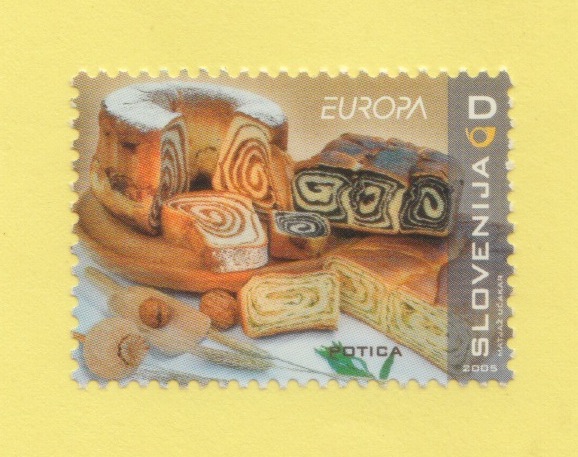
Slovenia 2005 - EUROPA, Gastronomy


Kazakhstan 2005 - EUROPA, Gastronomy


Spain 2005 - EUROPA, Gastronomy


Austria 2005 - EUROPA, Gastronomy


Denmark 2005 - EUROPA, Gastronomy


Russia 2005 - EUROPA, Gastronomy


Italy 2005 - EUROPA, Gastronomy


Latvia 2005 - EUROPA, Gastronomy


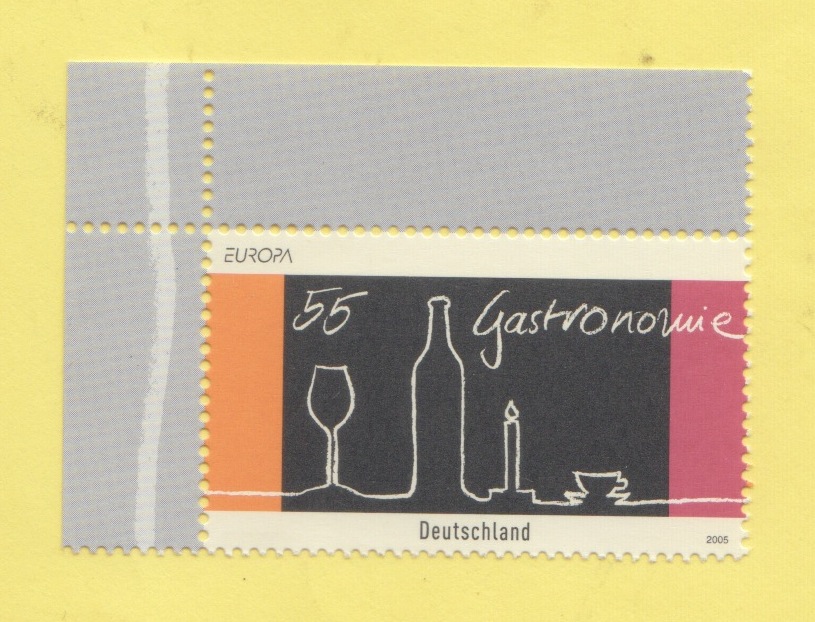
German 2005 - EUROPA, Gastronomy