Sunday, February 27, 2022

Colombia 2021 - Colombian Cuisine at the Table


Date of Issue: 24 September 2021
Presentation: Sheet with 10 Stamps
Size: 40 x 40 Millimeters
Printing: 20,000 Stamps
Face Value: $2,000 COP
Stamp Printer: Cartor Security Printing

Colombia 2021 - Sweet Flavors of Colombia


Date of Issue: 24 September 2021
Presentation: Sheet with 10 stamps
Size: 40 x 40 millimeters
Printing: 20,000 Stamps
Face Value: $2,000 COP
Stamp Printer: Cartor Security Printing

Thursday, February 24, 2022

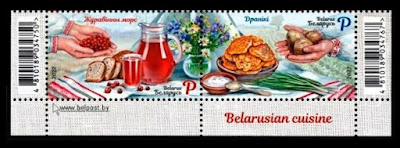
Belarusia 2022 - Belarusian Cuisine


Technical Details:
Date of issue: 05 January 2022
Designer: Alexander Mityanin and Marina Vitkovskaya
Paper: chalky
Printing process: offset
Perforation: comb 13 : 13 1/2
Size of a stamp: 52 x 29,60 mm.
Size of the Miniature Sheet: 128 x 113 mm.
Printing run: 15.000


P - Ranberry Juice
P - Draniki (Potato Pancakes)

Face value P is equal to the air-mail tariff of a letter up to 20 gram abroad.
Active agriculture, the widespread use of local products, the influence of neighboring countries and settlers influenced the formation of the Belarusian cuisine.
Belarusian cuisine is one of the most diverse on the continent. It is similar to Russian, Lithuanian, Ukrainian, Polish, Jewish, but unique and tasty in its own way.
A distinctive feature of the Belarusian cuisine is the widespread use of potato dishes. Traditional draniki (potato pancakes) are especially popular.
An irreplaceable ingredient in Belarusian cuisine is cranberry. This is one of the most vitamin-rich berries. Our country has the largest plantations of this berry in Europe.

Tuesday, February 22, 2022

France 2022 - Flowers and Sweets


Technical Details:
Date of Issued: 09 May 2022
Notebook: "Flowers and Sweets" - a mouthful of delicacies that will make your mouth water
Design and layout: Isabelle SIMLER © La Poste
Printing: Heliogravure
Support: Self-Adhesive Paper
Colour: Polychromy
Notebook format: H 256 x 54 mm
Format 12 TVP: V 24 x 38 mm (20 x 34)
Serrations: Wavy -
Face value: 12 TVP (at €1.16) - Green Letter, up to 20g - France
Booklet price: €13.92
Edition: 4,500,000

1st Section:
01 - Poppy and Poppy Candy
02 - Chestnut and Candied Chestnut
03 - Gum acacia and gumballs
04 - Marshmallow and Marshmallow

2th Section:
05 - The Mint and Stupidity of Cambrai
06 - Anise and Flavigny Anise
07 - Cocoa Tree and Chocolate Squares
08 - Violet and Violet Candy

3th Section:
09 - Bergamot and Bergamot from Nancy
10 - The Coconut Tree and the Coco Ball
11 - The Liquorice and Its Liquorice Roll
12 - The Almond Tree and The Dragee

Flowers and Sweets, a notebook full of delicacies that will make your mouth water. The world of flavors: the origins of confectionery merge with the beginnings of pharmacy. Pastes, jellies or sweet pastilles made from flowers, plants and honey were all remedies used by physicians such as Hippocrates of Cos (v.455 - 377 BC, Greek physician and philosopher) and Claudius Galen (v.129-v.201, Greek physician and writer). Around the year 1000, fondant kneaded sugar candies, candied fruits, jams and marmalades appeared. Some of these sweets are flavored with rose, violet, lavender, orange blossom, fresh or dried, or in the form of scented waters or oils and even flowers steeped in honey. Sold by apothecaries, sugar is used in the composition of remedies based on fruits, spices and flowers. Sugar is reserved for the nobility, along with fruit jellies and jams. These are also spices and dried fruits cooked in a layer of sugar. The insertion of flowers is also common in these sweets, especially rose and violet. In the 17th century, sugar became more democratic thanks to the plantations of the New World. Confectionery is appreciated for its taste and no longer for its therapeutic role. Books offering recipes are multiplying, giving rise to large compositions in spun sugar, candy or pastillage. Nutmeg rose marmalades, soft pasta with violets or crunchy carnations are a great success. When they are not eaten at the table, confectionery is kept within easy reach. of hand in small pocket bezels. Candies with crystallized flowers are arousing renewed interest (confiserie Florian in the Alpes de Hte-Provence).

01 - The poppy and the poppy candy: the poppy (papaver rhoeas) is a species of dicotyledonous plants of the papaveraceae family, native to Eurasia. It is an annual herbaceous plant, very abundant in freshly disturbed soils from spring, which is distinguished by the red color of its flowers and by the fact that it often forms large colored carpets visible from very far away. It belongs to the group of so-called messicole plants because it has been associated with agriculture for centuries. very old, thanks to its biological cycle adapted to cereal crops, with flowering and seed set taking place before harvest. Like all poppies, the poppy has narcotic effects due to the alkaloids it contains. Poppy petals are part of the composition of the pectoral flowers, in particular in the "tisanes of the four flowers" which in fact includes seven species. The poppy flower inspired many sweets of yesteryear. In Nemours (77-Seine-et-Marne), poppy sweets have been prepared since 1870 and poppy syrup and liqueur since 1996. poppy candy, made from natural products, is a little sweetness with a flowery taste, which also helps to calm coughs and colic in children.

02 - Chestnut and candied chestnut: the common chestnut (Castanea sativa) is a deciduous tree, from the Fagaceae family, which produces fruits widely consumed by humans: chestnuts. When numerous in a delimited territory, it forms a chestnut grove. The chestnuts, dried in clèdes (drying chestnuts), were for a long time the basis of the human diet in certain regions of Europe, generally devoid of cereal agriculture, which led to its being considered as a "food tree" to be valued. Around the Mediterranean, the chestnut tree was nicknamed "breadfruit" (or bread of the poor) because its fruits replaced cereals in times of famine. In the 17th century, Sieur Pierre François de La Varenne (1618-1678, chef and author of a first cookbook) gave us the first indications on the recipes called "marron glacé" and "marron au sec" that he made for the court of Louis XIV. Until the 19th century, candied chestnut was considered like a luxury confectionery made for special occasions. Chestnuts and chestnuts are the fruits of the same tree and its improved variety. At two years old, the chestnut tree receives a very specific graft, in order to obtain a well-formed chestnut. Many varieties of chestnuts are grown: the most popular are those say "peasant women" with the name: Comballe, chestnut from Lyon, Bouche de Clos or chestnut from Chevanceaux, etc. French production is mainly located in Ardèche, Dordogne and Var. A unique experience, with the fragrance, the effluvium and the perfume; then its aroma, taste and flavor. The candied chestnut is a delicate fruit, which must be opened in two, very gently, in order to discover the translucent flesh of the fruit moistened with its candy syrup.

03 - Gum acacia and gumballs: the acacia is a genus of trees and shrubs, belonging to the Fabaceae family, producing gum arabic. This gum comes mainly from the Senegalese acacia (Senegalia senegal, or acacia sap). It has been known since the Third Dynasty of Egypt (2650 BC), it is an essential raw material for the food industry and serves mainly as an emulsifier, especially for citrus oils, as a protective colloid in emulsions and carriers for flavorings. Acacia gum gives the rubbery texture to chewing gum, which coats many sweets, dragees but also medicine tablets. It is used in the composition of food products for its richness in natural, vegetable and organic dietary fibres. It has the advantage of not sticking to the teeth and not causing cavities.

04 - Marshmallow and marshmallow: Marshmallow officinalis (Althaea officinalis), also called Wild Marshmallow (or White Mallow), is a perennial herbaceous plant of the Malvaceae family, common in Europe. It is cultivated as a medicinal plant for its emollient properties, as an ornamental plant for its flowers and sometimes as a vegetable mainly for its roots. This plant was used in the composition of a soft and sweet confectionery, marshmallow paste, made originally from marshmallow root. It was made with the mucilage (vegetable substances) extracted from the marshmallow root, but which, in its form modern, is made of sugar, egg whites and gelatin. It has a spongy consistency and usually the shape of cubes or long, flexible sticks. It is naturally of a fairly neutral taste and white or pink in color but is often flavored and colored in pastel shades, the most common of which are pink, green, blue and yellow.

05 - Cambrai mint and stupidity: mints form a genus (Mentha) of perennial herbaceous plants of the Lamiaceae family. This genus includes many species, many of which are cultivated as aromatic and condiment, ornamental or medicinal plants. The original Bêtise de Cambrai with a refreshing scent of mint, or other flavors, is handcrafted at the Afchain confectionery in Cambrai (59-Nord). The story goes that Emile Afchain made a mistake when making berlingots, accidentally spilling mint when preparing the dough. He said nothing about it, until all the customers who had eaten this “nonsense” with such a good mint taste demanded it. Later Emile Afchain officially created La Bêtise de Cambrai, a delicacy produced around 1830. Since 1992, the Bêtise de Cambrai has been on the list of Culinary Heritage of Nord-Pas-de-Calais, and since 1994 of the national heritage of French confectionery, chocolate and biscuit specialties. Two companies share the "Bétises de Cambrai", Afchain and Despinoy. This candy has the shape of a small rectangular cushion, and it is flavored with mint, with stripes of caramelized sugar. Several new fragrances complete the variations: green apple, orange, lemon, praline, raspberry, violet and tutti frutti.

06 - Anise and Flavigny anise: Anise (Pimpinella anisum) is a species of herbaceous plants of the Apiaceae family, cultivated as a condiment plant for its aromatic leaves and seeds. The plant is sometimes called "green anise". "Anis de Flavigny" are sweets made in Flavigny-sur-Ozerain (21-Côte-d'Or). Each candy is made of a seed of green anise coated with flavored sugar syrup: natural anise, violet, rose, mint, liquorice, orange blossom…. It is a sugar-coating: the anise seed is covered with thin successive layers of sugar syrup. It takes fifteen days for the dragéiste to make from a small seed two milligrams a one gram candy. In 719, Benedictine monks, at the foundation of the Flavigny Abbey, started making this candy using anise brought back by the Roman traveler Flavius. Since 1591, the Benedictines, then the confectioners of the village have succeeded, remaining faithful to the recipe, but with various flavors.

07 - The cocoa tree and chocolate squares: the cocoa tree (Theobroma cacao - called cacao or cocoa tree) is a small evergreen tree of the genus Theobroma (the "Food of the Gods") of the family Sterculiaceae (classical classification) or Malvaceae (phylogenetic classification). It produces edible beans with different flavors depending on the varieties of cocoa tree, from which cocoa, the basic product of chocolate, is made. Cocoa is the powder obtained after grinding the kernels of cocoa beans. fermented and roasted cocoa produced by the cocoa tree. They are extracted from the berries, which are opened at harvest and left to dry. Chocolate (original term Mesoamerica), is a more or less sweet food produced from cocoa beans. The liquid cocoa mass from which the fat is extracted is called cocoa butter. cocoa. Chocolate is made up of the mixture, in varying proportions, of cocoa paste, cocoa butter and sugar; to which may be added spices, such as vanilla, or vegetable fats. Initially consumed as a xocoatl (a spicy drink of Aztec origin) in Mexico and Central America, chocolate became more democratic with the industrial revolution. In the XVI and century it is consumed in solid (dark or milk chocolate) or liquid (hot chocolate) form. Chocolate is found in many desserts such as confectionery, cookies, cakes, ice cream, pies, drinks, etc. Offering chocolate, molded in different ways, is become traditional during certain festivities. Many chocolatiers showcase their talent by making sculptures. The realization of the most beautiful sculpture (piece in chocolate) is the basis of any competition. Chocolate making is one of the disciplines in the "Meilleur Ouvrier de France" competition.

08 - The violet and the violet candy: the fragrant violet (Viola odorata) is a small herbaceous and perennial plant of the Violaceae family forming colonies more or less spreading, with stems forming stolons, with oval leaves, heart-shaped at the base, provided with a long petiole and with fragrant flowers, at the end of a thin stem. violets colonize meadows, woods and hedgerows. Violet is used in perfumery and herbalism. For its food use, the leaves rich in mucilages contain vitamin A, lots of vitamin C, mineral salts and saponins. The young leaves can be added raw to salads or the older, more fibrous, be cooked in soups which they thicken due to their mucilage (they swell on contact with water). The flowers are also used as decoration for pastries, fresh or candied with sugar; but also in confectionery, with violet sweets, such as "Toulouse violets" (1818, crystallized fresh flowers) or Vosges sweets.

09 - Bergamot and Nancy bergamot: bergamot is the fruit of the bergamot tree, a tree of the Rutaceae family. This citrus fruit is mainly grown in the province of Reggio Calabria (Italy) since the 18th century century and only on a narrow strip of the coast (Ionian and Tyrrhenian Seas) where bergamot still supplies a small local industry. The fruit is harvested mainly for the oil contained in its bark, which has a sweet and pungent fragrance. Half of this oil is used in the food sector and half in perfumery and cosmetics. Bergamot essence is used in several products, including bergamot (or bergamot) from Nancy. It is a slightly tart, square, flat, translucent, golden-coloured candy, flavored with bergamot essential oil, which the confectioners of Nancy (Lorraine) have made their specialty from 1830 (the confectioner Barbier-Duval). In 1898, the confectioner Louis Lefèvre-Denise registered the trademark "Bergamottes de Nancy".

10 - The coconut tree and the Coconut ball: the coconut tree (Cocos nucifera) is a species of palm from the Arecaceae family, it is not a tree but a monocotyledonous plant. Its fruit is the coconut: this large oval and hard fruit, light green or orange, turning brown when ripe, measures between 10 and 40 cm long and between 10 and 16 cm wide, weighs up to 1.5 kg and appears on a spathe (large membranous or leafy bract) between the long pinnate leaves; its seed has a brown, fibrous envelope; his white flesh (albumen) fresh or dried (copra) is edible, as well as coconut water (juice) and the embryo. Coconut is rich in potassium, iron, magnesium, phosphorus, copper and zinc, which gives it excellent nutritional value. When the fruit is green, the water it contains is consumed as a refreshing drink. blackberry, coconut almond is edible and serves as an ingredient in many tropical cuisine recipes due to its characteristic scent. The germ of the coconut which develops into occupying the space left by the coconut water, is also edible. It takes on a round shape covered with a thin layer of yellow color. The interior is made up of a whitish fibrous flesh with a sweet taste and steeped in coconut water. Once well dried, the pulp can be stored in an airtight jar away from heat and light. In small pieces, the coconut pulp can accompany a chocolate fondue, grated it is used in sauces. White or grilled, it can also be used frequently in desserts such as biscuits, ice cream, cakes, pound cakes and for decorating cakes. Coconut powder or shavings is marketed, it is used in the confection of pastry and confectionery. Coconut water is a refreshing drink, but it also goes into making of vinegars. Fermented, it forms a translucent gelatin called nata de coco.

11 - Licorice and its roll of licorice: glabrous licorice (Glycyrrhiza glabra) is a perennial plant of the Fabaceae family, of the Faboideae subfamily, with aromatic roots. It is native to southern Europe and Asia. Licorice refers to the root of this plant. Elixir of long life for traditional medicine Chinese and according to Hippocrates of Cos, this root, with its characteristic sweet and bitter taste, has been harvested since antiquity on the Calabrian Ionic coast, where it grows naturally. Liquorice refers to the aromatic extract from the root of this plant, used in confectionery (he or she also refers to confectionery made from of this aroma). Licorice is used in the manufacture of syrup (one of the components of pastis) and candy dough. Chewing sticks and licorice candies.

12 - The almond tree and the dragee: the almond tree (Prunus dulcis) is a species of tree in the Rosaceae family, whose pinkish-white flowers appear before the leaves. It is the first fruit tree to flower in late winter, a time when it can still freeze in the morning. It produces a fleshy stone fruit (or drupe) whose flesh becomes dry when ripe and splits into two valves, releasing a kernel containing an edible kernel. Since antiquity, the tree, first domesticated in the Near East to produce sweet almonds, was cultivated all around the Mediterranean before being cultivated in modern times in many arid regions of the world where it adapts well. Almond sweetness arises as a result of mutation and bitterness being a recessive trait can by selection be eliminated. The almond is very rich in fatty acid unsaturated, proteins, carbohydrates and vitamins. It is an important component of Provençal and Oriental pastries. The new trends are to consume it in the form snack (cereal bar) or almond-based drink (almond milk). Some almond confectionery: dragees, nougats, pralines, marzipan, etc.

Jersey 2022 - Post & Go: Harvest of the Sea


Date of Issued: 17 February 2022
Designer: Ron Mills
Size: 25mm x 56mm
Process: Digital
Denominations: Six Weight Step Tariffs

Situated in the English Channel, the island of Jersey enjoys access to a wide range of fresh-caught seafood, which is featured prominently on the menus of local restaurants. The species found in Jersey waters are often Atlantic in origin, fresh caught each day and supplied to the local fish markets and eateries.

Local fishers often choose to adopt sustainable catching methods such as traditional potting methods for the lobster and hand diving for scallops. Often served alongside locally grown vegetables and the Island’s famous Jersey Royal potatoes, the quality of the local seafood is second to none. Six different seafoods have been selected for display on these Post & Go stamps.
More from this collection...

Monday, February 21, 2022

Cyprus 2020 - EUROMED, Traditional Gastronomy in the Mediterranean


For the seventh consecutive year, Member States of the Postal Union for the Mediterranean "Euromed Postal" issue a stamp with a common theme. This year's theme is "Traditional Gastronomy".

The stamp of Cyprus illustrates kolokasi, a purely traditional Cypriot food cooked in various ways.

With its characteristic conical shape and special taste, kolokasi is identified with the Cypriot Gastronomy and the whole culture of the island.

It has a high nutritional value and significantly shields the immune system. Kolokasi is rich in vitamins A and C, proteins, carbohydrates and contains fibres as well as amino acids.


Tuesday, February 15, 2022

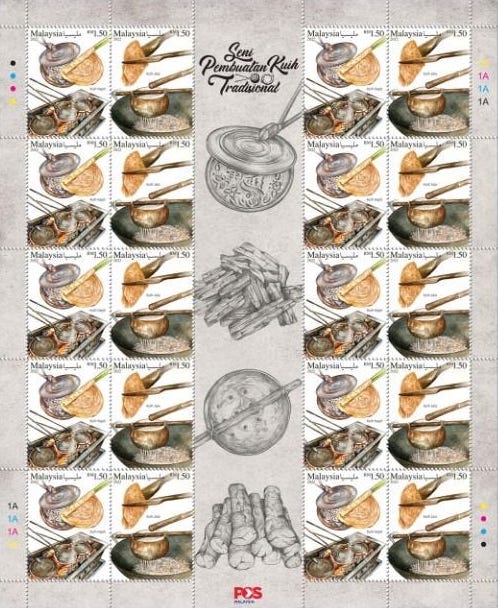
Malaysia 2022 - Art of Making Traditional Kuih


Date of Issued: 15 February 2022
Place of issue: Kuala Lumpur

In this day and age, Malaysian kuih are mostly commercially made with modern appliances to meet popular demand, hence the traditional way of kuih-making is a dying art.

The Seni Pembuatan Kuih Tradisional or Traditional Art of Making Kuih special stamp issue highlights the old-fashioned ways of making popular Malaysian kuih using brass moulds of various shapes and sizes, as well as materials including coconut shell, coconut fibre and charcoal while baking.

There are five conventional methods featured and they are of Kuih Akok, Kuih Bakar, Kuih Kapit, Kuih Jala and Kuih Bahulu.


Monday, February 7, 2022

Austria 2022 - Heimisches Superfood


Date of Issued: 03 January 2022

Some local foods are real energy bombs and nutrient stars that we can enjoy fresh and sustainable

Austria 2022 - Chocolate, Interesting facts from Josef Zotter


Date of Issued: 03 January 2022
 

Austria 2022 - Enjoyment Austria


Date of Issued: 03 January 2022

Monday, January 31, 2022

Mozambique 2013 - Local Dishes


Date of Issued: 25 June 2013
Perforation: 13¼


Singapore 2019 - Lo Hei, Chinese New Year Reunion


Technical Details:
Date of Issue: 4 February 2019
Denominations: $8.00
Size: A6 (105 x 148 mm)

Lo Hei Collector's Sheet

A special Collector's Sheet featuring Lo Hei, a popular dish eaten during the Chinese New Year Celebrations in Singapore.

Singapore 2020 - Steamboat, Chinese New Year Reunion


Technical Details:
Date of Issue: 24 January 2020
Denomination: $8.00
Stamp Size: 45mm x 45mm
Miniature Sheet Size: 120mm x 78mm
Perforation: 13 1/4
Paper: Unwatermarked
Printing Process: Offset Lithography
Printer: Cartor Security Print
Designer: Andy Koh

Chinese New Year Reunion - Steamboat Miniature Sheet

Chinese New Year or Lunar New Year is one of the most important festivals among the Chinese community in Singapore. On the eve of Chinese New Year, family members will return home for a reunion dinner (团圆饭) – an annual feast and significant tradition to reaffirm love and togetherness with one another. A popular way of having reunion dinner during this time is the Steamboat reunion dinner. Family members will gather around a hot pot of bubbling broth filled with delicious ingredients, and everyone from young to old will enjoy the sumptuous dinner in a joyful spirit. The simmering steamboat represents more than just good food, as the gathering over the feast is also a symbolic way to strengthen family bonding, sharing happiness with one another and wishes for a bountiful year ahead.

Singapore 2021 - Pen Cai, Chinese New Year Reunion


Technical Details:
Date of Issue: 11 February 2021
Denomination: $8
Stamp Size: 45mm x 44.76mm
Miniature Sheet Size: 120mm x 78mm
Perforation: 13
Paper: Unwatermarked
Printing Process: Offset Lithography with Gold Hot Stamping
Printer: Secura Singapore Pte Ltd
Designer: SNAP! Creative Pte Ltd

Chinese New Year Reunion - Pen Cai Miniature Sheet

Chinese New Year, also known as the Lunar New Year, is the most important traditional festival for the Chinese. The celebration lasts for 15 days and it is a great time for family reunions, visiting, feasting and collecting red packets (hongbao) for good fortune. One of the favourite get-togethers during the Chinese New Year is when families and friends celebrate by partaking in reunion feasts. The dish “pen cai” is a popular celebratory dish (comprising layers of ‘auspicious’ ingredients such as abalone, prawns, roast pork, and lotus root) during these get-togethers. As the old saying goes,“the family that eats together, stays together”. The annual reunion feasting is indeed significant and symbolic, and reaffirms love and togetherness with one another.

Tuesday, January 25, 2022

Turkey 2020 - EUROMED, Traditional Gastronomy of the Mediterranean


Albania 2020 - EUROMED, Traditional Gastronomy of the Mediterranean


Date of Issued: 30 March 2021
The issue consists of 1 series with 4 stamps
Author: Petraq Papa
The value of stamps: 10 lekë, 80 lekë, 90 lekë and 120 lekë
Circulation: 4,000 stamps (10 lek), 134,000 stamps (80 lek), 4,000 stamps (90 lek), 4,000 stamps (120 lek)
Stamp dimensions: 40 x 40 mm
First day envelopes with series: 150 pieces
The price of the first day envelope with series: 540 ALL Printed in Albania by Adel CO

Belgium 2020 - Speculoos


Technical Details:
Issue Date: 26 October 2020
Designer: Evelyne Bleeckx - Art'n Wood Sculpture / Speculoos
Illustrator & Photo: Luc Longin
Printer: bpost Philately & Stamps Printing
Process: Offset
Values: € 9.80

About Speculoos

Speculoos mold with Saint-Nicolas figure and cinnamon sticks and Speculoos (Saint-Nicolas figure) and spices, including cloves and star anise.

Belgium 2022 - Regional Cheeses


Technical Details:
Issue Date: 24 January 2022
Designer: Leen Depooter
Printer: Stamps Production Belgium
Process: Offset
Colours: 4 Colours
Layout: Leen Depooter
Value of postage stamps: 1 EUROPE
Leaflet Price: €10.45
Format of postage stamps: a-b-e: 40mm x 30mm; c-d: 30mm x 40mm
Sheet Size: 186mm x 152mm
Sheet composition: 5 Postage Stamps
Circulation: 43,704 sheets
Paper: FSC White Gummed
Serration: 11½
Printing Process: Offset
Printing: Bpost Philately & Stamps Printing

Theme:
Belgium can be proud of a wealthy culinary heritage. We have many cheeses that deserve to be in an assortment cheesemaker. In this show, we will discuss the richness of Belgian cheeses.
 Postage stamps: 
a. Jersey Milk Cheese - Blue-Veined Cheese
b. Gouda - Beer Cheese
c. Soft-Paste Cheese - Brussels Cheese 
d. Herve Cheese - Goat Cheese 
e. Trappist Cheese - Abbey Cheese 
Sheet: 
The sheet shows the map of Belgium, divided into regions where the different types appear of cheeses, with stylized drawings of cheeses and a cheese knife. The sheet has a cut out special shaped cheese slice with holes.
About Regional Cheeses
The sheetlet shows the map of Belgium, divided into regoins where certain types of cheeses occur, with stylized drawings of cheeses and a cheese knife. The sheetlet was also given a special shape, in the form of a slice of cheese with holes.
With more than 300 official cheeses, Belgium is a real cheese country. According to the master cheesemaker Ann Keymeulen, there would even be more than 1,000. For this collection, Ann and bpost have selected ten delicious typical Belgian cheeses, real ambassadors of the region where they are made.
Proud of Our Cheeses
National treats, When bpost asked him to select some Belgian cheeses for a show of stamps, Ann Keymeulen immediately appeared very enthusiastic. It's already been many years that it has been promoting cheeses Belgians with passion. “Belgians do not surrender not enough account of the treats we have with us."
Either way, Ann knows what she's talking about. She's a master cheese maker, lectures on cheese and provides training for become a master cheesemaker. “During training as a master cheese maker, I give courses on European cheeses," she says. " But I don't hide my passion for cheese Belgians. People are often flabbergasted when I tell them that they live in the region of an exceptional cheese maker. As I find it very regrettable, my mission consists in putting these artisan cheesemakers to honor. Our little country has so many, and it's really unbelievable.
Ten Typical Cheeses
As it is impossible to fit a thousand cheeses on a sheet of stamps, Ann had the difficult task to select ten. Moreover, she had to take into account the creation of the graphic designer Leen Depooter. Leen: “Pretty quickly, we decided to use a map of the Belgium where I arranged the cheeses according to of their origin or the place where they are more common. This shows which cheese is the most typical of his region. » Armed with this information, Ann did not have great difficulty in making his selection. Ann: “For each region, we looked for visually recognizable cheeses and belonging to our cheese heritage. He it often happens that we are inspired by the cheeses of neighboring countries to manufacture it. However, some cheeses are inscribed in our genes, like Trappist or abbey cheeses.
Cheese With Holes
Leen photographed all the cheeses herself choose. “I especially wanted every detail to be clearly visible. This allows collectors to stamps to become absorbed in their contemplation and discover things. The cutting of a slice of cheese with holes gives a additional touch of originality to the sheet. The sheet is also perforated. You have to do very be careful to make a nice cut of these round holes.

Thursday, January 20, 2022

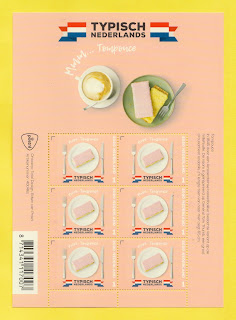
Netherlands 2020 - About Typically Dutch Food


Netherlands 2020 - About Typically Dutch Food:
- Rookworst (02 Jan 2020)
- Carrots (24 Feb 2020)
- Hagelslag (23 Mar 2020)
- Tompouce (06 Apr 2020)
- Bitterballen (15 Jun 2020)

Monday, May 3, 2021

Wednesday, April 28, 2021

Slovenia 2020 - Slovenian Gastronomy


Technical Details:
Issue Date:17 November 2020
Designer: Edi Berk
Illustrator Photo: Tomo Jeseničnik
Printer: Agencija za komercijalnu djelatnost d.o.o., Zagreb, Croatia
Process: Offset
Colours: 4 Colours

About Slovenian Gastronomy

The brand concludes the series in which we presented selected culinary characteristics in all 24 gastronomic regions of Slovenia. Both dishes on the stamp characterize the Slovenian part of Istria. Fish in šavor is a way of marinating fish or (na) šavor. Smaller blue fish, such as sardines, anchovies, menolas, trills and others, are particularly suitable for this form of preparation. The dish belongs to the old Venetian dishes and was originally a naval fishing dish. Due to the longer stay at sea, the fish were fried and marinated in vinegar and onions, which extended their edibility. The dish is supposedly first mentioned around 1300. Some authors hypothetically consider it to be even older.

Istrian štruklji are just one of the local and regional versions of štruklji, which are known in all Slovenian gastronomic regions as in other Slovenian regions and gastronomic regions as sweet or savory dishes with different fillings. They were also a festive dish in Slovenian Istria. They were obligatory on sagras (celebration of the anniversary of the local church patron saint) and belts (celebration of the consecration of the church), they were also cooked at confirmations, communions and weddings. They mostly cooked štruklji from rolled dough and with fillings from cracklings, spinach, cheese, cottage cheese, apples, walnuts, prosciutto, potatoes and with the addition of herbs and spices. Among the developmentally elderly is also a filling for strudels made of melted butter, breadcrumbs, grated cheese, sugar (formerly honey), raisins and ground almonds or walnuts. Some housewives have further seasoned this filling with mint, sage, thyme and marjoram. They coated the dough with the filling, which had previously been smeared with butter and scrambled egg yolk.

Saturday, July 11, 2020

Slovenia 2020 - EUROMED, Traditional Gastronomy of the Mediterranean


Technical Details:
Release date: 13 July 2020
Design: Edi Berk
Motive: Olive Oil, Istrian jota, Gulf, Refosco, Malvasia
Print: Agencija za komercijalnu djelatnost d.o.o., Zagreb, Croatia
Technique: 4-colour offset in sheets of 25 stamps
Papir: Tullis Russell Chancellor Litho PVA RMS GUM, 102 g/m2
Perforation: Comb 14 : 14

EUROMED POSTAL - Traditional Gastronomy of the Mediterranean

The Slovenian part of the Istrian peninsula, the Goriška Brda hill region and the valley of the river Vipava are among the northernmost areas where olives grow. For this reason, the extra virgin olive oil from these areas is of remarkable quality and flavour, as confirmed by numerous prestigious international awards. This oil is obtained using exclusively mechanical methods, undergoes no heat treatment or chemical treatment and contains no additives. Attention is paid when picking the olives to ensure they are not damaged. Olive oil from Slovenia is a highly prized ingredient, in particular as part of the so-called Mediterranean diet and in cosmetics, and has many beneficial effects.

Unlike the jota of the Karst and Trieste, traditional Istrian jota does not contain potato and is mainly eaten as a warming winter stew (this does not, of course mean that the potato-less variety is the only kind of jota prepared in Istria). The best accompaniment for jota is polenta, either white or yellow. Istrian jota also includes beans, although they have only been part of the recipe since the seventeenth century.

The Fonda fish farm in the Gulf of Piran, famous for its sea bass, is located at the southernmost point of Slovenia's territorial waters, an area characterised by clean, deep seawater and a strong marine current, which means that the water here is constantly replaced. The ideal local climate and low salinity of the seawater have a positive effect on the quality of Piran sea bass and the firmness of its meat. The fish are fed the finest natural feed, based exclusively on planktonic and benthic organisms. All these factors mean that the Piran sea bass farmed by Fonda are fish of the very highest quality. Fonda also farms mussels. These are farmed on ropes that float freely in the sea, attached to buoys.

The historically diverse and ethnically mixed area between the Friuli region of Italy and Istria also has some notable characteristics in the area of wine and viticulture. The two most notable wines of the Slovenian part of the Istrian peninsula are Refosco (refošk) and Malvasia (malvazija). Refosco is a domesticated grape variety that produces wines of a characteristic dark purplish-red colour with acidic and pleasant fruity flavours suggesting blackcurrant and raspberry. Some authors consider it to be native to the area extending from the Karst to Istria. On the Karst plateau the wine from this grape is called teran (Terrano). The Refosco grape does not only grow in the Slovenian part of Istria but also in the Goriška Brda hill region, on the Karst, in the Vipava Valley, in Friuli and in the Croatian part of Istria. The biggest Refosco-producing winery in the world is Vinakoper in Koper. The Malvasia grape is of Greek origin but is a domesticated variety in Istria. Malvasia is an excellent dry white wine of a golden-yellow colour, with an intense bouquet and full flavour. It goes well with white fish, shellfish, poultry and mild cheeses.

Janez Bogataj

Malta 2020 - EUROMED, Traditional Gastronomy In The Mediterranean


Technical Details:
Issue Date: 09 July 2020
Designer: MaltaPost p.l.c
Process: Offset
Sheet Size: 118mm x 185mm 
Stamp Size: 44mm x 31mm
Values: €0.30, €0.59, €1.25

About Euromed - Traditional Gastronomy In The Mediterranean

The Postal Union for the Mediterranean (PUMed), forms part of the Universal Postal Union, and marks the Mediterranean region as a political, economic and social area. It operates in a region where economies and societies face common challenges and opportunities.

Members come together to develop projects that assist postal operators keep abreast of challenges the market poses. Each year PUMed organises a stamp issue among all its members, based on a common theme. This year's joint stamp issue is themed "Traditional Gastronomy in the Mediterranean".

Maltese gastronomy is closely linked to our long relationship with outside cultures. Although traditional Maltese food is seasonal and rustic, both our history and geography have made our gastronomy eclectic, allowing us to 'borrow' from Italian, Maghreb and other cuisines.

As a nation we are well known for having a 'sweet tooth' with wheat and sugar forming the backbone of our pastries. Therefore, MaltaPost's philatelic offering for PuMed 2020 portrays Maltese sweet delicacies. The first stamp depicts Biskuttini tar-Rahal or Rustic Biscuits. These traditional pastries consist of a unique blend of spices and aromatic herbs including ground cloves, caraway seeds and aniseed. They were sometimes prepared for special occasions such as christening parties. They are decorated with swirls of pink or blue icing and served with tea. Their aroma has come to be associated with quaint, old village bakeries.

Qaghaq tal-Gunglien (Biscuit rings with sesame seeds) are ring shaped biscuits made of flour with lemon /orange rind and a blend of aromatic spices with sesame seeds scattered on top. They are extremely popular with the locals and available at most bakeries and supermarkets.

Pasta Roza bil-Gewz tal-Indi (Coconut Lamington) has become a traditional sweet. It originates from Australia but Malta adapted it and given it a local flavour. Consisting of soft vanilla or butter cake, it is soaked in a strawberry syrup (as opposed to dipped in chocolate) and rolled in desiccated coconut. It is light and fluffy in texture and incredibly moist. You can't miss it on the counters of small village shops nestled under a veil of soft tulle!

Thursday, June 25, 2020

New Zealand 2020 - Kiwi Cakes & Bakes


Technical Details:
Date of Issue: 1 July 2020
Number of stamps: 15 gummed stamps
Denominations: 15 x $1.40
Stamps, Miniature Sheet and FDC designed by: Graeme Mowday, Wellington, New Zealand
Printer and process: Southern Colour Print Ltd by Offset Lithography
Number of colours: Four process colours with Synseal Overgloss
Stamp size and format: 34.55mm x 35mm (vertical)
Stamp sheet size and format: 235mm x 180mm (horizontal)
Paper type: Tullis Russell 104gsm red phosphor gummed stamp paper
Number of stamps per sheet: 15
Perforation Gauge: 14.286 x 13.895
Period of sale: Unless stocks are exhausted earlier, these stamps will remain on sale until 30 June 2021. First day covers will remain on sale until 26 August 2020.

This  stamp  issue celebrates classic baked treats - favourites found in the little local cake shop or  lovingly made at home. Each stamp features a different item, presented as a work of art in the bakery window.

Issue Information:
Treats like afghans, custard squares and pavlova are all familiar to New Zealanders. The stamps in this issue represent some local or regional favourites, some recipes from abroad, and others that were locally invented. Wherever their origins, the best recipes can be the ones passed down the generations or from friend to friend. 

The baking tradition in Aotearoa New Zealand is alive and well - here we offer an issue that evokes flavourful memories. We invite you to simply feast your eyes or maybe satisfy your appetite with a little home baking of your own.

$1.40 Anzac Biscuits
During the First World War, women posted parcels of biscuits to men serving overseas and the acronym ANZAC was applied to the Australian and New Zealand Army Corps in 1914. But the crisp, golden oatmeal biscuits did not acquire their name until they appeared as Anzac Crispies in the 1919 edition of the St Andrew’s Cookery Book. Anzac Biscuits live on in both countries.

$1.40 Pavlova
Ownership of the original Pavlova has long been contested in the Antipodes. Culinary researcher Dr Helen Leach discovered a recipe for a meringue ‘Pavlova Cake’ in the 1933 Rangiora Mothers’ Union Cookery Book of Tried and Tested Recipes, sent in by Laurina Stevens. This was a few years after the visit of the Russian ballerina Anna Pavlova but two years before the first recipe for a meringue Pavlova appears in Australia.

$1.40 Churchill Slice
Named after the UK prime minister who saw his nation through the Second World War, this baked, two-layered chocolate slice with a coconut filling can be found in mid-20th century New Zealand recipe books.

$1.40 Cheese Rolls
Cheese Rolls are a southern specialty. Recipes vary, but generally to make them spread slices of crustless white bread with a mixture of thick onion soup from a packet and grated cheese, then roll them up and bake briefly to melt the cheese and crisp the bread.

$1.40 Lolly Cake
This children’s party favourite seems to have appeared in the 1970s. A mixture of crushed malt biscuits, sweetened condensed milk and melted butter with chopped marshmallow lollies is formed into a cylinder, rolled in coconut, chilled and then sliced.

$1.40 Neenish Tarts
Neenish Tarts were known as Nienich Tarts in Australia. Small baked cases filled with lemon-flavoured mock cream and distinctively iced – one half chocolate and the other vanilla – they are a graphic standout on any afternoon tea table.

$1.40 Lamingtons
Australian in origin, lamingtons’ first appearance seems to be in Queensland Country Life in December 1900, although similar small cakes iced and rolled in coconut are in earlier cookbooks. They took off quickly in New Zealand after an initial sighting in Dunedin’s Otago Witness in March 1902.

$1.40 Cheese Scones
Scones are the perfect quick bread made possible by the invention of baking powder in the 1850s, and cheese scones are always near the top of any list of favourites.

$1.40 Custard Squares
Custard Squares comprise two crisp sheets of flaky pastry with a significant layer of rich vanilla custard in between. The top is iced and either sprinkled with desiccated coconut or decorated with lines of feather icing.

$1.40 Chocolate Crackles
Cornflakes and rice bubbles were available in New Zealand from the late 1920s and were quickly adopted for biscuits and slices and even meringues. Involving no baking at all, Chocolate Crackles have been a children’s party favourite for decades.

$1.40 Ginger Biscuits
New Zealand seems to have a particular obsession with ginger in baking. Community cookery books abound with recipes for Ginger Biscuits or Gingersnaps, Ginger Crunch, Ginger Kisses, Ginger Gems, Ginger Puddings, Pear Ginger and of course homemade ginger beer. 

$1.40 Melting Moments
Melting Moments have a pretty name and a distinctive appearance. They are small round, buttery biscuits, decorated with indentations made with the tines of a fork and sandwiched in pairs with butter icing. Related to Scottish shortbread, they have a more melting texture since they are made with icing sugar and cornflour.

$1.40 Louise Cake
In New Zealand home baking, desiccated coconut has historically provided an economical substitute for the ground almonds used in many European recipes, since coconuts are grown throughout the Pacific. It is included in the meringue topping over the jam and biscuit base of Louise Cake.

$1.40 Afghans
Afghans, like Chocolate Crackles, involve using commercially made breakfast cereals. Afghans are small, crisp chocolate cakes iced with chocolate icing and topped with a half walnut. The source of the name remains a mystery, though one theory is that returned soldiers saw a likeness to the hats worn by Afghan camel drivers in Egypt.

$1.40 Banana Cake
In New Zealand, countless over-ripe bananas are rescued by their inclusion in moreish cakes, loaves and muffins. Banana Cake filled with sliced bananas and whipped cream and iced with thin lemon icing was the favourite of a legendary New Zealander, Sir Edmund Hillary.

Saturday, May 16, 2020

Tuesday, April 21, 2020

Great Britain 2005 - EUROPA, Gastronomy


2005 Changing Tastes in Britain
Issued by the Royal Mail on 23rd August 2005.

This pack contains a set of six mint stamps, which were produced to celebrate gastronomy. Royal Mail is representing Britain's fantastic range of cuisine in a set of six new stamps. Royal Mail turned to students at the Royal College of Art to provide culinary images that reflected the huge range of diversity of food and drink in Britain. After much deliberation we chose a series of illustrations created by Cattell Ronca, whose greatest pleasure of living in London is the huge variety of restaurants, cafes and takeaways. Cattell's inspiration stemmed from watching people from different cultures enjoying various cuisines, and capturing their characters using strong blocks of gouache colour. The result is a colourful, bold and stylish set of stamps.

Written by chef Keith Floyd, this pack highlights the dramatic increase in food choices since the Second World War and the flavours that are now taken for granted.

Thursday, April 2, 2020

Spain 2020 - Protected Gastronomy of Asturias


Technical Details:
Issue Date: 20 March 2020
Printing Procedure: Offset + flavor + 3D varnish
Paper: Coated, gummed, phosphorescent, cider flavor
Stamp Size: 28.8 x 40 mm
Block Sheet Size: 99 x 133 mm
Postal value of the stamps: € 3 each stamp
Block Circulation: 140,000

GASTRONOMY: DO PROTEGIDAS DE ASTURIAS

One more year Correos travels through the stamps to savor the products of our land.If last year it was Cantabria, this year its neighbor Asturias is the protagonist of one of the most innovative series of Philately.

The Protected Designation of Origin aims to preserve the name and quality of the products as well as their cultivation and manufacture in an artisanal way.

Asturias can be proud of displaying this distinction in many of its products.

The cheeses are the protagonists of this denomination, with four of them having the Protected Designation of Origin of Asturias. Cabrales cheese, made from three milks and matured in natural caves in the Picos de Europa, has a strong flavor that makes it unique; or the Gamonéu cheese, naturally smoked, is a blue cheese typical of the village of the same name; Casín cheese, of complex and prolonged elaboration, is also manufactured by hand in the council of Caso; and finally the Afuega´l Pitu cheese, made from cow's milk in farmhouses located on mountain slopes between the Narcea and Sella rivers.

Asturian cider is made from a wide variety of apples and is one of the most representative symbols of Asturias. The cultivation of different varieties of apple, its manufacture as well as the way to serve it, poured, make the cider a tradition.

Asturian Faba, with Protection is a dry bean that must have a minimum length of 18 mm. Protagonist of countless recipes, its version accompanied by compango or clams are the best known.

The block sheet features these last two products as protagonists. One of the stamps collects the image of a spoonful of fabada coming out of the plate; the other, to a glass of cider at the time of receiving the liquid when pouring. This stamp has the particularity, as has already happened with other philatelic issues, of picking up a slight cider flavor.