
Tuesday, January 25, 2022

Albania 2020 - EUROMED, Traditional Gastronomy of the Mediterranean


The issue consists of 1 series with 4 stamps
Author: Petraq Papa
The value of stamps: 10 lekë, 80 lekë, 90 lekë and 120 lekë
Circulation: 4,000 stamps (10 lek), 134,000 stamps (80 lek), 4,000 stamps (90 lek), 4,000 stamps (120 lek)
Stamp dimensions: 40 x 40 mm
First day envelopes with series: 150 pieces
The price of the first day envelope with series: 540 ALL Printed in Albania by Adel CO
Belgium 2020 - Speculoos

Issue Date: 26 October 2020
Designer: Evelyne Bleeckx - Art'n Wood Sculpture / Speculoos
Illustrator & Photo: Luc Longin
Printer: bpost Philately & Stamps Printing
Process: Offset
Values: € 9.80
About Speculoos
Speculoos mold with Saint-Nicolas figure and cinnamon sticks and Speculoos (Saint-Nicolas figure) and spices, including cloves and star anise.
Belgium 2022 - Regional Cheeses

Technical Details:
Issue Date: 24 January 2022
Designer: Leen Depooter
Printer: Stamps Production Belgium
Process: Offset
Colours: 4 Colours
Layout: Leen Depooter
Value of postage stamps: 1 EUROPE
Leaflet Price: €10.45
Format of postage stamps: a-b-e: 40mm x 30mm; c-d: 30mm x 40mm
Sheet Size: 186mm x 152mm
Sheet composition: 5 Postage Stamps
Circulation: 43,704 sheets
Paper: FSC White Gummed
Serration: 11½
Printing Process: Offset
Printing: Bpost Philately & Stamps Printing
Process: Offset
Colours: 4 Colours
Layout: Leen Depooter
Value of postage stamps: 1 EUROPE
Leaflet Price: €10.45
Format of postage stamps: a-b-e: 40mm x 30mm; c-d: 30mm x 40mm
Sheet Size: 186mm x 152mm
Sheet composition: 5 Postage Stamps
Circulation: 43,704 sheets
Paper: FSC White Gummed
Serration: 11½
Printing Process: Offset
Printing: Bpost Philately & Stamps Printing
Theme:
Belgium can be proud of a wealthy culinary heritage. We have many cheeses that deserve to be in an assortment cheesemaker. In this show, we will discuss the richness of Belgian cheeses.
Postage stamps:
a. Jersey Milk Cheese - Blue-Veined Cheese
b. Gouda - Beer Cheese
c. Soft-Paste Cheese - Brussels Cheese
d. Herve Cheese - Goat Cheese
e. Trappist Cheese - Abbey Cheese
Sheet:
The sheet shows the map of Belgium, divided into regions where the different types appear of cheeses, with stylized drawings of cheeses and a cheese knife. The sheet has a cut out special shaped cheese slice with holes.
About Regional Cheeses
The sheetlet shows the map of Belgium, divided into regoins where certain types of cheeses occur, with stylized drawings of cheeses and a cheese knife. The sheetlet was also given a special shape, in the form of a slice of cheese with holes.
The sheetlet shows the map of Belgium, divided into regoins where certain types of cheeses occur, with stylized drawings of cheeses and a cheese knife. The sheetlet was also given a special shape, in the form of a slice of cheese with holes.
With more than 300 official cheeses, Belgium is a real cheese country. According to the master cheesemaker Ann Keymeulen, there would even be more than 1,000. For this collection, Ann and bpost have selected ten delicious typical Belgian cheeses, real ambassadors of the region where they are made.
Proud of Our Cheeses
National treats, When bpost asked him to select some Belgian cheeses for a show of stamps, Ann Keymeulen immediately appeared very enthusiastic. It's already been many years that it has been promoting cheeses Belgians with passion. “Belgians do not surrender not enough account of the treats we have with us."
Either way, Ann knows what she's talking about. She's a master cheese maker, lectures on cheese and provides training for become a master cheesemaker. “During training as a master cheese maker, I give courses on European cheeses," she says. " But I don't hide my passion for cheese Belgians. People are often flabbergasted when I tell them that they live in the region of an exceptional cheese maker. As I find it very regrettable, my mission consists in putting these artisan cheesemakers to honor. Our little country has so many, and it's really unbelievable.
Ten Typical Cheeses
As it is impossible to fit a thousand cheeses on a sheet of stamps, Ann had the difficult task to select ten. Moreover, she had to take into account the creation of the graphic designer Leen Depooter. Leen: “Pretty quickly, we decided to use a map of the Belgium where I arranged the cheeses according to of their origin or the place where they are more common. This shows which cheese is the most typical of his region. » Armed with this information, Ann did not have great difficulty in making his selection. Ann: “For each region, we looked for visually recognizable cheeses and belonging to our cheese heritage. He it often happens that we are inspired by the cheeses of neighboring countries to manufacture it. However, some cheeses are inscribed in our genes, like Trappist or abbey cheeses.
Cheese With Holes
Leen photographed all the cheeses herself choose. “I especially wanted every detail to be clearly visible. This allows collectors to stamps to become absorbed in their contemplation and discover things. The cutting of a slice of cheese with holes gives a additional touch of originality to the sheet. The sheet is also perforated. You have to do very be careful to make a nice cut of these round holes.
Thursday, January 20, 2022
Netherlands 2020 - About Typically Dutch Food


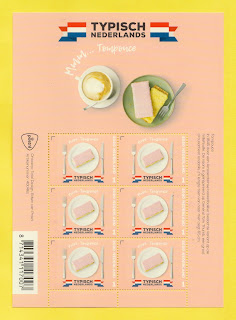
Netherlands 2020 - About Typically Dutch Food:
- Rookworst (02 Jan 2020)
- Carrots (24 Feb 2020)
- Hagelslag (23 Mar 2020)
- Tompouce (06 Apr 2020)
- Bitterballen (15 Jun 2020)
Monday, May 3, 2021

Wednesday, April 28, 2021
Slovenia 2020 - Slovenian Gastronomy


Technical Details:
Issue Date:17 November 2020
Designer: Edi Berk
Illustrator Photo: Tomo Jeseničnik
Printer: Agencija za komercijalnu djelatnost d.o.o., Zagreb, Croatia
Process: Offset
Colours: 4 Colours
About Slovenian Gastronomy
The brand concludes the series in which we presented selected culinary characteristics in all 24 gastronomic regions of Slovenia. Both dishes on the stamp characterize the Slovenian part of Istria. Fish in šavor is a way of marinating fish or (na) šavor. Smaller blue fish, such as sardines, anchovies, menolas, trills and others, are particularly suitable for this form of preparation. The dish belongs to the old Venetian dishes and was originally a naval fishing dish. Due to the longer stay at sea, the fish were fried and marinated in vinegar and onions, which extended their edibility. The dish is supposedly first mentioned around 1300. Some authors hypothetically consider it to be even older.
Istrian štruklji are just one of the local and regional versions of štruklji, which are known in all Slovenian gastronomic regions as in other Slovenian regions and gastronomic regions as sweet or savory dishes with different fillings. They were also a festive dish in Slovenian Istria. They were obligatory on sagras (celebration of the anniversary of the local church patron saint) and belts (celebration of the consecration of the church), they were also cooked at confirmations, communions and weddings. They mostly cooked štruklji from rolled dough and with fillings from cracklings, spinach, cheese, cottage cheese, apples, walnuts, prosciutto, potatoes and with the addition of herbs and spices. Among the developmentally elderly is also a filling for strudels made of melted butter, breadcrumbs, grated cheese, sugar (formerly honey), raisins and ground almonds or walnuts. Some housewives have further seasoned this filling with mint, sage, thyme and marjoram. They coated the dough with the filling, which had previously been smeared with butter and scrambled egg yolk.
Saturday, July 11, 2020
Slovenia 2020 - EUROMED, Traditional Gastronomy of the Mediterranean

Technical Details:
Release date: 13 July 2020
Design: Edi Berk
Motive: Olive Oil, Istrian jota, Gulf, Refosco, Malvasia
Print: Agencija za komercijalnu djelatnost d.o.o., Zagreb, Croatia
Technique: 4-colour offset in sheets of 25 stamps
Papir: Tullis Russell Chancellor Litho PVA RMS GUM, 102 g/m2
Perforation: Comb 14 : 14
EUROMED POSTAL - Traditional Gastronomy of the Mediterranean
The Slovenian part of the Istrian peninsula, the Goriška Brda hill region and the valley of the river Vipava are among the northernmost areas where olives grow. For this reason, the extra virgin olive oil from these areas is of remarkable quality and flavour, as confirmed by numerous prestigious international awards. This oil is obtained using exclusively mechanical methods, undergoes no heat treatment or chemical treatment and contains no additives. Attention is paid when picking the olives to ensure they are not damaged. Olive oil from Slovenia is a highly prized ingredient, in particular as part of the so-called Mediterranean diet and in cosmetics, and has many beneficial effects.
Unlike the jota of the Karst and Trieste, traditional Istrian jota does not contain potato and is mainly eaten as a warming winter stew (this does not, of course mean that the potato-less variety is the only kind of jota prepared in Istria). The best accompaniment for jota is polenta, either white or yellow. Istrian jota also includes beans, although they have only been part of the recipe since the seventeenth century.
The Fonda fish farm in the Gulf of Piran, famous for its sea bass, is located at the southernmost point of Slovenia's territorial waters, an area characterised by clean, deep seawater and a strong marine current, which means that the water here is constantly replaced. The ideal local climate and low salinity of the seawater have a positive effect on the quality of Piran sea bass and the firmness of its meat. The fish are fed the finest natural feed, based exclusively on planktonic and benthic organisms. All these factors mean that the Piran sea bass farmed by Fonda are fish of the very highest quality. Fonda also farms mussels. These are farmed on ropes that float freely in the sea, attached to buoys.
The historically diverse and ethnically mixed area between the Friuli region of Italy and Istria also has some notable characteristics in the area of wine and viticulture. The two most notable wines of the Slovenian part of the Istrian peninsula are Refosco (refošk) and Malvasia (malvazija). Refosco is a domesticated grape variety that produces wines of a characteristic dark purplish-red colour with acidic and pleasant fruity flavours suggesting blackcurrant and raspberry. Some authors consider it to be native to the area extending from the Karst to Istria. On the Karst plateau the wine from this grape is called teran (Terrano). The Refosco grape does not only grow in the Slovenian part of Istria but also in the Goriška Brda hill region, on the Karst, in the Vipava Valley, in Friuli and in the Croatian part of Istria. The biggest Refosco-producing winery in the world is Vinakoper in Koper. The Malvasia grape is of Greek origin but is a domesticated variety in Istria. Malvasia is an excellent dry white wine of a golden-yellow colour, with an intense bouquet and full flavour. It goes well with white fish, shellfish, poultry and mild cheeses.
Janez Bogataj
Release date: 13 July 2020
Design: Edi Berk
Motive: Olive Oil, Istrian jota, Gulf, Refosco, Malvasia
Print: Agencija za komercijalnu djelatnost d.o.o., Zagreb, Croatia
Technique: 4-colour offset in sheets of 25 stamps
Papir: Tullis Russell Chancellor Litho PVA RMS GUM, 102 g/m2
Perforation: Comb 14 : 14
EUROMED POSTAL - Traditional Gastronomy of the Mediterranean
The Slovenian part of the Istrian peninsula, the Goriška Brda hill region and the valley of the river Vipava are among the northernmost areas where olives grow. For this reason, the extra virgin olive oil from these areas is of remarkable quality and flavour, as confirmed by numerous prestigious international awards. This oil is obtained using exclusively mechanical methods, undergoes no heat treatment or chemical treatment and contains no additives. Attention is paid when picking the olives to ensure they are not damaged. Olive oil from Slovenia is a highly prized ingredient, in particular as part of the so-called Mediterranean diet and in cosmetics, and has many beneficial effects.
Unlike the jota of the Karst and Trieste, traditional Istrian jota does not contain potato and is mainly eaten as a warming winter stew (this does not, of course mean that the potato-less variety is the only kind of jota prepared in Istria). The best accompaniment for jota is polenta, either white or yellow. Istrian jota also includes beans, although they have only been part of the recipe since the seventeenth century.
The Fonda fish farm in the Gulf of Piran, famous for its sea bass, is located at the southernmost point of Slovenia's territorial waters, an area characterised by clean, deep seawater and a strong marine current, which means that the water here is constantly replaced. The ideal local climate and low salinity of the seawater have a positive effect on the quality of Piran sea bass and the firmness of its meat. The fish are fed the finest natural feed, based exclusively on planktonic and benthic organisms. All these factors mean that the Piran sea bass farmed by Fonda are fish of the very highest quality. Fonda also farms mussels. These are farmed on ropes that float freely in the sea, attached to buoys.
The historically diverse and ethnically mixed area between the Friuli region of Italy and Istria also has some notable characteristics in the area of wine and viticulture. The two most notable wines of the Slovenian part of the Istrian peninsula are Refosco (refošk) and Malvasia (malvazija). Refosco is a domesticated grape variety that produces wines of a characteristic dark purplish-red colour with acidic and pleasant fruity flavours suggesting blackcurrant and raspberry. Some authors consider it to be native to the area extending from the Karst to Istria. On the Karst plateau the wine from this grape is called teran (Terrano). The Refosco grape does not only grow in the Slovenian part of Istria but also in the Goriška Brda hill region, on the Karst, in the Vipava Valley, in Friuli and in the Croatian part of Istria. The biggest Refosco-producing winery in the world is Vinakoper in Koper. The Malvasia grape is of Greek origin but is a domesticated variety in Istria. Malvasia is an excellent dry white wine of a golden-yellow colour, with an intense bouquet and full flavour. It goes well with white fish, shellfish, poultry and mild cheeses.
Janez Bogataj
Malta 2020 - EUROMED, Traditional Gastronomy In The Mediterranean


Issue Date: 09 July 2020
Designer: MaltaPost p.l.c
Process: Offset
Sheet Size: 118mm x 185mm
Stamp Size: 44mm x 31mm
Values: €0.30, €0.59, €1.25
About Euromed - Traditional Gastronomy In The Mediterranean
The Postal Union for the Mediterranean (PUMed), forms part of the Universal Postal Union, and marks the Mediterranean region as a political, economic and social area. It operates in a region where economies and societies face common challenges and opportunities.
Members come together to develop projects that assist postal operators keep abreast of challenges the market poses. Each year PUMed organises a stamp issue among all its members, based on a common theme. This year's joint stamp issue is themed "Traditional Gastronomy in the Mediterranean".
Maltese gastronomy is closely linked to our long relationship with outside cultures. Although traditional Maltese food is seasonal and rustic, both our history and geography have made our gastronomy eclectic, allowing us to 'borrow' from Italian, Maghreb and other cuisines.
As a nation we are well known for having a 'sweet tooth' with wheat and sugar forming the backbone of our pastries. Therefore, MaltaPost's philatelic offering for PuMed 2020 portrays Maltese sweet delicacies. The first stamp depicts Biskuttini tar-Rahal or Rustic Biscuits. These traditional pastries consist of a unique blend of spices and aromatic herbs including ground cloves, caraway seeds and aniseed. They were sometimes prepared for special occasions such as christening parties. They are decorated with swirls of pink or blue icing and served with tea. Their aroma has come to be associated with quaint, old village bakeries.
Qaghaq tal-Gunglien (Biscuit rings with sesame seeds) are ring shaped biscuits made of flour with lemon /orange rind and a blend of aromatic spices with sesame seeds scattered on top. They are extremely popular with the locals and available at most bakeries and supermarkets.
Pasta Roza bil-Gewz tal-Indi (Coconut Lamington) has become a traditional sweet. It originates from Australia but Malta adapted it and given it a local flavour. Consisting of soft vanilla or butter cake, it is soaked in a strawberry syrup (as opposed to dipped in chocolate) and rolled in desiccated coconut. It is light and fluffy in texture and incredibly moist. You can't miss it on the counters of small village shops nestled under a veil of soft tulle!
Values: €0.30, €0.59, €1.25
About Euromed - Traditional Gastronomy In The Mediterranean
The Postal Union for the Mediterranean (PUMed), forms part of the Universal Postal Union, and marks the Mediterranean region as a political, economic and social area. It operates in a region where economies and societies face common challenges and opportunities.
Members come together to develop projects that assist postal operators keep abreast of challenges the market poses. Each year PUMed organises a stamp issue among all its members, based on a common theme. This year's joint stamp issue is themed "Traditional Gastronomy in the Mediterranean".
Maltese gastronomy is closely linked to our long relationship with outside cultures. Although traditional Maltese food is seasonal and rustic, both our history and geography have made our gastronomy eclectic, allowing us to 'borrow' from Italian, Maghreb and other cuisines.
As a nation we are well known for having a 'sweet tooth' with wheat and sugar forming the backbone of our pastries. Therefore, MaltaPost's philatelic offering for PuMed 2020 portrays Maltese sweet delicacies. The first stamp depicts Biskuttini tar-Rahal or Rustic Biscuits. These traditional pastries consist of a unique blend of spices and aromatic herbs including ground cloves, caraway seeds and aniseed. They were sometimes prepared for special occasions such as christening parties. They are decorated with swirls of pink or blue icing and served with tea. Their aroma has come to be associated with quaint, old village bakeries.
Qaghaq tal-Gunglien (Biscuit rings with sesame seeds) are ring shaped biscuits made of flour with lemon /orange rind and a blend of aromatic spices with sesame seeds scattered on top. They are extremely popular with the locals and available at most bakeries and supermarkets.
Pasta Roza bil-Gewz tal-Indi (Coconut Lamington) has become a traditional sweet. It originates from Australia but Malta adapted it and given it a local flavour. Consisting of soft vanilla or butter cake, it is soaked in a strawberry syrup (as opposed to dipped in chocolate) and rolled in desiccated coconut. It is light and fluffy in texture and incredibly moist. You can't miss it on the counters of small village shops nestled under a veil of soft tulle!
Thursday, June 25, 2020
New Zealand 2020 - Kiwi Cakes & Bakes

Technical Details:
Date of Issue: 1 July 2020
Number of stamps: 15 gummed stamps
Denominations: 15 x $1.40
Stamps, Miniature Sheet and FDC designed by: Graeme Mowday, Wellington, New Zealand
Printer and process: Southern Colour Print Ltd by Offset Lithography
Number of colours: Four process colours with Synseal Overgloss
Stamp size and format: 34.55mm x 35mm (vertical)
Stamp sheet size and format: 235mm x 180mm (horizontal)
Paper type: Tullis Russell 104gsm red phosphor gummed stamp paper
Number of stamps per sheet: 15
Perforation Gauge: 14.286 x 13.895
Period of sale: Unless stocks are exhausted earlier, these stamps will remain on sale until 30 June 2021. First day covers will remain on sale until 26 August 2020.
This stamp issue celebrates classic baked treats - favourites found in the little local cake shop or lovingly made at home. Each stamp features a different item, presented as a work of art in the bakery window.
Issue Information:
Treats like afghans, custard squares and pavlova are all familiar to New Zealanders. The stamps in this issue represent some local or regional favourites, some recipes from abroad, and others that were locally invented. Wherever their origins, the best recipes can be the ones passed down the generations or from friend to friend.
The baking tradition in Aotearoa New Zealand is alive and well - here we offer an issue that evokes flavourful memories. We invite you to simply feast your eyes or maybe satisfy your appetite with a little home baking of your own.
$1.40 Anzac Biscuits
During the First World War, women posted parcels of biscuits to men serving overseas and the acronym ANZAC was applied to the Australian and New Zealand Army Corps in 1914. But the crisp, golden oatmeal biscuits did not acquire their name until they appeared as Anzac Crispies in the 1919 edition of the St Andrew’s Cookery Book. Anzac Biscuits live on in both countries.
$1.40 Pavlova
Ownership of the original Pavlova has long been contested in the Antipodes. Culinary researcher Dr Helen Leach discovered a recipe for a meringue ‘Pavlova Cake’ in the 1933 Rangiora Mothers’ Union Cookery Book of Tried and Tested Recipes, sent in by Laurina Stevens. This was a few years after the visit of the Russian ballerina Anna Pavlova but two years before the first recipe for a meringue Pavlova appears in Australia.
$1.40 Churchill Slice
Named after the UK prime minister who saw his nation through the Second World War, this baked, two-layered chocolate slice with a coconut filling can be found in mid-20th century New Zealand recipe books.
$1.40 Cheese Rolls
Cheese Rolls are a southern specialty. Recipes vary, but generally to make them spread slices of crustless white bread with a mixture of thick onion soup from a packet and grated cheese, then roll them up and bake briefly to melt the cheese and crisp the bread.
$1.40 Lolly Cake
This children’s party favourite seems to have appeared in the 1970s. A mixture of crushed malt biscuits, sweetened condensed milk and melted butter with chopped marshmallow lollies is formed into a cylinder, rolled in coconut, chilled and then sliced.
$1.40 Neenish Tarts
Neenish Tarts were known as Nienich Tarts in Australia. Small baked cases filled with lemon-flavoured mock cream and distinctively iced – one half chocolate and the other vanilla – they are a graphic standout on any afternoon tea table.
$1.40 Lamingtons
Australian in origin, lamingtons’ first appearance seems to be in Queensland Country Life in December 1900, although similar small cakes iced and rolled in coconut are in earlier cookbooks. They took off quickly in New Zealand after an initial sighting in Dunedin’s Otago Witness in March 1902.
$1.40 Cheese Scones
Scones are the perfect quick bread made possible by the invention of baking powder in the 1850s, and cheese scones are always near the top of any list of favourites.
$1.40 Custard Squares
Custard Squares comprise two crisp sheets of flaky pastry with a significant layer of rich vanilla custard in between. The top is iced and either sprinkled with desiccated coconut or decorated with lines of feather icing.
$1.40 Chocolate Crackles
Cornflakes and rice bubbles were available in New Zealand from the late 1920s and were quickly adopted for biscuits and slices and even meringues. Involving no baking at all, Chocolate Crackles have been a children’s party favourite for decades.
$1.40 Ginger Biscuits
New Zealand seems to have a particular obsession with ginger in baking. Community cookery books abound with recipes for Ginger Biscuits or Gingersnaps, Ginger Crunch, Ginger Kisses, Ginger Gems, Ginger Puddings, Pear Ginger and of course homemade ginger beer.
$1.40 Melting Moments
Melting Moments have a pretty name and a distinctive appearance. They are small round, buttery biscuits, decorated with indentations made with the tines of a fork and sandwiched in pairs with butter icing. Related to Scottish shortbread, they have a more melting texture since they are made with icing sugar and cornflour.
$1.40 Louise Cake
In New Zealand home baking, desiccated coconut has historically provided an economical substitute for the ground almonds used in many European recipes, since coconuts are grown throughout the Pacific. It is included in the meringue topping over the jam and biscuit base of Louise Cake.
$1.40 Afghans
Afghans, like Chocolate Crackles, involve using commercially made breakfast cereals. Afghans are small, crisp chocolate cakes iced with chocolate icing and topped with a half walnut. The source of the name remains a mystery, though one theory is that returned soldiers saw a likeness to the hats worn by Afghan camel drivers in Egypt.
$1.40 Banana Cake
In New Zealand, countless over-ripe bananas are rescued by their inclusion in moreish cakes, loaves and muffins. Banana Cake filled with sliced bananas and whipped cream and iced with thin lemon icing was the favourite of a legendary New Zealander, Sir Edmund Hillary.
Date of Issue: 1 July 2020
Number of stamps: 15 gummed stamps
Denominations: 15 x $1.40
Stamps, Miniature Sheet and FDC designed by: Graeme Mowday, Wellington, New Zealand
Printer and process: Southern Colour Print Ltd by Offset Lithography
Number of colours: Four process colours with Synseal Overgloss
Stamp size and format: 34.55mm x 35mm (vertical)
Stamp sheet size and format: 235mm x 180mm (horizontal)
Paper type: Tullis Russell 104gsm red phosphor gummed stamp paper
Number of stamps per sheet: 15
Perforation Gauge: 14.286 x 13.895
Period of sale: Unless stocks are exhausted earlier, these stamps will remain on sale until 30 June 2021. First day covers will remain on sale until 26 August 2020.
This stamp issue celebrates classic baked treats - favourites found in the little local cake shop or lovingly made at home. Each stamp features a different item, presented as a work of art in the bakery window.
Issue Information:
Treats like afghans, custard squares and pavlova are all familiar to New Zealanders. The stamps in this issue represent some local or regional favourites, some recipes from abroad, and others that were locally invented. Wherever their origins, the best recipes can be the ones passed down the generations or from friend to friend.
The baking tradition in Aotearoa New Zealand is alive and well - here we offer an issue that evokes flavourful memories. We invite you to simply feast your eyes or maybe satisfy your appetite with a little home baking of your own.
$1.40 Anzac Biscuits
During the First World War, women posted parcels of biscuits to men serving overseas and the acronym ANZAC was applied to the Australian and New Zealand Army Corps in 1914. But the crisp, golden oatmeal biscuits did not acquire their name until they appeared as Anzac Crispies in the 1919 edition of the St Andrew’s Cookery Book. Anzac Biscuits live on in both countries.
$1.40 Pavlova
Ownership of the original Pavlova has long been contested in the Antipodes. Culinary researcher Dr Helen Leach discovered a recipe for a meringue ‘Pavlova Cake’ in the 1933 Rangiora Mothers’ Union Cookery Book of Tried and Tested Recipes, sent in by Laurina Stevens. This was a few years after the visit of the Russian ballerina Anna Pavlova but two years before the first recipe for a meringue Pavlova appears in Australia.
$1.40 Churchill Slice
Named after the UK prime minister who saw his nation through the Second World War, this baked, two-layered chocolate slice with a coconut filling can be found in mid-20th century New Zealand recipe books.
$1.40 Cheese Rolls
Cheese Rolls are a southern specialty. Recipes vary, but generally to make them spread slices of crustless white bread with a mixture of thick onion soup from a packet and grated cheese, then roll them up and bake briefly to melt the cheese and crisp the bread.
$1.40 Lolly Cake
This children’s party favourite seems to have appeared in the 1970s. A mixture of crushed malt biscuits, sweetened condensed milk and melted butter with chopped marshmallow lollies is formed into a cylinder, rolled in coconut, chilled and then sliced.
$1.40 Neenish Tarts
Neenish Tarts were known as Nienich Tarts in Australia. Small baked cases filled with lemon-flavoured mock cream and distinctively iced – one half chocolate and the other vanilla – they are a graphic standout on any afternoon tea table.
$1.40 Lamingtons
Australian in origin, lamingtons’ first appearance seems to be in Queensland Country Life in December 1900, although similar small cakes iced and rolled in coconut are in earlier cookbooks. They took off quickly in New Zealand after an initial sighting in Dunedin’s Otago Witness in March 1902.
$1.40 Cheese Scones
Scones are the perfect quick bread made possible by the invention of baking powder in the 1850s, and cheese scones are always near the top of any list of favourites.
$1.40 Custard Squares
Custard Squares comprise two crisp sheets of flaky pastry with a significant layer of rich vanilla custard in between. The top is iced and either sprinkled with desiccated coconut or decorated with lines of feather icing.
$1.40 Chocolate Crackles
Cornflakes and rice bubbles were available in New Zealand from the late 1920s and were quickly adopted for biscuits and slices and even meringues. Involving no baking at all, Chocolate Crackles have been a children’s party favourite for decades.
$1.40 Ginger Biscuits
New Zealand seems to have a particular obsession with ginger in baking. Community cookery books abound with recipes for Ginger Biscuits or Gingersnaps, Ginger Crunch, Ginger Kisses, Ginger Gems, Ginger Puddings, Pear Ginger and of course homemade ginger beer.
$1.40 Melting Moments
Melting Moments have a pretty name and a distinctive appearance. They are small round, buttery biscuits, decorated with indentations made with the tines of a fork and sandwiched in pairs with butter icing. Related to Scottish shortbread, they have a more melting texture since they are made with icing sugar and cornflour.
$1.40 Louise Cake
In New Zealand home baking, desiccated coconut has historically provided an economical substitute for the ground almonds used in many European recipes, since coconuts are grown throughout the Pacific. It is included in the meringue topping over the jam and biscuit base of Louise Cake.
$1.40 Afghans
Afghans, like Chocolate Crackles, involve using commercially made breakfast cereals. Afghans are small, crisp chocolate cakes iced with chocolate icing and topped with a half walnut. The source of the name remains a mystery, though one theory is that returned soldiers saw a likeness to the hats worn by Afghan camel drivers in Egypt.
$1.40 Banana Cake
In New Zealand, countless over-ripe bananas are rescued by their inclusion in moreish cakes, loaves and muffins. Banana Cake filled with sliced bananas and whipped cream and iced with thin lemon icing was the favourite of a legendary New Zealander, Sir Edmund Hillary.
Saturday, May 16, 2020

Tuesday, April 21, 2020
Great Britain 2005 - EUROPA, Gastronomy

2005 Changing Tastes in Britain
Issued by the Royal Mail on 23rd August 2005.
This pack contains a set of six mint stamps, which were produced to celebrate gastronomy. Royal Mail is representing Britain's fantastic range of cuisine in a set of six new stamps. Royal Mail turned to students at the Royal College of Art to provide culinary images that reflected the huge range of diversity of food and drink in Britain. After much deliberation we chose a series of illustrations created by Cattell Ronca, whose greatest pleasure of living in London is the huge variety of restaurants, cafes and takeaways. Cattell's inspiration stemmed from watching people from different cultures enjoying various cuisines, and capturing their characters using strong blocks of gouache colour. The result is a colourful, bold and stylish set of stamps.
Written by chef Keith Floyd, this pack highlights the dramatic increase in food choices since the Second World War and the flavours that are now taken for granted.
Thursday, April 2, 2020
Spain 2020 - Protected Gastronomy of Asturias

Technical Details:
Issue Date: 20 March 2020
Printing Procedure: Offset + flavor + 3D varnish
Paper: Coated, gummed, phosphorescent, cider flavor
Stamp Size: 28.8 x 40 mm
Block Sheet Size: 99 x 133 mm
Postal value of the stamps: € 3 each stamp
Block Circulation: 140,000
GASTRONOMY: DO PROTEGIDAS DE ASTURIAS
One more year Correos travels through the stamps to savor the products of our land.If last year it was Cantabria, this year its neighbor Asturias is the protagonist of one of the most innovative series of Philately.
The Protected Designation of Origin aims to preserve the name and quality of the products as well as their cultivation and manufacture in an artisanal way.
Asturias can be proud of displaying this distinction in many of its products.
The cheeses are the protagonists of this denomination, with four of them having the Protected Designation of Origin of Asturias. Cabrales cheese, made from three milks and matured in natural caves in the Picos de Europa, has a strong flavor that makes it unique; or the Gamonéu cheese, naturally smoked, is a blue cheese typical of the village of the same name; Casín cheese, of complex and prolonged elaboration, is also manufactured by hand in the council of Caso; and finally the Afuega´l Pitu cheese, made from cow's milk in farmhouses located on mountain slopes between the Narcea and Sella rivers.
Asturian cider is made from a wide variety of apples and is one of the most representative symbols of Asturias. The cultivation of different varieties of apple, its manufacture as well as the way to serve it, poured, make the cider a tradition.
Asturian Faba, with Protection is a dry bean that must have a minimum length of 18 mm. Protagonist of countless recipes, its version accompanied by compango or clams are the best known.
The block sheet features these last two products as protagonists. One of the stamps collects the image of a spoonful of fabada coming out of the plate; the other, to a glass of cider at the time of receiving the liquid when pouring. This stamp has the particularity, as has already happened with other philatelic issues, of picking up a slight cider flavor.
Issue Date: 20 March 2020
Printing Procedure: Offset + flavor + 3D varnish
Paper: Coated, gummed, phosphorescent, cider flavor
Stamp Size: 28.8 x 40 mm
Block Sheet Size: 99 x 133 mm
Postal value of the stamps: € 3 each stamp
Block Circulation: 140,000
GASTRONOMY: DO PROTEGIDAS DE ASTURIAS
One more year Correos travels through the stamps to savor the products of our land.If last year it was Cantabria, this year its neighbor Asturias is the protagonist of one of the most innovative series of Philately.
The Protected Designation of Origin aims to preserve the name and quality of the products as well as their cultivation and manufacture in an artisanal way.
Asturias can be proud of displaying this distinction in many of its products.
The cheeses are the protagonists of this denomination, with four of them having the Protected Designation of Origin of Asturias. Cabrales cheese, made from three milks and matured in natural caves in the Picos de Europa, has a strong flavor that makes it unique; or the Gamonéu cheese, naturally smoked, is a blue cheese typical of the village of the same name; Casín cheese, of complex and prolonged elaboration, is also manufactured by hand in the council of Caso; and finally the Afuega´l Pitu cheese, made from cow's milk in farmhouses located on mountain slopes between the Narcea and Sella rivers.
Asturian cider is made from a wide variety of apples and is one of the most representative symbols of Asturias. The cultivation of different varieties of apple, its manufacture as well as the way to serve it, poured, make the cider a tradition.
Asturian Faba, with Protection is a dry bean that must have a minimum length of 18 mm. Protagonist of countless recipes, its version accompanied by compango or clams are the best known.
The block sheet features these last two products as protagonists. One of the stamps collects the image of a spoonful of fabada coming out of the plate; the other, to a glass of cider at the time of receiving the liquid when pouring. This stamp has the particularity, as has already happened with other philatelic issues, of picking up a slight cider flavor.
Thursday, March 5, 2020

Sunday, March 1, 2020
Vatican 2005 - EUROPA, Gastronomy

Vatican stamp designers had the supreme test of their creativity in 2005, when PostEurop announced that its member nations had chosen “Gastronomy” as the common theme. Having no distinctive cuisine of its own, the Vatican issued €0.60 and €0.80 stamps showing fishes painted on ceramic by Pablo Picasso. Picasso worked with ceramics around 1946 when he asked Georges and Suzanne Ramie, who ran the Madoura pottery works, if he might study with them. Eventually he created more than 3,500 clay sculptures featuring everything from fishes to bullfights, birds and other Mediterranean- inspired subjects.

Ukraine 2005 - EUROPA, Gastronomy

Date of Issue 20 May 2005
Artist - Deigner: Svitlana Bondar Perforate
Photo: Oleksandr Kostiuchenko
Perforation: 14x14 1/4
Protect - Protection: pictures of haricot, lard, garlic, sour cream and linen of towel;
microprint "S.Bondar O.Kostiuchenko" luminesce under UV light
Artist - Deigner: Svitlana Bondar Perforate
Photo: Oleksandr Kostiuchenko
Perforation: 14x14 1/4
Protect - Protection: pictures of haricot, lard, garlic, sour cream and linen of towel;
microprint "S.Bondar O.Kostiuchenko" luminesce under UV light

Slovakia 2005 - EUROPA, Gastronomy

Technical Details:
Date of Issue: 22 April 2005
Stamp Dimensions: 44 mm x 27 mm
Form of Printing Sheet: UTL
Stamps per Sheet: 8
Stamps in Set: 1
Printer: WSP - Cartor, France
Printing Technology: Offset
Stamp Designer: Karol Prudil
© Slovak Post., 2005 In dependence on the Slovak environment, vegetable and dairy products have traditionally constituted the preponderances of Slovak citizens’ diets. Meat originally did not play a significant role. Slovak food was characterised by its generally sour taste. Sweeter meals were consumed only occasionally. Considering the techniques used for the preparation of meals, boiled meals were preferred over roasts. Over the previous two centuries the development of Slovak food was influenced by the expansion of agricultural commodities such as potatoes, maize and sugar-beet, the enhanced milling of cereals, as well as increasing cross-border trade. Vegetable products, bread, cooked pasta, mashed vegetable and potato meals, soups, sauces and various kinds of cakes formed the basic components of Slovak citizens’ meals. Bread was always treated with respect. Welcoming noble guests with bread and salt represents one of the best-known Slovak customs. However, small dumplings made of potato and flour are the best-known and most typical ‘pasta’ cooked by the Slovak population. Cabbage, especially in sour and fermented forms, is the historically most used vegetable. Specific dairy products in Slovak food are made of ewes’ milk, whilst soft ewes’ milk cheese (bryndza), various smoked and cooked cheeses (oštiepok, parenica), and milk drinks (žinčica) are the best-known. With respect to alcoholic drinks, mead (medovina) represents one of the oldest kinds. Distilled spirits, made from plums and juniper berries, are characteristic for the Slovak nation. In its design, the stamp characterizes the basic food-stuff in the Slovak diet, bread with salt, which simultaneously represents the symbol of hospitality. Zora Valentová
Norwegia 2005 - EUROPA, Gastronomy

Technical Details:
Date of Issue: 16 September 2005
Width: 40.5 mm
Height: 30.0 mm
Denomination: 9.50 NOK, 10.50 NOK
Number in Set: 2
Layout/ Format: Sheet of 50
Perforations: 13.5 by 13.5
Stamp Issuing Authority: Norway Post
Printer: Joh Enschedé Security Printers


Subscribe to:
Posts (Atom)


